Michigan lawmakers finalize $85B budget after all-night legislative session
Jul 03, 2026 | 8:54 am ET
Description
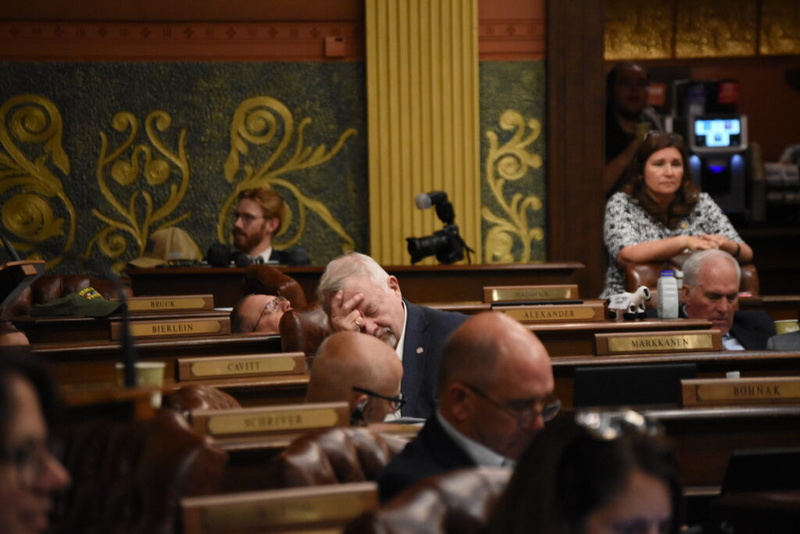
Republican legislators spend the early hours of Friday morning on the House floor for votes on the fiscal year 2027 budget. July 3, 2026. | Photo by Katherine Dailey/Michigan Advance.
It took nearly 24 hours, an all-night legislative session and a deluge of stalled policy bills that did not move for most of the year to compel Michigan lawmakers early Friday morning to finally pass a roughly $85 billion budget funding state government and education in the upcoming 2026-27 fiscal year.
But there were still areas of the budget where funding totals remained uncertain by not accounting for potential federal funding that the Legislature would be authorized to spend if and when it is received. That would make the budget appear smaller on paper, although the Legislature did not drastically reduce spending or increase it from the current fiscal year’s spending.
In the coming fiscal year, the state plans to spend $63 billion for state agencies with $12.6 billion coming from the general fund. Statewide K-12 and higher education will be funded at $22.9 billion for K-12 and higher education, with $20.6 billion coming from the state’s school aid fund and another $1.18 billion coming from the general fund.
In all, the state plans to spend $13.8 billion from the general fund across both budgets.
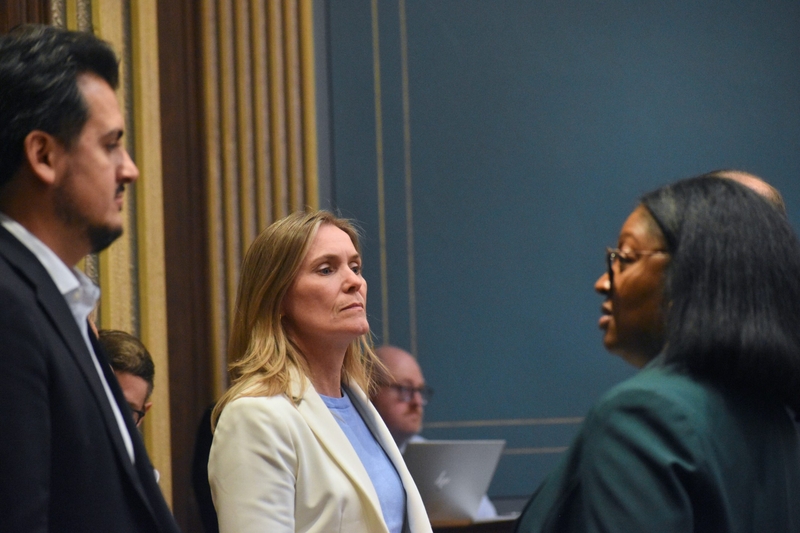
Lawmakers missed their July 1 deadline to have the budget passed, but they worked through Thursday night into Friday morning to pass a budget that funds statewide needs. They also accomplished it well before the constitutional deadline of Oct. 1, the beginning of the next fiscal year, avoiding the chaos that wracked state government last year and led to a short government shutdown.
The budget includes some cuts and what appropriators called efficiencies to address the fact that Michigan has a $1 billion revenue shortfall. That said, the budget includes zero new taxes as proposed by Gov. Gretchen Whitmer in her initial recommendations issued earlier this year.
Both of the respective leaders of the Democratic-led Senate and the Republican-controlled House, as well as their respective appropriations chairs, called that a win in the face of hard choices of what to keep and what to reduce along the way.
House Speaker Matt Hall (R-Richland Township) said months ago that he planned to use dollars actually spent by departments on specific programs to determine needed appropriations, as opposed to the amounts that had been designated in the past.
Just before midnight on Friday, Hall told reporters that he had used that strategy with great success.
“I think what the Democrats realized is I was right,” he said. “If we go to real dollars spent, we can cut $3 billion of waste, fraud, and abuse in this budget just by going to the real dollars spent, and we did that.”
That includes, he said, cutting another 250 so-called “ghost jobs” — government employment positions that were unfilled — as well as what the speaker has consistently alleged is fraud in public assistance programs.
Despite his claim of success, the Legislature still blew its deadline again, a trend that has become more of the norm over the past several years.
As for why the deadline was missed, Hall said, “Democrats have a really hard time cutting.”
Education budget to see a decrease but with more per-pupil funding
The education budget decreased by more than $1 billion from the current fiscal year. Even so, per-pupil funding will increase by $250 to $10,300, a smaller increase than last year’s $442 boost.
K-12 schools received $19.8 billion in total funding.
One main change in the funding formula is the use of weighted funding for at-risk students, which includes students who are English language learners or are economically disadvantaged. In the past, that funding was allocated in a fixed amount across a number of line items in the budget.
This year, $1.4 billion is transferred to the weighted funding formula, where at-risk and English language learning pupils are given higher funding weights, as are students in rural and isolated school districts.
The weighting, said state Sen. Darrin Camilleri (D-Trenton), who chairs the Senate Appropriations Subcommittee on K-12 Education, indicates that at-risk kids deserve 47% more than just the foundation allowance. This budget does not fully reach that 47% funding, he said, but moves towards it.
“This year in this budget we did a massive increase of 20% every year,” Camilleri said. “Going forward, we are saying a base minimum of two times the foundation allowance. So, if the foundation allowance increases 3%, at-risk funding must increase 6%. Now it can go higher than that, depending on the resources and the decisions based on the budget.”
That weighted funding system is now codified, put in place by Senate Bill 903, which was passed on Friday as well.
Camilleri called the weighted funding formula for at-risk students “a massive investment in our kids who need it the most.”
The final version of the school aid bill passed the House by a wide margin of 99-8 around 6:20 a.m. Friday. The eight votes against came from a bipartisan group of legislators — Republicans Steve Carra, Jim DeSana, Joseph Fox, Jamie Greene and Jennifer Wortz, as well as Democrats Veronica Paiz, Dylan Wegela and Regina Weiss.
Senators voted on the education funding bill at 8:30 a.m. on Friday 25-11, with Republican Sens. Thomas Albert of Lowell, Kevin Daley of Lum, Roger Hauck of Mount Pleasant, Michele Hoitenga of Manton, Jonathan Lindsey of Coldwater, Ruth Johnson of Groveland Township, Aric Nesbitt of Porter Township, Jim Runestad of White Lake, Lana Theis of Brighton and Roger Victory of Georgetown Township voting no.
Camilleri emphasized that the new formula is a step towards improving education outcomes in Michigan — an issue that has become a key priority on both sides of the aisle, though they have not always agreed on how specifically to resolve those issues.
“We’re not going to fix everything in one budget, but what we did tonight sets us on a course to be like Mississippi and Massachusetts, who started their transformations of their education system with a weighted funding formula, and so this is a massive bipartisan win for all of us to make sure that we are meeting the needs of all of our kids.”
Camilleri, as well as Rep. Nancy DeBoer (R-Holland), also emphasized the inclusion of $75 million for literacy training for educators.
“With Michigan ranking 44th of student achievement, simpler days of youth earning As and Bs has become the pathway of struggle,” said House Appropriations Chair Ann Bollin (R-Brighton Township). “This is not acceptable. Our kids deserve better, and Michigan needs a reset if we want to give our kids a chance. This budget is a reset.”
Community colleges were appropriated $496.6 million, with every community college besides Alpena seeing an increase in funding. All of those funds come from the school aid fund.
The higher education budget is $2.6 billion dollars — more of which comes from the school aid fund than the general fund, a diversion from prior budgets. Every college and university received a small increase in funding — despite threats early in the budget process from House Republicans to slash budgets for the University of Michigan and Michigan State University by over half.
State departmental funding reduced, but with a balancing of key services
The Senate voted on the general funding bill at 8:15 a.m. Friday. It passed the chamber 27-9, with Albert, Daley, Hauck, Hoitenga, Lindsey, McBroom, Nesbitt, Runestad and Theis voting no.
The House passed the bill just before 9 a.m. Friday. It passed the chamber 99-7, with Republican members Carra, DeSana, Fox, Greene and Hoadley, as well as Democrats Wegela and Weiss voting no.
Among the larger department-focused budget items, the state plans to spend $40.5 billion, using $7.3 billion from the general fund, on the Department of Health and Human Services. No other state department’s funding comes close to that, with the second highest funded department being the Department of Transportation, which will receive $8.4 billion in the coming fiscal year.
State Sen. Sarah Anthony (D-Lansing), chair of the Senate Appropriations Committee, said the budget was big but it was one that was “full of compromises.”
“It’s a truly bipartisan budget. It’s one that obviously we built with the House and administration, but this was a very challenging budget negotiation,” Anthony said. “Mainly because of the $1 billion deficit that we had to address, but being able to do so without reducing any benefits for folks who are receiving Medicaid or food assistance is probably the proudest thing that I am that comes out of this process.”
A lot of the reductions were made to address the shortfalls in the budget, Anthony said, but that enabled the Legislature to ensure that Medicaid beneficiaries didn’t face any interruptions.
There were no new taxes or increased fees to inflate the budget, either, considering the $1 billion shortfall; nor did lawmakers need to dip into the state’s rainy day fund to make up the loss.
Anthony said that was something that “we’re really proud of, being able to do a mix of creative accounting, making sure that we were trimming any type of fat that we needed to.”
“At the end of the day, we found enough efficiencies and reductions throughout multiple departments, so that folks are still able to have healthcare and food in the state. … We try to prioritize programs that lower costs for individuals. Investing $30 million into childcare is something that I’m particularly excited about. The fact that we are continuing our $50 million housing investment to keep housing more affordable for folks in the state of Michigan. Those are big programmatic investments.”
Anthony added that the Legislature was also able to invest in water affordability programs and permanent supportive housing.
“These are things that often don’t get a lot of big headlines, but it means a lot to people who are struggling right now, I think,” she said.
That doesn’t mean there weren’t some areas where Anthony would have liked to see funded to a greater degree.
“I have been looking around the state at all the needs, and they’re very great. We could afford more money into healthcare, more money into housing,” she said. “We’re also seeing a rise in gun violence. We were able to invest more resources into community violence intervention funding, but even in the last few days here in Lansing, a 15-year-old child was shot in a park and unfortunately lost their life. So, the more we can do on gun violence prevention and safety measures, I think we can always do more.”
To Hall’s assertion that the budget was smaller than last year, Anthony was asked if the trickier math in the budget related to the federal funding was an effort to make the budget less than what it really was.
Anthony, speaking of Hall but not mentioning him by name, said: “I think there’s one person in this building who likes to demonstrate that the budget is smaller.”
“We were not focused on a talking point,” Anthony said. “We were focused on making sure that people had the resources they needed in the budget.”
Lansing, MI