Mayes calls Trump lawsuit against in-state tuition for immigrant students ‘baseless’
Aug 27, 2026 | 3:41 pm ET
Description
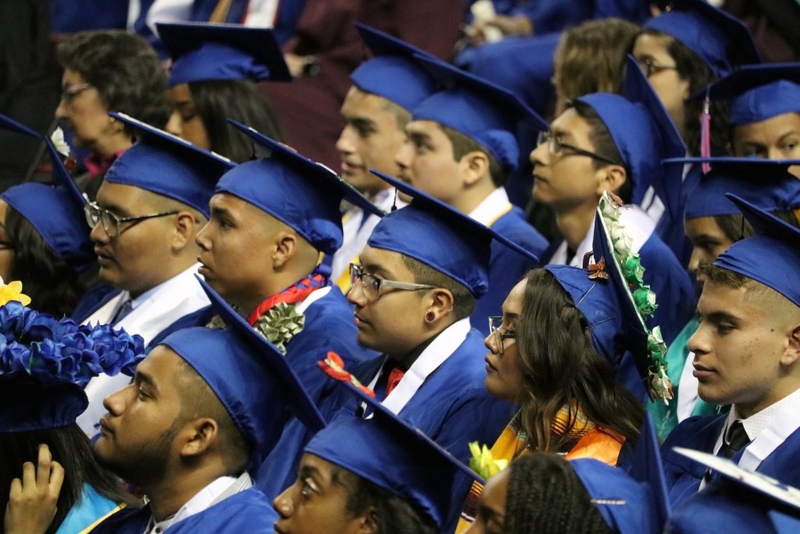
In Arizona, about 2,000 students without immigration status graduate from high school every year, according to the Migration Policy Institute. Pictured are graduates from North High School in Phoenix during a commencement ceremony on May 22, 2019. (Photo by Laura Gómez/Arizona Mirror )
Arizona voters in 2022 approved Proposition 308, which reversed a law voters had enshrined 16 years earlier that explicitly forbade non-citizens from receiving state subsidized help, including financial aid or in-state tuition rates.
The new law allows any student, regardless of their immigration status, to qualify for in-state tuition rates at any of the state’s community colleges or three public universities as long as they obtained a high school diploma or GED and attended a high school in Arizona for at least two years. Previously, undocumented students were forced to pay nearly double what their classmates did.
Unlike laws that make it easier for undocumented students to earn a degree in other states, Arizona’s law doesn’t hinge on residency requirements, which the U.S. Department of Justice has used to challenge such laws. That’s because federal law specifically bars states from granting undocumented people postsecondary benefits based on their length of residency. But DOJ attorney Garrett Greene argued that Arizona’s law uses high school attendance as a stand-in for residency.
“A student’s high school attendance for two or more years within the State is a near-perfect proxy for residence given that to enroll a child in a public school in Arizona, given that to enroll a child in a public school in Arizona, the school district ‘shall require and maintain verifiable documentation of residency in this state for pupils who enroll in the school district or charter school,’ ” Greene wrote in the lawsuit against Arizona.
Arizona Attorney General Kris Mayes foresaw a potential challenge against Prop. 308 and argued in a 2025 legal opinion that it complies with federal law, chiefly because its requirements turn on educational attainment and not length of time in the state.
The state law’s broad language, the Democrat wrote, covers different kinds of students, including some who may have graduated from an Arizona school and moved out of state, with the intention of returning to attend college in Arizona, and others who grew up traveling back and forth between an Arizona school and tribal land, which spans multiple states.
“Residence is not what triggers eligibility under (Prop. 308),” Mayes wrote. “Although many people who meet the eligibility requirements will also be residents, not all will be. And whether someone is or is not a resident is simply not relevant to the eligibility inquiry under (Prop. 308).”
In an emailed statement, Richie Taylor, a spokesman for Mayes’ office, reiterated that Prop. 308 doesn’t turn on residency and said that the DOJ’s lawsuit is baseless.
“Proposition 308, as written and approved by Arizona voters, doesn’t condition eligibility on residence, which is what the government alleges,” Taylor said. “It conditions eligibility on whether a student attended and graduated from an Arizona high school (or homeschool equivalent). That’s the standard the voters wrote into law — tied to where a student attended school and where they graduated, not their residency.”
Supporters of Prop. 308 lambasted the lawsuit as poorly thought out and discriminatory. Tyler Montague, who headed the Yes on 308 campaign in 2022, said the law was intentionally crafted to comply with federal requirements and noted that it doesn’t give undocumented students any special concessions.
“It’s not tied to DACA, it’s not a special treatment for undocumented people,” he said. “It simply does not exclude undocumented people.”
Montague, a lifelong Republican, said that while he agrees that the country’s immigration policy needs work and violent criminals should be removed, undocumented people who are pursuing a degree, often called Dreamers, are not who should be targeted by the federal government.
“Our Dreamers that are trying to go to college represent a big opportunity for our economy and our country and they’re not one of the problems of immigration,” he said. “To take action against them is just spiteful, it’s based in nationalist sentiment, it’s ugly we should fight it.”
And, Montague added, Arizona voters chose to change state law to remove barriers for undocumented students. The DOJ’s lawsuit is a “tone-deaf” bid to undermine that choice, he said.
“Arizona voters support dreamers who are trying to go to college to make a better life for themselves,” Montague said.
Reyna Montoya, the CEO and founder of Aliento Arizona, which advocates for the educational opportunities for immigrant youth and was one of the main forces behind Prop. 308, said she’s confident that the lawsuit will be defeated.
“The DOJ is trying to do everything they can to stop Dreamers from attending college,” she said, in a written statement. “The Arizona in-state tuition law that is voter protected is in alignment with state and federal law and I have no doubt that the DOJ will lose this battle in the courts.”
Phoenix, AZ