Maryland Republicans file lawsuit challenging redistricting ballot question
Aug 07, 2026 | 10:02 am ET
Description
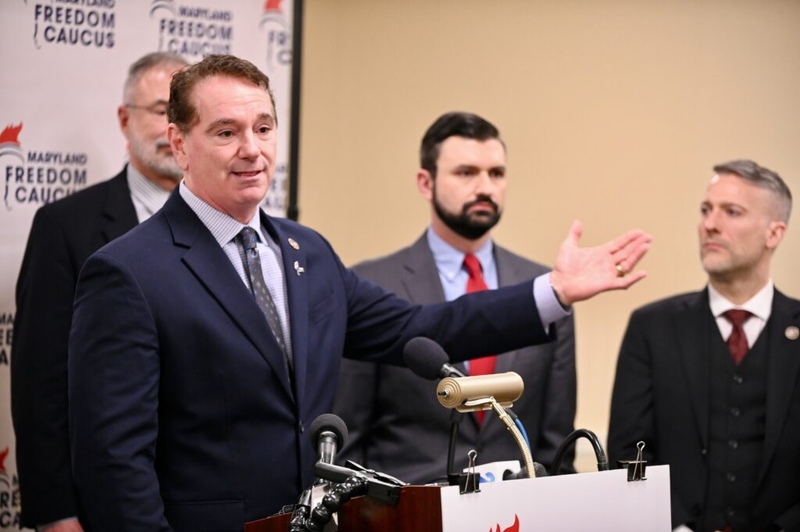
All seven members of the Maryland Freedom Caucus signed onto a lawsuit challenging Maryland's redistricting ballot question, including chair Del. Matt Morgan (R-St. Mary's), shown here at a February event with U.S. Rep. Andy Harris (R-1st) behind him. (Photo by Bryan P. Sears/Maryland Matters)
Republicans in the Maryland General Assembly filed their promised lawsuit late Thursday against Democrats’ ballot question on congressional redistricting.
The late-night filing came just a few days after lawmakers finished a special legislative session to pass the ballot question, a constitutional amendment that, if approved by voters in November, could pave the way for Democrats to draw a map that eliminates Maryland’s last remaining Republican seat in Congress, held by Rep. Andy Harris (R-1st), chairman of the U.S. House Freedom Caucus.
The suit was filed in Anne Arundel County Circuit Court by all seven members of the conservative Maryland Freedom Caucus, the Senate minority leader and minority whip, and the president of the conservative advocacy group, the Oversight Project.
“Annapolis Democrats spent taxpayer dollars on a special session for one reason: To rewrite the Maryland Constitution and eliminate the last remaining Republican congressional seat,” Del. Matt Morgan (R-St. Mary’s), chair of the Maryland Freedom Caucus, said in a Thursday news release announcing the suit. “Like a banana republic, they suspended the rules, ignored statutory deadlines, and treated the Constitution as an obstacle to be removed.”
The suit argues that Maryland Democrats missed a July deadline for getting the question on the November ballot, and that the ballot question does not contain plain language, another violation of state law. In addition to the Maryland State Board of Elections, it names Gov. Wes Moore, Attorney General Anthony Brown, State Elections Administrator Jared DeMarinis and Secretary of State Susan Lee as defendants.
“They hurt due process. They hurt peoples’ rights to weigh in on this,” Morgan said Friday morning. “They blatantly missed the dates, and then they tried to cover it up with some legal language.”
Maryland Republicans predict legal challenge to constitutional amendment on redistricting
The bill passed earlier this week contains language stating that the question should be presented to state voters in November “notwithstanding any other provision of law.” Morgan said that the plaintiffs believe this provision is legally problematic.
“It’s circumventing election law,” Morgan said.
Throughout this week’s two-day special session, Democratic leaders expressed confidence that they are on firm legal footing.
“So we’ve been working very closely with not just members of the General Assembly, not just with the Attorney General’s office, but also constitutional experts — both Maryland and federal constitutional experts — because we wanted to make sure that we didn’t just get this done, but that we got this done right,” said Maryland Gov. Wes Moore (D) in a news conference Wednesday.
In a way, history was repeating itself. In 2021, Del. Kathy Szeliga (R-Baltimore County) joined a number of other plaintiffs in a lawsuit challenging Democrats’ congressional map at the time, drawn in the wake of the 2020 Census.
The plaintiffs ultimately prevailed. Judge Lynne Battaglia, then a senior judge in the Anne Arundel County Circuit Court, overturned the map and forced lawmakers back to the drawing board. They ultimately drew a map that has given Democrats seven out of Maryland’s eight seats in Congress.
“Four years ago, I was the lead plaintiff when Judge Lynne Battaglia struck down the Democrats’ extreme partisan gerrymander. Today, the Maryland Freedom Caucus is once again leading the fight to stop them from changing the rules midstream,” Szeliga said in the caucus’ press release. “The process matters. We will not let them rewrite the Constitution on a rushed, defective timeline and without due process.”
Legal experts skeptical of suit
This time, Republicans are not challenging an actual map, but rather a ballot initiative.
Mark Graber, a constitutional law professor at the University of Maryland Francis King Carey School of Law, said prior to the lawsuit’s filing that challengers to the ballot question are unlikely to prevail.
Maryland’s requirements differ from those of Virginia, Graber said, where a court invalidated Virginia’s ballot question, ruling that leaders violated public notice rules before placing the amendment on the ballot. Maryland does not share those exact rules, and Maryland lawmakers appear to have followed the typical process for a constitutional amendment, Graber said.
Some lawyer may make some money, but that's going to be the only consequence of Republican efforts to overturn this in court.
“They’re required to have enough time so that people can become familiar with the amendment. But it’s now August. It’s three months. There is no way a court’s going to say three months is not enough time,” said Graber, who is a regents professor at the university, a designation for distinguished faculty.
“Some lawyer may make some money, but that’s going to be the only consequence of Republican efforts to overturn this in court,” Graber said.
Graber said he agrees with Republicans’ contention that, if the ballot question passes, citizens in Maryland would not be able to challenge the state’s congressional map on the grounds of partisan gerrymandering, though they could challenge the map on other grounds.
That’s because the U.S. Supreme Court ruled that partisan gerrymandering is constitutional. As a result, challenging the map on those grounds in any federal court would be futile, Graber said. Also under the new ballot measure, rules from Maryland’s Constitution requiring compact and contiguous districts would not apply to congressional districts — only to General Assembly districts.
Those rules require that districts “shall consist of adjoining territory, be compact in form, and of substantially equal population,” and that “due regard shall be given to natural boundaries and the boundaries of political subdivisions.”
“You can lose in state court, or you can lose in federal court. Which has the better restaurants outside?” Graber joked.
Joseph Dietrich, an assistant professor of political science at Towson University, said he wouldn’t be surprised to see Republican opponents challenge the redistricting effort at multiple stages. They could also challenge the outcome of the ballot question, for instance, in addition to challenging any map Democrats might later produce.
“They’re going to drop as many land mines in front of this as they possibly can before the inevitable redistricting that will occur sometime next year,” Dietrich said.
Dietrich said he believes that Democrats will ultimately draw new maps, likely during the 2027 session, no matter what happens to the balance of Congress in November. Democrats have sacrificed political capital with moderates and Republicans in Maryland to move forward with the special session, he said.
“They’re spending an awful lot of resources here, and I can’t imagine that they wouldn’t use the tool that comes from spending those resources,” Dietrich said.
But even if they do draw a map, Dietrich said he isn’t sure that Harris would lose in a district that sweeps from the Eastern Shore to bluer Annapolis and surrounding suburbs.
“He’s very, very popular on the Eastern Shore, and so I’m not entirely certain that this gerrymander is going to do anything,” Dietrich said.
— Maryland Matters reporter Bryan P. Sears contributed to this report.
Annapolis, MD