Louisiana lawmakers continue to boost prison spending while leaving teacher pay cut in place
May 21, 2026 | 12:58 pm ET
Description
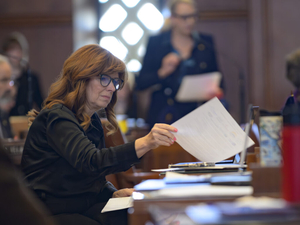
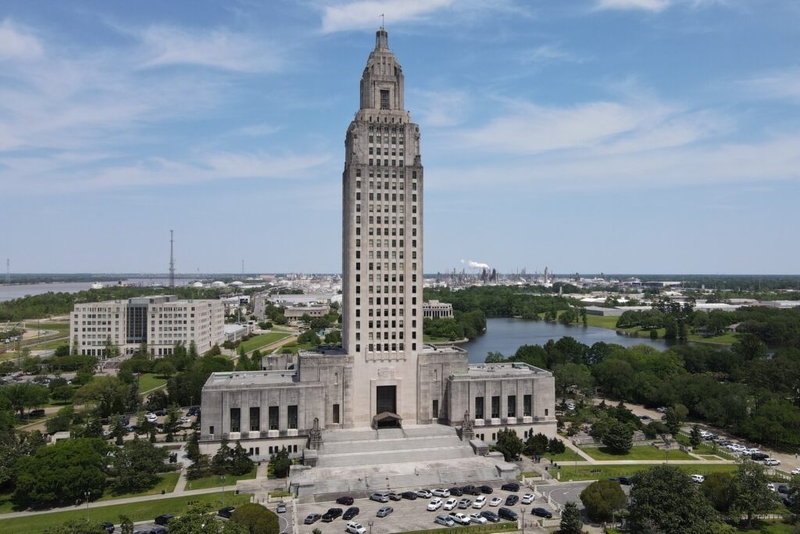
The latest version of the Louisiana budget moved Thursday, May 21, 2026, includes a teacher pay cut but a raise for prison guards. (Wesley Muller/Louisiana Illuminator)
Louisiana lawmakers continue to add more money for prisons, law enforcement and other public safety agencies into the state budget plan, while also saying they can’t afford to avoid a teacher pay cut next school year.
The Senate Finance Committee unveiled Thursday the latest version of a state spending package that legislative leaders have worked on in earnest over the past week. The annual spending plan must be finalized by the time the lawmakers adjourn their annual session June 1 for it to kick in during the fiscal year that begins July 1.
The revised budget plan builds on a previous proposal Gov. Jeff Landry backed and the Louisiana House approved that already increased spending on criminal justice programs more than $100 million.
The Senate committee added $18.6 million Thursday for prison guard pay raises and $8 million to cover prisoner medical expenses. They also included $10.1 million for sheriffs, $7.7 million for local police departments, $1.9 million for 10 new State Police troopers and $2.3 million for more security staff and police equipment at the State Capitol complex.
Senate President Cameron Henry, R-Metairie, said extra funding for prison guard pay was a priority because the jobs are hard to fill at the current pay scale, and the state corrections department needs to attract more workers.
“It’s very difficult for people to be hired,” Henry said.
This new allocation comes on top of Landry’s initial budget proposal that already had an $82 million year-over-year increase in prison spending, including $17.5 million more for Louisiana State Penitentiary at Angola. Even before the prison guard pay bump was included Thursday, the prison system budget was supposed to go up 11% next fiscal year.
Landry and legislators have proposed more funding for Angola, in particular, to cover an additional 688 prisoners at the prison, which will require 150 more staff members. The governor’s original budget proposal also included $27 million to pay for general prison system cost overruns in the current fiscal year, such as overtime pay for guards.
Next fiscal year’s budget proposal also prioritizes youth prison growth. Landry and lawmakers have agreed to spend $15.2 million for a new 56-bed youth criminal justice facility in Vernon Parish that will need 122 new staff members. There is also $1.9 million for 36 more beds and 31 new staff at the old Jetson Center for Youth in Baker.
State Police was also expected to get $22.1 million more in funding, including $9.6 million to open a new crime lab, even before the Senate committee added the extra money to hire more troopers.
The proposed surge in prison spending comes two years after Landry and lawmakers overhauled criminal justice sentences to keep people convicted of crimes in prison longer.
The state’s prison population has also grown by approximately 2,000 people since Landry took office at the beginning of 2024, according to statistics on the Department of Public Safety and Corrections website.
Teachers, education programs lose out
Meanwhile, legislators continue to say there is no money available for another round of public school teacher and support worker stipends, which would cost almost $200 million next year.
Landry and lawmakers were counting on the passage of Constitutional Amendment 3 last week to cover a permanent pay raise to replace the stipends teachers and school staff have received the past three years. But the measure failed by a large margin, and legislators don’t have an alternative plan to replace that money.
The consequences are that teachers and support workers will likely see their pay cut by $2,000 and $1,000, respectively, in the 2026-27 academic year.
“Educators will not be happy,” D’Shay Oaks, president of the Louisiana Association of Educators, said in an interview Thursday. “They will have problems supporting their families, and they may have to take on another job.”
Lawmakers also pulled back funding for other education programs to deal with a state revenue shortfall of $103 million in the next fiscal year.
For the second year in a row, they nixed a $44 million expansion of the governor’s signature school voucher program, LA GATOR, which allows public money to be used for private education. They also rejected a plan to give K-12 school districts an extra $29 million to help cover rising operating costs such as insurance and fuel.
The cut in teacher pay and loss of extra money for school operations will hit traditional and charter schools hard, said Caroline Roemer, executive director of the Louisiana Association of Public Charter Schools.
“The more we invest on the front end in people, then maybe we won’t need as much on the back end” for the prison system, she said in an interview Thursday.
Larry Carter, with the Louisiana Federation of Teachers, said he will continue to advocate for lawmakers to tap into a $2.4 billion state savings account, the Revenue Stabilization Trust Fund, to extend the temporary stipend for another year.
“We are going to try to push to use the reserve funds,” he said Thursday.
But Henry and House Appropriations Committee Chairman Jack McFarland, R-Jonesboro, have been adamant that using savings for a teacher stipend is harder than teacher advocates realize.
The temporary pay stipend has been given out for three years in a row, which would make it a “recurring” expense for state budgeting purposes in the next fiscal year. The legislature has rules that make it harder to use reserves for a recurring expense, the Senate president said.
The lawmakers plan to look next year at the state’s school funding formula to find a way to increase teacher pay with the general K-12 school money already available, Henry added.
Withdrawing $800 million in savings
While they aren’t using it for teacher stipends, legislators have agreed to withdraw $800 million from the $2.4 billion savings account for other projects.
Nearly $400 million will go to one-time road, bridge and other infrastructure projects.
Legislators have also allocated $50 million to attract business investment to specific economic development sites around the state and $5 million for workforce development. Another $5 million will be spent on economic development initiatives for the wood pellet industry.
A health care industry investment adjacent to the LSU Health Sciences Center in Shreveport will get $25 million of the savings withdrawal, and $10 million will go to the redevelopment of the shuttered Charity Hospital site in New Orleans.
But tens of millions of these dollars from the savings accounts will also go toward legislators’ pet projects. These small amounts, often under $1 million, are given out to parish governments, sheriffs, local police and nonprofit entities that wouldn’t normally receive state financial support.
Henry said the pet projects are among members’ priorities.
“Whether it’s infrastructure back home, police equipment back home … they are trying to bring some money back home to help their district out,” the Senate president said.
Baton Rouge, LA