Louisiana GOP lawmakers thwart proposal for 42% Black congressional district
Feb 15, 2022 | 7:56 am ET
Description
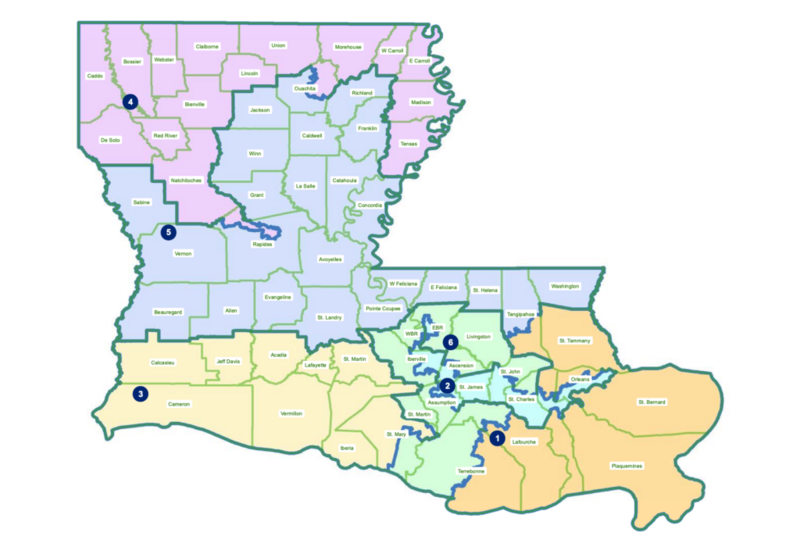
Louisiana House Bill 12 proposed a redistricting map with a 42% Black and 53% white population in the 4th Congressional District but it was narrowly defeated in committee on Monday, Feb. 14, 2022. (Image via La. Legislature HB-12)
With Republican lawmakers blocking every attempt to add a second majority-minority Louisiana congressional district, a Democrat offered a compromise Monday. Rep. Marcus Bryant, D-New Iberia, wanted to add more Black residents while maintaining a white majority in one of the state’s five GOP-dominated districts, but his bill was narrowly defeated in committee.
In a 7-8 vote, House Bill 12 failed to advance from the House redistricting committee. Bryant’s map redrew the 4th and 5th districts, increasing the 4th District’s Black registered voter share from 33.6% to 42.5%. The White population would have dropped from 61.9% to 53.5%. U.S. Rep. Mike Johnson, a Republican from Shreveport, currently represents the 4th District.
Bryant, a member of the Legislative Black Caucus, said those percentages are not enough to give 4th District minority voters a chance to elect their preferred candidate, but they might give them more of a voice with their representative.
“Their congressman at least has to answer their calls and give them some kind of opportunity to make changes to projects in their area,” Bryant said.
Except for the 4th and 5th districts, Bryant’s map matches the House Bill 1 from House Speaker Clay Schexnayder, R-Gonzales, that the House approved last week.
Bryant said his map would still ensure the incumbent’s re-election while also creating more incentive for him to seek support from the Black community.
“Mike Johnson should be able to still win in that district and just kind of hear the voice of the other party,” Bryant said.
Rep. Barry Ivey of Central was the only Republican to cross party lines in support of the bill. He later proposed a map to redraw boundaries for the seven-district Louisiana Supreme Court to create a second majority-Black seat. The committee approved Ivey’s bill, 10-7, advancing it to the House floor for consideration later this week.
Census figures show Black residents comprise one-third of Louisiana’s population, yet only one of the state’s congressional districts has a Black majority. Aside from Ivey’s Supreme Court proposal, Republicans have so far had no appetite for any maps that increase minority representation. Every such proposal has failed or been deferred in committee.
Gov. John Bel Edwards, a Democrat, can veto any map the Legislature approves. He called the GOP-supported proposals without additional Black-majority districts “very problematic” with regards to federal voting rights laws, but he said he had not made any decisions on vetoes because no final versions of bills had advanced to his desk yet.
Louisiana Senate, House approve initial version of their own political maps
Black Caucus Chairman Rep. Vincent Pierre, D-Lafayette, said he expects Edwards to veto maps that maintain the status quo, which exists in every government body undergoing redistricting: Congress, the Legislature, Public Service Commission, Louisiana Supreme Court and the state school board.
“The governor has expressed support for a second majority-minority congressional district, and the Black Caucus has the expectation that that support hasn’t changed,” Pierre said. “We’ve seen through exhaustive dialogue and committee hearings that maps with increased minority representation are not only necessitated by Census information we have received, but also by public input that has been loud and clear. We are sure the Governor has received that message as well and expect that he continues to stand in support.”
Jan Moller, executive director of the Louisiana Budget Project, said Edwards has several political tools at his disposal to fend off a veto override, including line-item veto authority over the state budget. He can use this discretion to encourage individual legislators to vote his way, Moller said.
Louisiana will receive an additional $3 billion in one-time revenue for this upcoming budget, thanks in large part to the passage of the federal infrastructure bill, Moller said.
“So there’s an enormous amount of one-time revenue at the Legislature’s disposal,” Moller said. “If he did veto a map, then there would be a close override vote, and you would assume the governor would use any persuasive tools at his disposal. Redistricting is inherently political, so it wouldn’t surprise me if this plays out in a political fashion.”
Baton Rouge, LA