Louisiana could put removed Confederate monuments on display at state parks
May 11, 2026 | 2:50 pm ET
Description
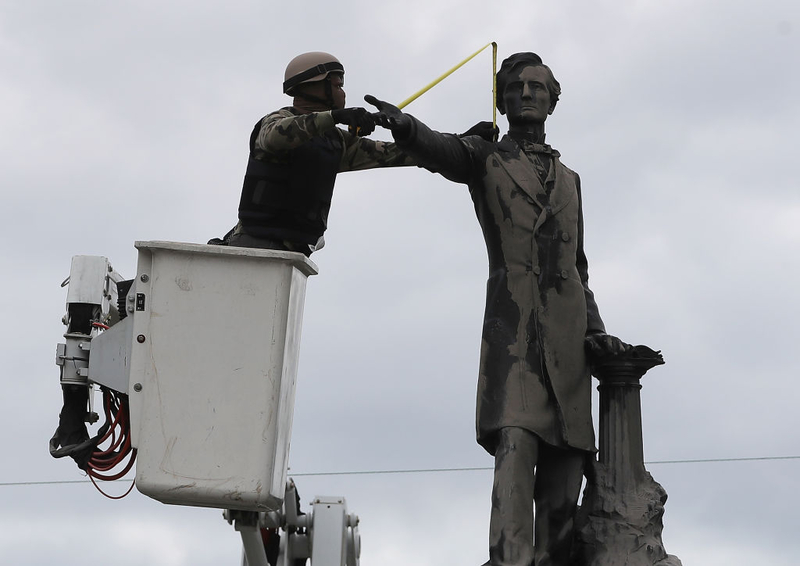
Louisiana lawmakers may pass a new law that would transfer Confederate monuments taken down in New Orleans in 2017 from a city storage unit to state parks for public display. In the picture above, a New Orleans city worker wears body armor and a face covering as he measures the Jefferson Davis monument on May 4, 2017, a week before it would be removed.(Photo by Justin Sullivan/Getty Images)
Louisiana might move Confederate monuments that have been taken down by local governments to state parks.
State lawmakers are considering a proposed law that would transfer any “historical statue or monument” owned by a government and removed from a public display on or after Aug. 1, 2006, to the Office of State Parks.
The Office of State Parks, run by the lieutenant governor, would be required to relocate the monument to a place that could be accessed by the public, according to House BIll 1215. Its new location could not be in the same parish where the monument originally stood.
Under the bill, the state park system would also be required to provide signs for each monument at its new location that present “accurate historical context.” This would include the circumstances under which the monument was both erected and removed.
The legislation, sponsored by state Rep. Mike Bayham, R-Chalmette, passed the Louisiana House of Representatives on a 78-14 vote last week. The Louisiana Senate must also approve the proposal for it to become law.
The bill addresses monuments and statue removal more generally and doesn’t reference Confederate monuments in particular. But Lt. Gov. Billy Nungesser, a Republican, said in an interview it was designed to deal with Confederate monuments taken down in New Orleans in 2017.
Three of the four Confederate monuments New Orleans removed that year still sit in city-owned storage, said Nungesser, who worked with Bayham on the bill.
The fourth, a 19th century obelisk honoring a white supremacist revolt called the Battle of Liberty Place, was supposed to be on display at the Museum of Contemporary Art in Los Angeles as part of a wider exhibit on removed Confederate monuments earlier this year, according to The New Orleans Times-Picayune.
New Orleans Mayor Helena Moreno is opposed to Bayham’s legislation and said she had not been consulted about the bill ahead of time.
“The statues are the property of the City of New Orleans, and under the Louisiana Constitution, decisions regarding the disposition of city property ultimately rest with the City,” Moreno said in a written statement released Monday night. “This bill cannot change that. It is neither reasonable nor lawful for the state to seize city property. The statues remain secured in storage and no longer in public spaces in New Orleans.”
Lafayette and Shreveport also took down statues of Confederate figures from public property in 2021 and 2022. But they have been relocated to a Confederate cemetery in Kentwood and a battlefield in DeSoto Parish, respectively, according to news reports.
Bayham and Nungesser, who are white, said the intent of the proposed law is to preserve monuments in a thoughtful way.
Nungesser said he has consulted with a group of Black pastors about the signs and descriptions that would be put up to explain the monuments. The language would be truthful, even if it reflects a painful history, he said.
“I’m hoping this is something that can bring people together and is not a divide,” Nungesser said. “It’s history. Telling the story, both good and bad, is not a bad thing.”
Bayham said lawmakers in other states have introduced legislation that would restore or replace Confederate monuments that had been taken down. He wanted to craft a more sensitive solution for Louisiana.
“I think this is the way for us to handle this in a much more respectful manner,” Bayham said.
Dozens of Confederate monuments were put up across Southern states, including in Louisiana, decades after the end of the Civil War. Their erection coincided with a rise in Jim Crow laws, which mandated segregation by race, and an increase in violence against Black people.
Where the monuments would go and who would pay for their transfer under the legislation is not clear.
In 2018, Nungesser backed a plan to move them to Houma House plantation in Ascension Parish, a private estate New Orleans businessman Kevin Kelly owns. But Nungesser said the monuments would now likely go to one of Louisiana’s 16 historical sites located in state parks outside New Orleans.
“It would probably be at a park that is relevant to that particular monument,” Bayham said last month during a legislative committee hearing on his legislation.
The bill is structured to deflect any cost for the transfer of the monuments from local governments. Bayham and Nungesser said they expect private funding will be put up to cover the relocation expenses.
“We are not going to use state dollars to move the statues,” Nungesser said in an interview.
The legislation comes at a particularly fraught time for Black and white elected officials in Louisiana.
Gov. Jeff Landry suspended U.S. House races scheduled to take place at the end of the week, giving the legislature’s Republican majority time to enact a new congressional map that will likely remove one or both of Louisiana’s Black congressmen.
The legislature has also passed a new law to eliminate the elected position of Orleans Parish clerk of criminal court, a seat held by Black officials for decades. The new measure blocked a Black man, Calvin Duncan, from assuming the office despite being resoundingly elected in November.
Bills to eliminate New Orleans judgeships, some of which are filled by elected Black people, have also advanced this session.
Still, Black and white lawmakers have avoided the mention of New Orleans or Confederate monuments during public discussions of Bayham’s bill. When it came up for a vote Thursday in the Louisiana House, no representatives spoke out against the proposal.
The closest lawmakers have come to acknowledging the bill was meant to address Confederate monuments was a question from state Rep. Beth Anne Billings, R-Destrehan, during the bill’s initial committee hearing last month.
“So they will be spread out? There’s not going to be a risk of overcrowding where there is this monument park and it doesn’t have any context?” Billings asked Bayham.
Bayham responded that the intention of the legislation was not to create one large monument park, but neither representative acknowledged the concern would presumably be about a Confederate-specific monument park.
On the House floor, the New Orleans delegation split their votes on the legislation.
Reps. Delisha Boyd, Dana Henry, Stephanie Hilferty, Alonzo Knox and Shaun Mena voted for the bill. Reps. Aimee Freeman, Mandie Landry, Ed Murray and Candace Newell voted against the proposal. Rep. Jacob Braud, whose district is mostly in Plaquemines Parish, was absent for the vote.
State Rep. Edmond Jordan, D-West Baton Rouge, declined to comment on Bayham’s legislation as the head of the Louisiana Legislative Black Caucus. Jordan was also absent for the vote on Bayham’s bill and said he wanted to study it further before making a statement.
Baton Rouge, LA