Legislature poised to vote on massive bills to offset federal cuts to SNAP, health care
Mar 13, 2026 | 11:53 am ET
Description
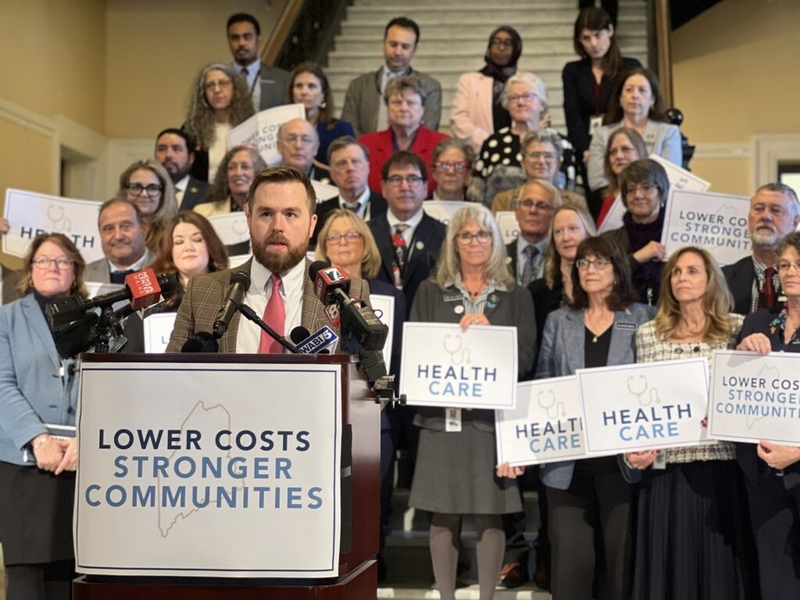
Maine House of Representatives Speaker Ryan Fecteau, flanked by legislative Democrats, called for a state investment of $250 million to offset federal health care cuts. (Photo by Eesha Pendharkar/ Maine Morning Star)
Maine lawmakers on Thursday advanced two bills that would allocate hundreds of millions in state funding for health care and food assistance to offset cuts made by the Republican-led Congress and President Donald Trump’s administration.
A health care funding bill proposes more than $250 million to support rural hospitals, lower health insurance costs and create a fund to respond to federal Medicaid cuts. At the same time, legislation to bolster state support for food assistance would establish an $87 million contingency fund to ensure that people continue receiving Supplemental Nutrition Assistance Program benefits in the event of future federal shutdowns or disruptions.
The proposals both won majority support from their respective committees Thursday and now advance to the full Legislature for votes.
Together, the proposals would ensure Mainers facing cuts to SNAP, Medicaid or spiking health care premiums due to changes in federal policies would be shielded from much of the impact. However, House of Representatives Speaker Ryan Fecteau, who sponsored both bills, previously told Maine Morning Star that these proposals still won’t be enough to make up for the full impact of the federal changes.
“It is simply impossible for us to be responsive to every single bad thing that this administration is doing to hurt working class, low-income families in our communities,” the Biddeford Democrat said.
Both bills don’t address changing eligibility requirements for MaineCare or SNAP, neither do they add enough money to shield Mainers from these impacts long term.
Health care bill
LD 2208 would establish three different funds to offset the impacts of federal health cuts: $50 million for a rural hospital stabilization program, helping defray operating costs for rural facilities; $17 million for a health care premium stabilization fund to help Mainers who get their insurance through the marketplace maintain coverage; and the MaineCare federal response fund, allocating $105 million to the Maine Department of Health and Human Services to make up for federal reductions to the state’s Medicaid program.
To lower 2027 health insurance premiums, the bill also includes $80 million in one-time funding to the Maine Guaranteed Access Reinsurance Association Program, which spreads out the cost of expensive medical claims so that individual health insurance premiums stay more affordable.
Democratic Rep. Kristi Mathieson of Kittery, who co-chairs the Health Coverage, Insurance and Financial Services Committee — which voted 6-5 to advance the bill — said LD 2208 directly addresses soaring premiums and bolsters rural health systems, which are critical to ensure Maine people can actually afford and access the care they deserve.
“With costs climbing and health care growing harder to find in rural communities, the Speaker’s proposal lands at exactly the right moment,” Mathieson said. “I’m thrilled a majority of the committee voted to push this measure forward.”
SNAP bill
LD 2122, was described by Anna Korsen, deputy director of the nonprofit organization Full Plates Full Potential, as “the bill that has the potential to have the most impact for SNAP in Maine.”
Members of the Health and Human Services Committee voted 7-5 along party lines to pass the bill, which proposes an $87 million contingency fund to cover three months worth of food assistance.
The proposal also seeks to help lower the amount the state is obligated to pay in cost-sharing by reducing the rate of over or under-payments made to SNAP recipients. These errors are often due to mistakes in reporting and eligibility so the legislation seeks to improve communication and technology within DHHS. Maine’s most recent error rate was 10.26%, which is lower than the national average but still leaves the state responsible for more than $50 million in administrative costs starting next year.
But even if the state can lower its error rate, Maine’s cost share would be about $35 million a year starting in 2027, Korsen told Maine Morning Star.
The legislation also seeks to make up for federal cuts in SNAP outreach, which ensures people know about program eligibility and enrollment. It would allocate $750,000 to support programs (previously paid by the federal government) who provide services that range from publishing informational materials in several languages to helping people fill out applications at food pantries. It would also create a new position to support organizations in that work.
Sandy Swett, executive director of the Harrison Food Bank, emphasized the importance of passing the bill in Maine, where 13.8% of adults and 20.6% of children are food insecure.
“SNAP funding is important for staple goods that are needed daily in these food insecure homes whereas food banks are only meant to provide supplemental food,” she said.
- March 16, 20265:44 pmCorrection: An earlier version of this story wrongly stated that SNAP legislation would allocate $750,000 million to support programs, not $750,000.
Augusta, ME