Black candidates make gains in Arkansas, but haven’t broken barrier for top offices
Nov 23, 2026 | 6:00 am ET
Description
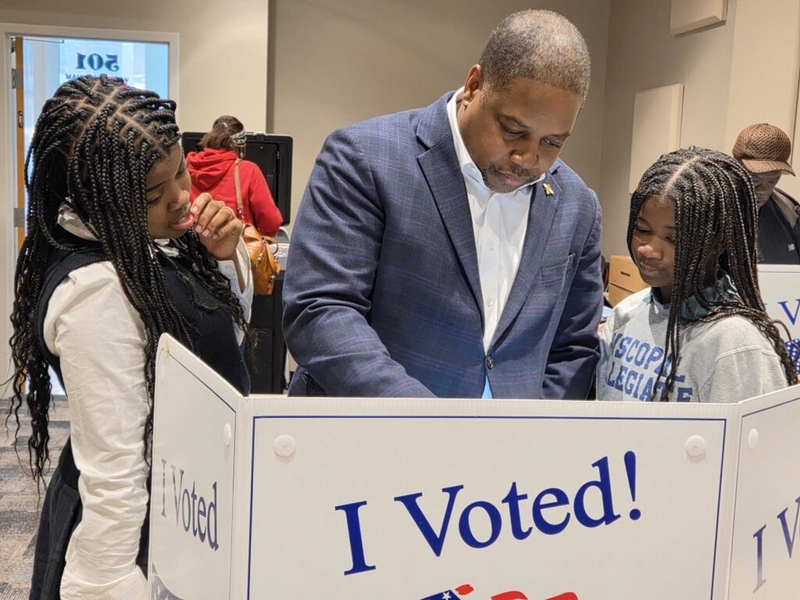
Democratic congressional nominee Chris Jones voting with his daughters Janelle (13, left) and Jasmine (10, right) at the Pulaski County early voting site in downtown Little Rock on Monday, Oct. 19, 2026. Jones ran against Republican U.S. Rep. French Hill in the 2nd Congressional District. (Photo by Tess Vrbin/Arkansas Advocate)
Chris Jones came the closest any Democrat has to winning federal office in Arkansas in 16 years when he lost his bid for a U.S. House seat by less than a percentage point.
He also nearly ended Arkansas’ status as the only former Confederate state that hasn’t elected a Black candidate to Congress.
Black candidates made gains in Arkansas’ midterm election with victories that included the race to run the state’s most populous county and flipping a Republican-held legislative seat in the Little Rock suburbs.
In an election where history was made by Black candidates in states like Mississippi, Florida and Georgia, the racial barrier to Arkansas’ federal and top statewide offices remains. But candidates and observers say they see hopeful signs that achieving that milestone is within reach.
“Do I see progress? Absolutely,” Jones said last week. “And let me be clear: it’s not progress for the sake of electing a Black person. I think it is progress for the sake of seeing that no matter what color you are, there is tremendous value you can bring in the work.”
Jones, an ordained pastor and nuclear engineer who ran for governor four years ago, faced an uphill climb challenging Republican U.S. Rep. French Hill in central Arkansas’ 2nd Congressional District.
GOP US Rep. French Hill wins seventh term to central Arkansas seat
The district, which includes Little Rock, was widely seen as more favorable to Republicans after the GOP-led Legislature redrew its boundaries. Hill won reelection to his seat by nearly 18 percentage points two years ago, and President Donald Trump won the district by more than 15 percentage points that year.
Jones and supporters point to him coming closer than any other Democrat has to unseating Hill as a sign of how flippable the seat is. The Democratic Congressional Committee identified the district as a key target ahead of the November election, and Jones had drawn the support of national party figures like former Vice President Kamala Harris, former Transportation Secretary Pete Buttigieg and Illinois Gov. JB Pritzker.
“He could have broken it if they didn’t gerrymander Pulaski County and turn it into three different congressional districts,” said Barry Jefferson, president of the NAACP Arkansas State Conference.
Jones narrowly lost the election as Democratic state Sen. Fred Love, a Black lawmaker from the Little Rock area, unsuccessfully challenged Republican Gov. Sarah Huckabee Sanders. Love lost to Sanders by double digits.
Love noted he received more votes statewide than any Black candidate previously in Arkansas, but said a lack of national investment in his campaign hurt his bid.
“If leaders would have been more supportive and offered resources, we could have seen more headway than we saw this election cycle, and I believe you have heard this message in other Southern states,” Love wrote in a text message to the Arkansas Advocate.
“Arkansas is ready for change and hopefully leadership will make the investment so that we can see real change in the next election cycle,” he wrote. “In addition, in the future, we can hopefully draw maps that do not intentionally disenfranchise voters so they can truly choose the candidate that best represents them, regardless of race.”
Arkansas is one of a handful of states that hasn’t elected a Black candidate to statewide, nonjudicial office since Reconstruction.
Nationally, the midterms led to historic advances for Black officeholders. Six Black governors will serve at the same time in Florida, Georgia, Maryland, Wisconsin, Virginia and the Virgin Islands. The incoming U.S. Senate will include a record seven Black senators and nine Black lawmakers are set to serve as state House speakers next year.
Black leaders in Arkansas say the lack of representation at the state or federal level is a distinction they’re eager to end in a state known for the 1957 desegregation battle at Little Rock Central High School.
One of the hurdles has been the lack of congressional districts where African-Americans make up a majority of the voting population. Arkansas has never had a majority-Black U.S. House district, unlike other Southern states like Alabama, Georgia and Mississippi.
About 15% of Arkansas’ population is Black, according to the U.S. Census Bureau. The 2nd Congressional District has the highest percentage of Black residents, with about 21%.
Arkansas has had a history of racialized voting patterns, with white voters tending to support white candidates, said Jay Barth, professor emeritus of politics at Hendrix College. Exit polling showed more than two-thirds of white voters in Arkansas chose Republican John McCain in the 2008 presidential election he lost to Barack Obama.
But Jones’ surprisingly close loss to Hill after the 2021 redistricting moved thousands of Black voters to other districts indicates that pattern may be breaking.
“Now we have a generation that has come of age in which race is kind of less of a divider in politics than historically,” Barth said. “You know, party is the more important divider.”
There were signs of progress at the local level as well. Democrat Wendell Griffen, a former circuit and appeals court judge, became the first Black person elected to the top administrative job in Pulaski County. It’s the latest barrier broken in a county that elected its first Black sheriff and clerk in 2018.
Frank Scott, the first popularly elected Black mayor of Little Rock, easily won a third term in the November election.
Another gain was in the race for a Maumelle-area House seat, where Democrat Cassandra Mayes defeated Republican Stephen Bright. The race was one of 10 House seats Democrats flipped, stripping Republicans of the 75-vote supermajority needed to pass most budget items.
In east Arkansas, Democrat Dexter Miller unseated Republican Rep. Mark McElroy.
Jefferson said building on those gains will require more work in boosting voter turnout, an area where Arkansas has ranked at or near the bottom of the country for years. But that will require state officials working to make it easier for people to register to vote rather than placing obstacles, he said.
“Do you really care about the diversity of the state of Arkansas and want to have people represented?” Jefferson said. “We have work to do.”
Jones isn’t shutting the door on trying again to make history. Days after his loss to Hill, Jones posted on Facebook that “2028 is just around the corner.”
“I have every reason to stay in the game and I have every reason to continue to fight,” he said.
Little Rock