Legislative immunity clause protects Alaska ethics investigations, state Supreme Court says
Aug 07, 2026 | 7:01 pm ET
Description
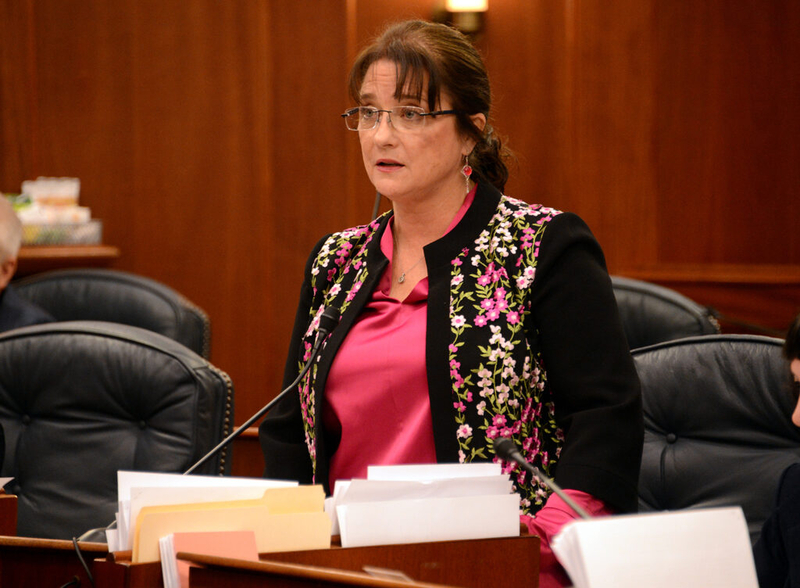
Sen. Lora Reinbold, R-Eagle River, speaks Tuesday, May 10, 2022, on the floor of the Alaska Senate at the Alaska State Capitol in Juneau, Alaska. (Photo by James Brooks/Alaska Beacon)
The Alaska Supreme Court on Friday upheld a lower court’s decision to dismiss a lawsuit by former state Sen. Lora Reinbold, R-Eagle River, against the state of Alaska and the Alaska Legislature’s committee on legislative ethics.
Reinbold had sued the committee and the state’s executive branch in 2022 after the committee concluded that Reinbold had violated the Legislative Ethics Act by blocking people from commenting on her legislative Facebook page “solely for expressing opinions in disagreement with her own.”
Superior Court Judge Thomas Matthews dismissed Reinbold’s case in 2024. She unsuccessfully asked Matthews to reconsider, then appealed to the Supreme Court.
Writing on behalf of the court — which ruled unanimously — Justice Dario Borghesan said, “At no point did the Ethics Committee act outside the statutorily defined investigative process. Therefore, its actions are protected by legislative immunity.”
That immunity derives from Article II, Section 6 of the Alaska Constitution, which states that “Legislators may not be held to answer before any other tribunal for any statement made in exercise of their legislative duties while the legislature is in session.”
Reinbold argued that immunity should not apply because her due process rights were violated.
“But legislative immunity applies even to claims that a legislative body has violated the right to due process,” Borghesan wrote.
Reinbold, reached by text message on Friday morning, said she was unable to immediately talk about the issue because she was at an event with U.S. Speaker of the House Mike Johnson.
Johnson is in Alaska this week as part of a trip to boost the re-election campaign of U.S. Rep. Nick Begich III, R-Alaska.
In Friday’s 19-page order, Borghesan states that a plaintiff or defendant could make an argument that immunity conflicts with the Alaska Constitution’s guarantee — under Article I, Section 7 — of “fair and just treatment in the course of executive legislative and executive investigations.”
In this case, neither plaintiffs nor defendants briefed that argument, Borghesan said. Reinbold briefly raised the argument, he said, but “offer(ed) no legal authority to help us interpret this constitutional provision.”
“Because Reinbold’s assertion that the Ethics Committee violated her right to fair and just treatment was not adequately briefed, we do not consider it,” he said.
The court’s order this week also upholds Judge Matthews’ decision to deny Reinbold the chance to amend her legal complaint. Reinbold had requested to change it after the deadline to do so.
In addition, the order upholds Matthews’ decision to dismiss claims against the executive branch as moot.
Reinbold had objected to a letter from the governor saying that neither he nor other members of the administration would work with her because she repeatedly spread misinformation about the state’s response to COVID-19.
“Reinbold is no longer a legislator, so we could not order the executive branch to work with her,” Borghesan wrote.
Reinbold had argued that a similar case could arise in the future and that the issue is not moot.
But Borghesan said that if a similar case arises between another legislator and another governor in the future, the court will consider those arguments at that time.

Juneau