Lawsuit over courthouse security ‘break-in’ is headed toward trial
Jan 21, 2026 | 2:45 pm ET

Description
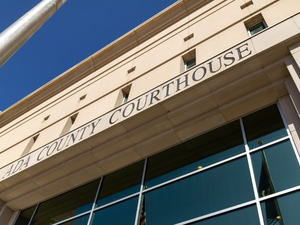
The Dallas County Courthouse in Adel, Iowa. (Photo via Google Earth)
A long-simmering defamation lawsuit involving two security experts arrested at the Dallas County Courthouse during a midnight “break-in” is now headed for trial.
Gary DeMercurio and Justin Lawson Wynn are suing Dallas County and retired former Sheriff Chad Leonard for false arrest and defamation. The case is scheduled to go to trial next week, on Jan. 26, 2026.
In 2019, DeMercurio and Wynn were working for Coalfire Labs, a Colorado-based cybersecurity firm that had been retained by the Iowa Judicial Branch to perform a security analysis of Iowa’s court system. As part of that contract, the Judicial Branch provided a “letter of authorization” to Coalfire employees, euphemistically called a “get out of jail free” letter, that was intended to protect them from being wrongfully arrested for their testing activities.
The contract allegedly contemplated the surreptitious entry of courthouse buildings during daytime and evening hours, with no advance notice given to local law enforcement or security personnel.
On the evening of Sept. 10, 2019, DeMercurio and Wynn went to the Dallas County Courthouse in Adel and allegedly found one of the main doors was unlocked. In subsequent depositions, the two recalled they latched the door and then, using a thin, flexible cutting board, manipulated the latch to unlock it and gain entry.
The two said they then entered the courthouse, where they tripped an alarm and then looked through various rooms while waiting for law enforcement to arrive. Shortly after midnight, Dallas County deputies arrived on the scene, and DeMercurio and Wynn identified themselves and provided the deputies with their “get out of jail free” letter.
Court records indicate the deputies verified the letter’s authenticity and then told DeMercurio and Wynn they were free to go. However, their lawsuit alleges, Sheriff Leonard arrived on the scene minutes later, “refused to recognize the authority of the Iowa Judicial Branch” to allow such security testing, and then ordered his deputies to arrest the two men.
DeMercurio and Wynn were booked into the county jail and held for roughly 20 hours on charges of burglary in the third degree and possession of burglary tools. The charges were later amended to trespassing and then dropped altogether.
Court records indicate DeMercurio and Wynn hope to show that when Sheriff Leonard arrived on the scene, Deputy Joey Marchant stated, “This ought to be good” and then said, “I better shut my video tape off,” and switched off his body camera.
During pretrial depositions, Marchant was asked why he shut off his body camera when Leonard approached him to discuss the matter. “There’s been times before that officers will engage in conversation that periodically we have … (shut) off videos before because it is just a conversation between us officers,” he said.
When asked whether that was consistent with department policy on body cameras, Marchant stated, “Again, like I said, in the course of our duties, there are times that we do have conversations with other officers that are — not necessarily going to say private, but it’s a conversation between us officers to formulate, make decisions, things of that nature.”
Leonard acknowledged comments to reporter
The defamation claim against Leonard that is part of the lawsuit is tied in part to a November 2019 article that appeared on the Ars Technica cybersecurity website.
The plaintiffs allege Leonard was interviewed by the article’s author and that the sheriff described DeMercurio and Wynn as being found inside the courthouse, “crouched down like turkeys peeking over the balcony. Here we are at 12:30 in the morning confronted with this issue — on September 11, no less. We have two unknown people in our courthouse, in a government building, carrying backpacks that remind me and several other deputies of maybe the pressure-cooker bombs.”
During a pretrial deposition, Leonard indicated he “probably did” make the comments attributed to him on that point, although he questioned the reported reference to “several” other deputies.
In that same August 2024 deposition, Leonard acknowledged he wasn’t happy that Coalfire Labs’ security check had, in his view, put his deputies in harm’s way.
“You can’t do this,” Leonard said at the time. “Those deputies were all were probably going (to the courthouse) at a high rate of speed to get there. They were probably thinking the worst, and I don’t want one of them getting — one of them said he about smacked a deer at 100 (miles per hour), you know. I got to go to his wife and tell her than, ‘Yeah, I’m sorry, your husband died for a fake call.’ So that stuff sits with me.”’
In his deposition, Leonard also said that if Coalfire Labs had contacted him and given him all of the documentation showing DeMercurio and Wynn were authorized to be in the building, he most likely would have asked Dallas County Attorney Chuck Sinnard to immediately drop the charges.
“If they would have called and given me all the stuff that we needed, that they were authorized to break in, they were just — I mean, if they, if all of those things were in there, then, yeah, I would have gave it to Chuck and said, ‘You deal with it,’ because – yeah,” Leonard testified.
Widespread fallout from courthouse break-in
The arrest of DeMercurio and Wynn sparked controversy and complaints from state lawmakers that the Iowa Judicial Branch had hired Coalfire to commit crimes, placing law enforcement officers and others at risk. Mark Cady, then the Iowa Supreme Court’s chief justice, apologized to lawmakers for the incident, saying it had diminished “public trust and confidence in the court system.”
At the time, judicial branch officials said they had not intended to authorize Coalfire to physically break into buildings or enter facilities outside normal business hours.
In their lawsuit, Wynn and DeMercurio allege their contract specifically called for “physical attacks” on buildings, including lockpicking and physical “penetration” of the premises.
Dallas County has argued that Iowa’s state court administrator had no “authority to grant permission to enter a county owned courthouse,” and because of that, there is “no set of facts showing any unlawfulness” in the arrest of Wynn and DeMercurio.
The lawsuit was initially filed in 2021 in Dallas County District Court and in May 2022, it was moved to Polk County District Court. In June 2023, it moved to the U.S. District Court for the Southern District of Iowa based on a federal statute that allows individuals to sue, for civil rights violations, government employees whose actions are controlled by state law.
In November 2023, a federal judge dismissed that particular element of the lawsuit, which resulted in the remaining elements of the lawsuit being remanded back to state court where it was first filed.

Des Moines, IA