Lawsuit alleges MDOC staff filmed incarcerated woman while giving birth, violating privacy statute
Oct 15, 2026 | 4:00 am ET
Description
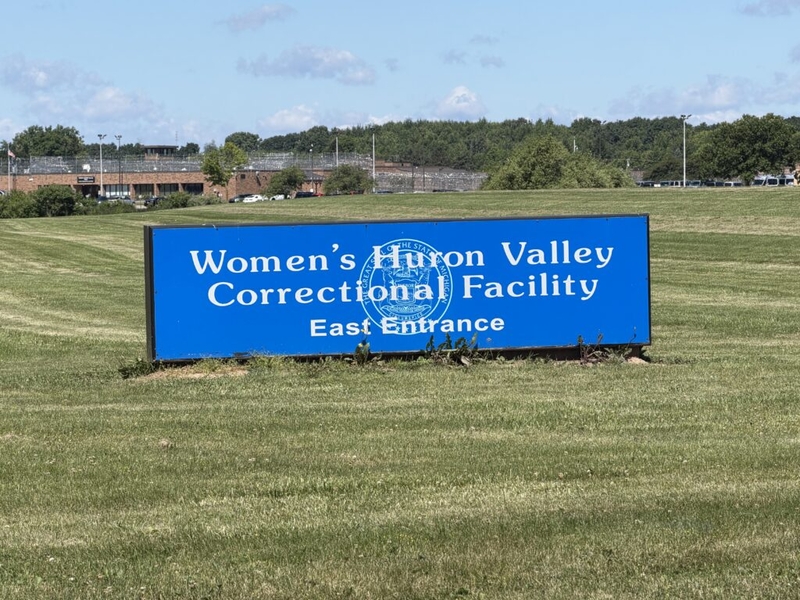
Women's Huron Valley Correctional Facility in Saline Township, Michigan. | Photo by Jon King/Michigan Advance
A new lawsuit filed Oct. 8 in federal court against eight employees of the Michigan Department of Corrections, alleges that the right to privacy of Natalie Forrest, who was incarcerated at the Women’s Huron Valley Correctional Facility at the time, when officers recorded her on their body cameras while she was giving birth to her son.
“It was hard to be able to even try to connect with my newborn son, just for the simple fact that they were sitting there recording everything,” Forrest said in an interview. “I can’t even put into words how uncomfortable I felt. I felt degraded. I just felt like I couldn’t even actually enjoy the moment of my son being born.”
The lawsuit, filed in the Eastern District of Michigan, argues that filming Forrest while giving birth on March 8, 2025, violated Michigan’s criminal voyeurism statute — and that the Department of Corrections was notified on Feb. 17, 2025, nearly a month before Forrest delivered her baby that the policy in place allowing that filming to happen was illegal. Changes to the policy, which had also allowed correctional officers to record on their body cameras during strip searches, did not go into effect until March 24, 2025.
A spokesperson for the Department of Corrections did not respond to multiple requests for comment by Michigan Advance on the lawsuit. This story will be updated when a response is received.
Forrest described the practice of recording, up until she gave birth, as a pattern, adding that “There were multiple times where I was strip searched due to the simple fact that I had to leave the prison to go to doctor’s appointments for the baby, seeing that I was high risk. Every time that I had to leave the prison to go to a doctor’s appointment, they would strip search me, pregnant at all.”
According to the complaint, two correctional officers, one of them male, remained inside the delivery room with Forrest through cervical exams, labor and delivery, not outside the door or behind the privacy curtain, with chest-mounted cameras facing her bed.
Maura Battersby, an attorney with Flood Law representing Forrest along with her minor son and her mother, who was present at the time of Forrest giving birth, described the situation in the lawsuit as “treating these women like they’re subhuman.”
Battersby emphasized that, even though incarcerated individuals have a lower expectation of privacy than non-incarcerated individuals, and some recording is necessary for the safety of guards and others in custody, she does not believe that there is a justification for recording during strip searches or similar nude settings.
“When you are incarcerated, you have a much lesser expectation of privacy than a citizen out in the world, not in custody,” she explained. “But as far as the standards go, and where it is more important, nude is top of the list as far as your expectation of privacy, even as an incarcerated individual.”
Recording during strip searches at Women’s Huron Valley was the subject of an earlier lawsuit from Flood Law against department leadership — and though a state circuit court dismissed that lawsuit, an appeal remains open according to online court records.
“You’re not supposed to follow an illegal order if you know that to be wrong. You are not supposed to do that. So I don’t think that absolves even just the corrections officers from doing that,” Battersby said of the recording policy. “From the top all the way down, there’s blame to be had all around there. They knew for a very long time this is what was happening. They were told by lawmakers … Part of our complaint in the exhibits shows the emails with the lawmakers saying this is illegal. You have to stop doing this immediately.”
Forrest emphasized that having officers who she did not know made her feel uncomfortable communicating with both her mother, who was present as her support person while giving birth, and her doctors. She also said that it made it harder for her to connect with her newborn son — something that was already difficult for her because she was incarcerated for the first months of his life.
“I got less than 48 hours with him. They took my baby. My mom had to take my baby. I didn’t get to actually physically hold him, connect with him, see him,” she said. “And the simple fact that I’m sitting here thinking about the moment I gave birth to my son. It’s all recorded. Who knows where those recordings are? Who knows who has access to those recordings? Who knows what they could do with them?”
Forrest said that the whole experience continues to take a toll on her mental health, saying, “I still think about it every single day.”
The lawsuit alleges that after Forrest’s son was born, a corrections officer told her mother, who is also a plaintiff, that two years would be added to Forrest’s sentence if she took a picture of her newborn grandson in the hospital.
Battersby said she was unaware of any mechanism for an individual officer to do that, adding, “What’s important is that it was meant to intimidate and meant to control, whether true or not. I would be interested to see what that complaint was or what any additional charge was for that.”
On March 14, 2025, eight days after her son’s birth, Forrest filed an internal grievance with the department, describing her experience which, the lawsuit claims, “described conduct constituting
sexual abuse as defined by the Prison Rape Elimination Act and MDOC’s own policy directives governing sexual abuse and the mandatory referral of such allegations to the facility’s PREA Coordinator rather than the ordinary grievance process.”
Instead of referring the grievance to the Prison Rape Elimination Act coordinator, the lawsuit says that it was thrown out for being “Untimely,” despite Forrest’s arguments that, in her recovery from pregnancy, she submitted the grievance as quickly as was reasonable. An appeal of the grievance was also denied.
Lansing, MI