Lawmakers override 2 Moore vetoes during special session, sustain 3
Aug 05, 2026 | 4:31 am ET
Description
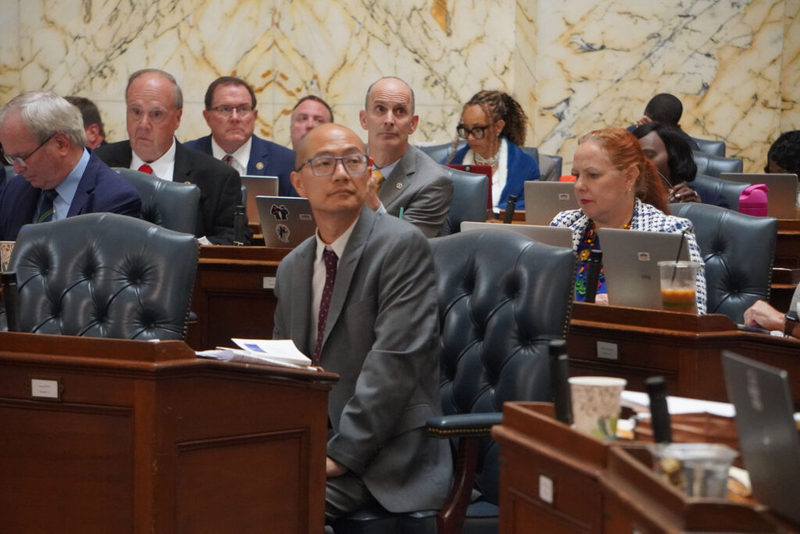
House Majority Leader David Moon (D-Montgomery) on the House floor Monday, the first day of the special session. (Photo by Will Hammann/Maryland Matters)
Lost in the drama of redistricting, state lawmakers overrode two of Gov. Wes Moore’s five vetoes from this year before adjourning the special session Tuesday after two days.
Lawmakers voted overwhelmingly to override Moore’s veto of Senate Bill 426, which would shield most records in divorce cases from public disclosure, and restored by a narrower margin House Bill 862. which requires at least two crew members on freight trains. The other three vetoes were sustained.
HB 362 was the only bill of the five to see any actual debate. Supporters called it an important safety measure, even though it largely repeat federal regulations.
Freight trains can be “miles and miles long,” said Del. Michele Guyton (D-Baltimore County). “If there is only one crew member on a freight train … that crew member is required to stay with the train. They cannot assess damage, they cannot help assist first responders,” she said. A second crew member would be able to do that while the first stays on the train, she argued.
Guyton noted that the two-man crew minimum is already required by a Federal Railroad Administration rule, but a state law creates an important backstop were the Trump administration to undo that rule, enacted under the Biden administration.
“We all know that regulation can be changed,” said Del. Linda Foley (D-Montgomery) in support of the bill. “We can’t leave it to the whim of regulators.”
Maryland Republicans predict legal challenge to constitutional amendment on redistricting
In his veto message, Moore wrote that HB 362that this bill conflicts with the Federal Railroad Administration’s existing rule and could be preempted. Even though it does not require any more staff than the federal rule, Moore noted that the cost of increased staffing rail companies might incur under the bill could be offloaded onto the state because of agreements between the Maryland Transit Administration and rail conglomerate CSX.
Del. Ryan Nawrocki (R-Baltimore County) spoke against the bill on the House floor. “Because this is already the law of the land, I will be voting no on this, just like I have many times in the past,” he said.
The override passed the House 99-30 before heading to the Senate, where it passed 33-11 after a debate.
“There’s a huge need for it,” Senate Majority Leader Nancy King (D-Montgomery) said of the bill. “We battled a long time to get it, so yeah, that was a good move.”
The Senate voted unanimously Monday to override Moore’s veto of SB 426, which was originally sponsored by Sen. Charles Sydnor (D-Baltimore County) following the harassment faced by a constituent and that person’s ex-partner after their divorce records were posted online.
But Moore said in his veto message that measures already exist to prevent such harassment from happening.
“If proper procedures had been followed, this painful and unfortunate incident most likely could have been avoided,” Moore wrote, referring Sydnor’s constituent. “A party can request that a case file or specific pleading be sealed or shielded.”
He added that the Public Information Act generally defers to the Maryland Rules on Access to Judicial Records enacted by the Supreme Court of Maryland. Amending the PIA as the bill does could pose constitutional questions since it only restricts public information requests, Moore wrote.
Senators disagreed. The House followed Tuesday with a unanimous vote to override the veto.
“There’s not a whole lot that I can say,” King said of the unanimous vote. “There was no conversation about it, we just all overrode the veto. So, all good.”
The Senate effectively sustained the governor’s vetoes when it indefinitely postponed action indefinitely on two bills that would require state agencies to spend at least half of their advertising dollars with local news organizations and a redundant $27 million Carroll County bond bill.
And the House on Monday morning special ordered an override vote on HB 1151, a bill that called for a study on the possibility of state reimbursement of room and board for hospice services. Delegates failed to call the bill up for a vote before the House adjourned shortly after 6 p.m. Tuesday, effectively sustaining that veto.
In his veto message for SB 459, the local advertising bill, Moore commended Sen. Jim Rosapepe (D-Prince George’s and Anne Arundel) and Del. Linda Foley (D-Montgomery), the bill’s sponsors, “for their sustained commitment to supporting Maryland’s local journalism.” But forcing the state to advertise mostly with those outlets would limit returns on its advertising expenses, he wrote.
“There weren’t strong enough feelings to override the veto,” King said about the bill. “There were so many people on both sides of the issue that at this point, you just start it all over again. If it’s important enough to pass, it’ll pass by itself this year.”
SB 448, the Carroll County bond bill, was vetoed because it was a duplicate of HB 833 that had already been signed into law, authorizing Carroll County commissioners to borrow up to $27 million for the construction, maintenance and improvement of public facilities.
HB 1151, the hospice study bill, had admirable intentions, Moore wrote, but federal law prohibits the use of Medicaid dollars for certain hospice payments, so any reimbursement would fall to the state. That could cost $8 million a year, to start, at a time of tight health budgets. He said the Maryland Health Department would “instead work with the bill
sponsor during the interim to identify alternative ways of improving hospice patient outcomes.”
Annapolis, MD