Lawmakers fail to override veto of Nebraska safe syringe programs
Mar 12, 2024 | 3:26 pm ET
Description
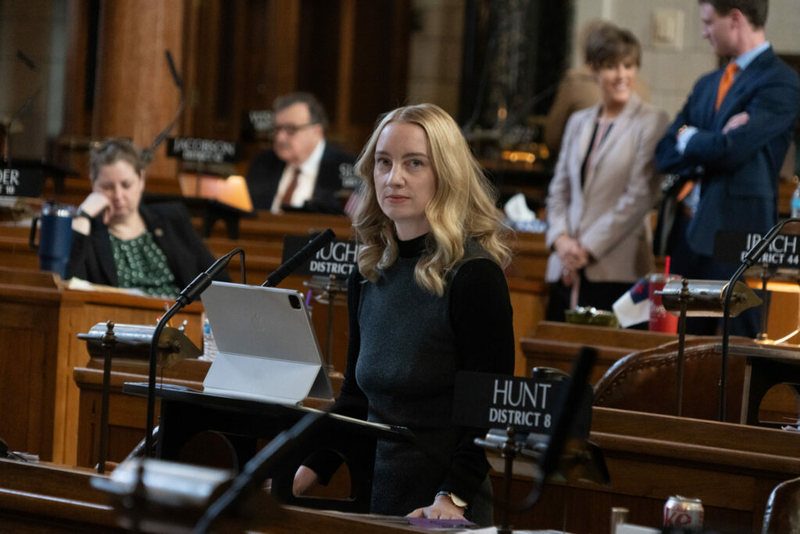
State Sen. Megan Hunt of Omaha glances at the speaking queue during debate on her 2024 priority bill, LB 307, to authorize safe syringe programs in the state. March 12, 2024. (Zach Wendling/Nebraska Examiner)
LINCOLN — Lawmakers failed Tuesday to override Gov. Jim Pillen’s veto of legislation to authorize safe syringe programs in the state, a vote that some said was deeper than one bill.
Pillen last week vetoed Omaha State Sen. Megan Hunt’s Legislative Bill 307, which would have authorized localities to adopt syringe services programs, or SSPs. Lawmakers failed 27-20 to override the veto, falling three votes short.
Seven lawmakers who voted to pass the bill 30-7 on Feb. 29 flipped to oppose the bill Tuesday. Six more who were “present, not voting” on Feb. 29 voted against it Tuesday.
Hunt told her colleagues earlier in debate that the Legislature knows the policy underlying the bill better than Pillen and that, traditionally, lawmakers “stand together as a family” — they make the choice to trust one another, the committee process and policy experts.
“That doesn’t mean that we allow the executive branch to tell us how we’re going to act at the end of the day,” Hunt said.
Hunt addressed Pillen’s veto letter in turn, describing it as fearmongering, with the governor suggesting the programs could allow Nebraska to become like San Francisco.
“Be serious about the work in here,” Hunt said. “It doesn’t say someone can open up a tent at 72nd and Dodge (in Omaha) and hand out free needles.”
A ‘door’ to treatment
One of Hunt’s staunchest supporters came in the Legislature’s top leader, Speaker John Arch of La Vista, who said he had talked with Dr. Jerome Adams about the benefits of LB 307. Adams is the executive director of health equity initiatives at Purdue University and served under former Gov. Mike Pence in Indiana and as U.S. surgeon general under former President Donald Trump.
In the past week, Arch said, he’s talked with Adams about other SSPs. Five states do not allow them: Kansas, Mississippi, Nebraska, South Dakota and Wyoming.
Adams, in a Jan. 26 letter to Arch, said the programs are “so much more than syringes” and can build trust and empathy with community members who struggle with substance use disorder. He said the programs also create pathways to treatment and recovery.
“When local communities are empowered to authorize, design and operate SSPs, they can do so according to local needs and conditions, and in a way that builds partnerships with the public safety community, the business community, the faith community and more,” Adams wrote.
Arch echoed Adams in saying the SSPs could create a “door” to treatment.
“If there is no treatment, there is no recovery,” Arch said.
‘Slippery slope’
State Sen. Christy Armendariz of Omaha, who previously supported the bill but voted “no” Tuesday, said she supported the bill because Hunt asked her to. Armendariz said she didn’t believe there were good arguments on whether SSPs would reduce or increase drug use.
After Pillen asked Armendariz to support his veto and explained it could be a “slippery slope,” she reconsidered, she told the Nebraska Examiner.
“Free needles in a vending machine is a different thing than having an area where you have somebody overseeing and providing,” Armendariz said.
State Sen. Jana Hughes of Seward was another who previously supported the bill but voted to sustain the veto. She said in a Friday Facebook post that she had “no illusions that LB 307 will stem the tide of the opioid crisis.”
“However, this is a well-intentioned effort and Senator Hunt deserves credit for crafting a very thoughtful bill,” Hughes wrote.
Hughes also wrote that she understood Pillen’s concerns but that the bill doesn’t decriminalize or condone drug use.
A different solution?
Pillen stated that Nebraska has the lowest opioid overdose rate in the country, but both Hughes and Hunt said that isn’t a reason for inaction.
“While that is good news for Nebraska relative to other states, that is a bit like saying you are the last person to jump out of the plane without a parachute,” Hughes wrote Friday. “Ignoring a problem does not make it go away.”
“Denying one potential, local solution without offering any other solution in its place is dangerous considering the issue at hand,” Huges added.
While declining to comment on her Tuesday vote, Hughes told the Examiner she intends to work on a solution after the Legislature adjourns next month.
Pillen and Armendariz also voiced support for an alternative solution, which the governor said he is looking forward to working toward ahead of 2025.
“We need to invest in less harmful ways to combat drug usage and disease transmission that are in line with Nebraska values,” Pillen said after Tuesday’s vote.
Armendariz said more counseling could help and if there is a concern about getting treatment to individuals, the treatment must be brought to them.
“You have to go seek them out if they’re not going to come to you,” Armendariz said.
Hunt said there is no other bill before the Legislature this year that would help and said her bill presented an “important opportunity to save lives.”
What is a ‘legislative leader?’
State Sen. John Fredrickson of Omaha said Tuesday’s vote was larger than Hunt or LB 307 and was about “what it means to be a legislative leader.”
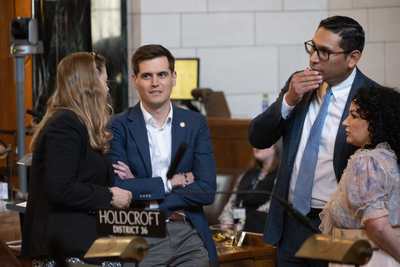
He and others said they were watching to see who would step up and defend the Legislature as a separate but co-equal branch of government or who would “bend over with a little text or a phone call.”
“Leadership in this body requires standing up and defending the Legislature,” Fredrickson said.
State Sen. Danielle Conrad of Lincoln argued that her colleagues represented their constituents, not the governor.
State Sen. Teresa Ibach of Sumner said it was because of her constituents that she opposed the bill, even after supporting it during the first round of debate and advancing it from the Judiciary Committee.
“I’m doing what my constituents asked me to do,” Ibach said.
‘A badge of pride’
State Sen. Justin Wayne of Omaha, chair of the Judiciary Committee that voted 7-0 to advance LB 307 from committee last year, told Hunt to wear the veto as a “badge of pride” because she worked “against the crowd” to get into the Governor’s Office.
State Sen. Carolyn Bosn of Lincoln, a former prosecutor and Judiciary Committee member, also switched her vote from “yes” to “no.” She said she committed to having an open mind during the debate and was ultimately persuaded that with the controversy around LB 307, it was right at this time to sustain the veto.
“It was not due to pressure from the governor’s office,” Bosn said.
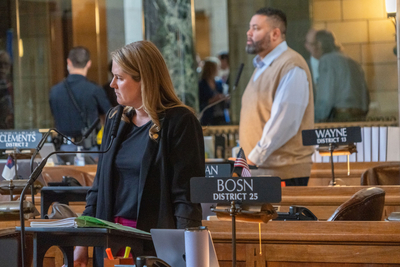
Wayne pointed to Bosn’s opening statement two weeks ago on a different bill — her LB 137, which would enhance penalties for overdose deaths — when Bosn stated the reality is the Legislature can attack drug concerns “from every angle, simultaneously.”
“This is not just Senator Bosn coming in and wanting to enhance a penalty to put more people in jail — that couldn’t be farther from the truth,” Bosn said Feb. 21.
She discussed her support for Hunt’s LB 307, treatment programs, drug courts and more.
“This war will not be fought on my bill alone,” Bosn said. “We’ve got to come at this with every tool in the toolbox.”
Bosn said she still thinks lawmakers need to come at fentanyl from every direction.
“If SSPs aren’t the right fit for right now, we need to reevaluate,” Bosn said. “I do think we have to keep trying — the crisis is here, whether we want it or not.”
Wayne said it was Bosn’s previous statements that caused him to back off his filibuster of Bosn’s LB 137, which he said is now “definitely” back on.
Lincoln, NE