Lawmakers added $1 to Texans’ car insurance policies. That money paid for thousands of Flock cameras.
Aug 28, 2026 | 5:43 pm ET
Description
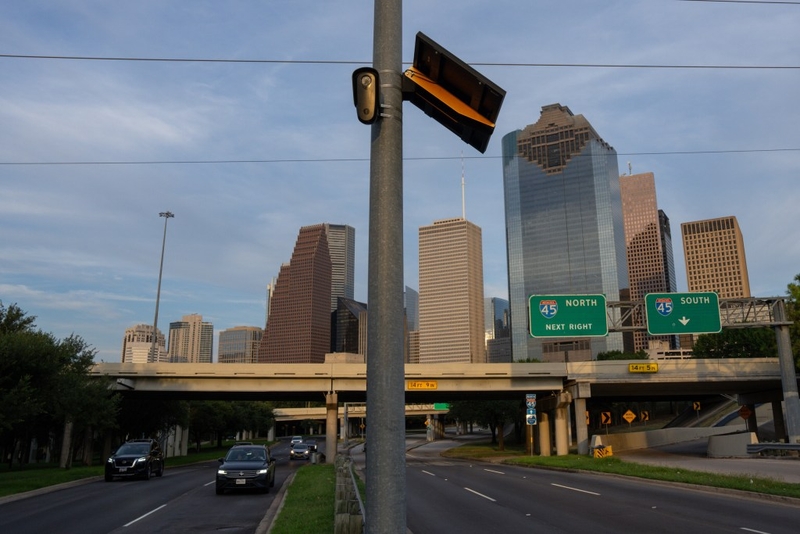
A Flock camera records drivers on Allen Parkway near downtown Houston on Monday, Aug. 24, 2026. (Jon Shapley for The Texas Tribune)
In 2023, the Texas Legislature unanimously passed a law raising auto insurance costs for Texans by $1 to combat rampant catalytic converter theft.
Three years later, a little-known state agency has devoted at least $30 million of that fee toward supercharging the state’s Flock surveillance network, placing cameras along highways and streets from El Paso to the Louisiana border, an analysis by The Texas Tribune found.
The Motor Vehicle Crime Prevention Authority, led by a board mostly appointed by Gov. Greg Abbott, has turned the $1 fee hike into at least 3,200 Flock cameras.
The agency has awarded no fewer than 95 grants to help law enforcement agencies purchase and maintain about 2,000 Flock cameras. Another $15.9 million is helping the Texas Department of Public Safety add almost 1,200 more.
The effort is far from over. In early August, the agency approved another $3 million to help DPS install 583 more cameras along Texas tollways over the next year.
Miguel Rodriguez, chair of the Motor Vehicle Crime Prevention Authority, said during an August 2023 meeting that he hoped to use proceeds from the fee increase to “cover the entire state” with cameras.
Rodriguez, who is also the Laredo Police Chief, sees the cameras as a powerful law enforcement tool, particularly to combat criminal organizations.
“That kind of capability directly disrupts the operational advantage these transnational criminal organizations rely on, and it strengthens our ability to protect both Texas communitiesand the broader region,” he said in an email.
But on Friday evening, after multiple requests for comment from the Tribune about its findings, Abbott’s office said the governor was pausing all state funding for local grants to be used for Flock cameras.
“To the extent that cities get any funding for those cameras, most of it comes from the federal government. To the extent any funding comes from Texas agencies, those agencies are clarifying that those funds cannot be used for Flock cameras,” Abbott spokesperson Andrew Mahaleris said in a statement shared first with the Tribune.
The $1 per year fee increase has raised an estimated $81 million, allowing the authority to funnel $50.8 million into 234 grants that have helped reimburse police departments for officers, crime analysts and attorneys to prosecute vehicular crimes, as well as drones and other surveillance devices.
The Tribune found agency grants to police departments ranged from $7,000 for two Flock cameras in Bellmead, near Waco, to almost $1.7 million for 201 cameras in Dallas. Some city networks — like the 165 cameras in Laredo and 150 in El Paso — were entirely subsidized by the grants.
The state agency does not detail how much of its grant money went to Flock cameras. Instead, the Tribune tracked the grants by reviewing the vehicle authority’s meeting records, as well as documents, agendas and discussions from 101 city councils and county commissions that approved or discussed Flock-related grants.
It is likely the authority has paid for more Flock cameras than the Tribune analysis found because 124 grants lack clear public documentation about what was purchased.
The statewide effort to proliferate Flock cameras comes as backlash is mounting over the surveillance, including from some members of the Legislature, where the $1 fee was approved without opposition.
“The sheer volume of information captured is not something that is entertained, in my view, by the Fourth Amendment,” said Rep. Mitch Little, R-Lewisville.
State Sen. Carol Alvarado and Rep. Jeff Leach, the bill’s author and House sponsor, said surveillance cameras were never discussed when the bill was considered. Alvarado said she was surprised to learn from the Tribune that the insurance fee was funding AI-supported license plate readers.
“I did not have that in mind when we passed the bill,” said Alvarado, D-Houston. “When I think of combating crime, I’m thinking … more boots on the ground, hiring more officers to tackle the crime or some type of undercover work.”
Alvarado said there is a “fine line” between protecting the public from crime and protecting people’s privacy, but said she did not plan to file legislation to shift the grant requirements.
Flock cameras, the nation’s most commonly used license plate reader, create a “vehicle fingerprint” with the use of artificial intelligence — storing each vehicle’s license plate, make, model, color and details such as dents and bumper stickers in a database accessible by law enforcement across the country without having to obtain a search warrant.
The exact number of Flock cameras in Texas is unclear. DeFlock, an anti-surveillance watchdog that has mapped the locations of Flock cameras using verified crowdsourcing, has identified about 13,000 in the state. By that count, the insurance fee increase has paid for one in four Texas cameras.
That also represents a sharp increase in Flock cameras in the state since December 2023, when a company spokesperson told the vehicle authority’s board that there were about 7,500 cameras in the state.
Flock does not disclose how many cameras it has in the field, but Texas is estimated to have the second most in the nation, after California. Nationally, Flock officials say, about 7,000 law enforcement agencies use a total of 120,000 cameras and other surveillance products.
In Texas, state agencies don’t rely solely on vehicle authority grants to add surveillance devices, and Abbott’s office pointed to federal grants for funding the cameras. DPS, for example, has a $28.5 million contract for Flock cameras. But the grants have helped get the cameras into the hands of the state’s smaller police departments that may have struggled with the cost of the equipment.
Departments that opt in to Flock’s national lookup program can search each other’s data from anywhere in the country, allowing vehicles to be tracked with unprecedented efficiency.
The ability to share data “has been one of the most effective ways Flock has been able to help find, just last year, over 10,000 missing persons,” Flock spokesperson Trevor Chandler said in an interview.
But for a rapidly growing coalition of Texans opposed to the cameras, the Flock network is a dangerous combination of invasive surveillance and limited oversight that undermines privacy rights.
Kenneth Feagins, an organizer with DFW DeFlock, one of several new grassroots anti-surveillance groups in the state, said he sees an “alarming trend” of police improperly accessing a network that can amass data on where people live, shop, worship and work.
“For me, it’s always been the question of, well, how much liberty are we willing to trade for safety?” Feagins said.
Recently revealed examples of misuse — including police officers using Flock data to stalk ex-partners and co-workers — have sharpened those concerns.
A Lufkin officer was indicted Aug. 24 on 100 counts of misusing official information, which Abbott cited as a concerning development during a Friday radio interview. Officers in Baytown, Harris County, Fort Bend County, Temple and Pasadena also have been arrested, disciplined or investigated.
“There’s a lot of malicious things that can be done with this data, and those things are no longer hypothetical,” Feagins said.
Cameras “changed the game” for police
The Motor Vehicle Crime Prevention Authority was established by the Legislature in 1991 to combat automobile theft.
The authority is led by a DPS official and six governor-appointed board members — two from law enforcement, two from the insurance industry and two consumer representatives.
The vehicle authority primarily flexes its muscle via grants funded by fees added to annual auto insurance premiums — $1 initially, rising to $2 in 2011 and $4 in 2019 — that largely went to fund task force efforts for police departments.
In 2023, with catalytic converter theft spiking across Texas, lawmakers approved adding another $1 to the insurance fee in a bill named for Harris County Deputy Darren Almendarez, who was shot to death after interrupting catalytic converter thieves in a grocery store parking lot.
The legislation made no reference to license plate readers, and Rep. Brian Harrison, who voted for the bill, said he wasn’t aware of any conversations about using the fee increase that way. The Midlothian Republican filed bills that year and in 2025 to require a warrant before police could access license plate reader data.
“In a million years, I never could have even contemplated that this would be used to fund what is effectively warrantless surveillance,” Harrison said. “Otherwise, I can’t imagine it would have gotten unanimous support. I sure as hell wouldn’t have voted for it if I knew some bureaucrat was going to redirect the money to Flock cameras.”
Anticipating millions from the $1 insurance fee hike, the vehicle authority in 2023 asked law enforcement for advice on how best to spend the money. Automatic license plate readers like Flock cameras were by far the top choice for combatting catalytic converter theft, beating out overtime for investigators and additional training.
The cameras, Rodriguez said, are particularly helpful for addressing catalytic converter theft, a “mobile, high-volume, low-witness crime” where the vehicle used is often the only lead.
Without technological help, departments were left working with partial descriptions taken from grainy surveillance footage of suspect vehicles, Rodriguez said.
Data from the license plate readers, known in law enforcement as LPRs, was searched 62,000 times in 2025, leading to about 1,660 cleared catalytic converter theft cases, a report from the authority said.
Pasadena Police Sgt. Douglas Buckert said the cameras “changed the game” for catalytic converter theft investigations.
“The number of leads we’ve gotten since our department has deployed Flock cameras is outrageous,” Buckert told the authority in early 2024. “I could have six more investigators and not get it all done.”
Grant-funded cameras, much more than other technology, have also expanded the reach of police in investigations far beyond catalytic converter cases, department officials say.
Dallas Police Sgt. Bryan Roden told board members during a January meeting that an authority grant let his department increase its network from 100 to 300 cameras, helping to bust a million-dollar tire theft ring and solve a hit and run. Working with the Department of Homeland Security, Dallas police located a fugitive wanted for cocaine manufacturing by using Flock cameras he regularly passed to build a “pattern of life assessment,” Roden said.
Temple Police crime analyst Mike Treehern told the Tribune that the cameras helped decrease the number of stolen vehicles in his city, where 84% of their Flock cameras are funded by the state grant.
“It’s absolutely helped us, and we would not have anywhere near the amount of cameras that we do without [vehicle authority] funds,” Treehern said.
The grant has also been a force multiplier for smaller departments. In Cibolo, a city north of San Antonio with a population of 36,000, an authority grant multiplied the number of Flock cameras from 11 to 52.
“Honestly, a lot of our surrounding communities started looking at them, specifically through the [Motor Vehicle Crime Prevention Authority],” Cibolo Police Lt. John Wells told board members in a January meeting. “Seguin was looking at them, Guadalupe County, the New Braunfels Police Department, all of our neighbors, so we started looking as well.”
Hannah Foust, founder of DeFlock Carrollton, said the cameras give police surveillance power well in excess of what’s needed to stop car thieves.
“I do think that motor vehicle theft is a concern, it’s an issue,” Foust said. “[But] I do think that this grant program, and the way it’s been used … it really shifts the focus to a broader surveillance program, as opposed to focusing on catalytic converter prevention.”
$1 fee hike helped DPS expand its Flock network
The authority’s most significant investment in Flock came in 2025 when it signed a three-year, $15.9 million contract with DPS to install 1,183 cameras in a project largely overseen by DPS Major Sharon Jones, the board’s self-described “pro Flock” member who left the position Aug. 1.
The contract aims to bolster DPS’ network of cameras and make it accessible to local law enforcement agencies in places that otherwise could not be easily reached — including local municipalities that are resistant to the surveillance.
Patrick McBroom, police commander for the Panhandle Auto Burglary and Theft Unit, said DPS cameras help his task force monitor interstate traffic at the Oklahoma and New Mexico borders — areas of Texas beyond the view of 138 grant-funded cameras his team monitors.
“All those roads leading out and into Texas have DPS cameras on them, so if we have stolen items that may be going out of state, we’re able to look at those cameras to see if those vehicles have left the state,” McBroom said.
During an April conversation about the DPS contract, Rodriguez noted the state police force’s cameras could improve surveillance in areas where locals are unwilling to install their own cameras. A growing number of cities and counties, including Austin, have canceled their Flock contracts in the face of residents’ privacy concerns.
“I think that if for whatever reason you are within those jurisdictions that do not want Flock, let’s get together with DPS, [so] that, you know, we can put those in state right-of-way. And there’s nothing that they can tell us,” Rodriguez said to Jones.
Rodriguez told the Tribune that the DPS network provides a needed crime-fighting tool in areas hostile to Flock cameras and similar devices.
Almost 100 municipalities in the U.S. have ended their Flock contracts in response to public outcry, including several in Texas, such as Bandera and Hood County. Both had received grants for their cameras but ended their contracts after issues with Flock installation and in response to public uproar over their use.
As criticism over the cameras has exploded — including devices that were cut down or vandalized as acts of protest — agency board members have expressed frustration at what they see as misinformation that clouds the positive impact from the cameras.
“We’ll have a larger conversation regarding the need to educate the public, and we must put a stamp on those who are spreading false information on license plate readers,” Jones said in a July grant meeting.
“A concern for our privacy”
Foust started Carrollton’s DeFlock group after her neighbors expressed frustration at the cameras’ rapid spread. Spotting a camera along the route her children walk to school gave her pause; seeing one go up in front of her community recreation center made her act.
“You can’t enter or exit that complex without passing a Flock camera, and that’s also my polling place, so that really gave me a strong reaction,” Foust said. “They were in places that we normally feel very safe at, and there’s no concerns for our safety, for our children’s well-being, but there suddenly was a concern for our privacy.”
Foust is open to discuss a variety of solutions to her concerns, including action by the Texas Legislature, but said the first step is getting city officials to be transparent about their use.
“I think before we can have a true and honest conversation about what legislation might look like or what guardrails or safeguards could be put in place, I think we need to start on a level playing field of understanding,” Foust said. “What is the system, what is it capable of, and how could it be set up in a way that’s supposedly safe?”
Harrison and Little said they intend to file bills next legislative session banning the devices because they believe the cameras violate the Fourth Amendment’s protection against unreasonable searches. Little said he’s particularly concerned about whether vast amounts of personal data is securely stored and whether Flock, a private company, should be able to access it.
“The people in Lewisville, Texas have a reasonable expectation of privacy from police officers in Pampa, Texas, and yet they can observe all that data,” Little said. “So the sharing of it across state lines, across jurisdictional lines, to me is highly problematic.”
Harrison said he was “shocked and dismayed” that so few Republicans had spoken out against Flock cameras and what he calls blatant constitutional violations. He also said state officials should take more immediate action to “shut off” Flock grants because legislators never intended to use the insurance fee increase for cameras.
“I think the Legislature shouldn’t take this sitting down. I think the governor should act on this,” Harrison said. “If that’s happening, what that means is there’s clearly no explicit legislative intent or direction for that to be happening.”
Austin, TX