Ken Paxton survived scandal after scandal. He couldn’t survive a Senate race.
Nov 04, 2026 | 1:48 pm ET
Description
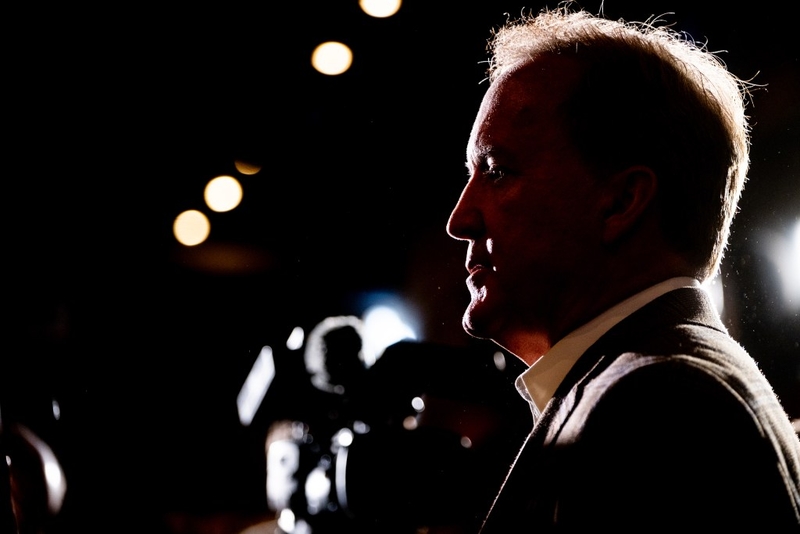
Attorney General Ken Paxton speaks at the Republic Icehouse in Tyler on Feb.16, 2026, as part of a campaign stop for his U.S. Senate bid. (Michael Cavazos for The Texas Tribune)
For the home stretch of his yearlong Senate campaign, Texas Attorney General Ken Paxton goaded his opponent, James Talarico, to “Come and Take It.”
On Tuesday night, Talarico did just that, handing Paxton his first ever electoral defeat in an election that decimated Republicans’ decades-long winning streak.
Despite months of polls projecting a Talarico win, Paxton’s loss came as a shock to both his supporters and detractors who have grown used to seeing the scandal-plagued candidate defy the odds and snatch victory from the jaws of defeat, time and time again.
Riding the wave of Texas’ growing hardline conservatism, Paxton rose from a legislative backbencher to the most prominent red-state attorney general in the country and a standard bearer of the modern Texas GOP. He built a national profile by suing the Biden administration more than 100 times, challenging the 2020 election results and waging culture wars on gender, abortion and immigration, all while weathering indictments, federal investigations and allegations of infidelity that would have felled even the toughest of fighters.
But Paxton had a preternatural talent for spinning disgrace into political momentum, painting himself as a victim of a political witch hunt orchestrated by Democrats and moderate, establishment Republicans. It was this narrative that pushed Paxton to challenge longtime U.S. Sen. John Cornyn, who had called Paxton’s legal troubles an “embarrassment to the party.” With an endorsement from President Donald Trump, Paxton won, installing himself at the top of the GOP ticket during what turned out to be the most difficult midterm environment for Republicans in recent memory.
After years of winning elections by catering to the most engaged, most conservative primary voters, Paxton proved unable, or unwilling, to knit together a broader coalition from across a party he helped to fracture apart. His ethical baggage, long dismissed as a down ballot sideshow, became harder to run from on the national stage. On Tuesday, he was dragged down further by a mass repudiation of Republicans across the state and nation.
“Paxton came onto the scene at a time when the Republican primary electorate wanted a fighter, someone to own the libs, no compromises, and we can overlook your flaws if you’re winning consistently,” said Cal Jillson, a political science professor at SMU. “After this, Republicans will still want a fighter — but a fighter that the other side can’t just take apart entirely in front of you.”
Paxton’s first forays into power
Paxton was elected to represent McKinney in the state House in 2002, just as Republicans were coming to dominate Texas politics. At the time, the Texas GOP was focused on cutting taxes and creating a friendly business climate, with the fresh memories of decades of Democratic dominance restraining some of their more ambitious goals on social issues.
Paxton initially laid low, focusing on getting things done for his district. Before he was reelected in 2004, the Dallas Morning News endorsed him, saying “we need more consensus builders like Paxton.”
He first made headlines not for his conservative stances, but for an early brush with the state’s ethics laws, when it came out in 2008 that he and two other lawmakers had not disclosed that they were “influential shareholders” in a police video equipment company that received millions in state contracts. In response, Paxton shifted all of his investments into a blind trust managed by a third party.
Meanwhile, the Texas GOP found itself in the early chapters of an internecine conflict that rages to this day. A new, more aggressively partisan wing of the party was rising to prominence, fueled by conservative Christians focused on divisive culture issues like gay marriage, abortion and prayer in schools.
Paxton picked sides early, staking out his position as the chief agitator on the right. In 2011, he made a long-shot bid to unseat then-House Speaker Joe Straus, running to the right of the moderate Republican from San Antonio. He ultimately gave up the challenge before it came to a public vote, but his ambitions were undashed. He was elected to the state Senate in 2012.
Jason Villalba, a fellow North Texas Republican, served in the Legislature at the same time as Paxton. He recalls Paxton being forthright about his intention to pursue higher office, which surprised Villalba and his legislative colleagues.
“He had no charisma. He was not well regarded and had gotten into a number of fights with other members, politically and otherwise,” he said. “Couple that with the stories we were hearing about defrauding his business partners and other legislators, and there was a sense that his overall character wasn’t impressive.”
But Paxton was cultivating support from the party’s maverick wing, especially its deep-pocket donors like West Texas billionaires Tim Dunn and Farris Wilks, who became known for supporting candidates unafraid of fighting culture wars. As the Tea Party took hold, Paxton pitched himself as an aggressive fighter not afraid to take on those across the aisle — and within his own party.
A year later, when then-Attorney General Greg Abbott announced his plan to run for governor, Paxton threw his hat in the ring to replace him. While he was running, The Texas Tribune revealed that Paxton had failed to report several business and professional relationships as required by law, and had been soliciting investment clients without registering for the Texas State Securities Board. He was disciplined and ordered to pay a $1,000 civil fine.
Paxton finished first in the attorney general primary but was forced into a runoff with state Rep. Dan Branch. In a foreshadowing of the 2026 Senate primary, Branch attacked Paxton’s ethics violations, while Paxton claimed Branch was a weak conservative. Paxton won the runoff by 30 points, then won in November by 20.
He didn’t get to enjoy the new office smell for long before another scandal hit. In August 2015, he was indicted on multiple felony charges stemming from his involvement with a North Texas technology company accused of defrauding investors. Immediately, Paxton cried political witch hunt, a claim echoed by some of his supporters in the growing grassroots arm of the party.
That indictment hung over Paxton for more than nine years, until he finally struck a deal with prosecutors, three weeks before he was set to face trial in 2024. He was ordered to pay restitution and do 100 hours of community service. He did not admit to wrongdoing, calling the episode “political prosecution.”
From under this cloud of suspicion, Paxton was reelected in 2018 by a narrow margin against Democrat Justin Nelson. He ran on his record of suing the Obama administration over environmental orders and immigration policy, as well as defending Texas’ conservative laws in court. The agency had become a major draw for conservative legal talent, with many of the recruits giving up lucrative private practice jobs to move to Texas and advance major GOP priorities through the courts.
But his legal problems were just beginning.
Paxton under fire
In 2020, a cadre of Paxton’s top aides went to the FBI and told them their boss was engaging in bribery and abusing his office to help a friend and donor, real estate developer Nate Paul. Paxton also directed Paul to hire a Senate aide Paxton was having an extramarital affair with, the aides reported. While several of the senior agency leaders who reported Paxton resigned, others were fired and later sued Paxton for violations of the Texas Whistleblower Act.
The allegations rocked the agency, and the broader conservative legal movement. Paxton’s accusers included Republican stalwarts with national party credibility, including Jeff Mateer who was general counsel for the First Liberty Institute, and David Maxwell, a former Texas Ranger. A handful of Republicans, including his former top aide, now U.S. Rep. Chip Roy, called for him to step down.
Paxton did not resign. Instead, just a few weeks later, he dragged the agency into another legal gray area, this time asking the U.S. Supreme Court to throw out the 2020 election results in four swing states.
The lawsuit, derided as “dangerous garbage” by election experts, was promptly rejected by the Supreme Court. The State Bar of Texas later sued Paxton for professional misconduct. (That suit was dismissed by the Texas Supreme Court in January 2025.)
But the long-shot lawsuit brought Paxton into President Donald Trump’s inner circle, solidifying the attorney general’s allegiance to the MAGA movement. He proceeded to file more than 100 lawsuits against the Biden administration, aiming to stymie the president’s priorities on immigration, abortion, the environment and the new hot-button issue, gender identity.
Paxton’s deluge of lawsuits made him a conservative cause célèbre, even as other parts of the agency’s responsibilities withered. His office led multistate lawsuits, filed amicus briefs on unrelated cases before the Supreme Court and began using novel tools to go after left-leaning policies and groups.
But with an indictment and federal investigation still looming, Paxton drew prominent, well-funded challengers in the 2022 primary. Then-Land Commissioner George P. Bush, the heir to the Bush dynasty, said he was running against Paxton because the embattled attorney general was the GOP’s “weak link.”
Even though Bush hammered Paxton on his ethical lapses and professional baggage, and argued they would make him an easy target for Democrats, the attorney general skated through a runoff and easily defeated civil rights attorney Rochelle Garza in the general election.
Then, several months into Paxton’s new term, the Republican-dominated Texas House dropped a bomb that would change the course of state GOP politics. In the final days of the 2023 legislative session, the GOP-dominated House voted to impeach Paxton based on the whistleblower allegations.
Paxton’s attorneys argued that this was a set up by establishment Republicans and Democrats looking to take down a MAGA fighter in his prime. The Senate held a two-week trial, in which Paxton’s alleged mistress briefly occupied the same chamber as his wife, state Sen. Angela Paxton, and luminaries of the conservative legal movement detailed his alleged abuse of office.
It seemed Paxton might actually be removed from office, with several Republicans considering voting to impeach, according to reporting at the time. But ultimately they voted to acquit, restoring Paxton to office and giving him another feather in his political persecution hat — and another mark of kinship with Trump.
An “arrogant” U.S. Senate bid
Weeks after he was acquitted by the Texas Senate, Paxton went on Tucker Carlson’s show to start settling scores. One of his first targets? Cornyn, and the Bush-era establishment Republicans who Paxton felt were out to get him.
“I can’t think of a single thing he’s accomplished for our state or even for the country,” Paxton said about the elder statesman who flipped the attorney general’s office red for the first time since Reconstruction in the late 1990s, before spending a quarter century in the Senate.
Cornyn, a well-liked incumbent, planned to run for another term. Paxton decided to challenge him anyway, setting up what ultimately became the costliest Texas Senate primary in history.
“Republicans up and down the ticket will pay the price of having an albatross like the corrupt attorney general hung around their neck,” Cornyn said in February. “We haven’t lost a statewide election in Texas since 1994, but we could this year if the wrong person is at the top of the ticket.”
Paxton whipped his base into a fervor, painting Cornyn as a moderate who had betrayed Trump and conservative values. He was empowered, not only by the acquittal, but by a number of his legal troubles resolving without action. He cleared up the fraud indictment with community service; the DOJ dropped the investigation into his former aides’ allegations; the State Bar complaint was dismissed; and the state, not Paxton, would be on the hook for the $6.6 million whistleblower payout.
When Paxton trounced Cornyn in an expensive, contentious runoff election, thanks in large part to a last-minute Trump endorsement, it seemed like the final triumph of the grassroots, conservative Christian arm of the party over the traditional Bush Republicans. Party leaders didn’t stop to assess why it was that Democrats were salivating at the chance to take on Paxton, Jillson said.
“You’ve got a Republican Party that has been in office for so long that it is arrogant and entitled, and it thinks you can put up poor candidates like Ken Paxton,” Jillson said. “Even though he’s a weak candidate, even though he’s got baggage, they can’t imagine not winning that office.”
Immediately, Talarico and national Democrats went in hard on Paxton’s record, focusing less on the tawdry details of the scandals and more on what it was costing average Texans battling an affordability crisis. New allegations kept piling up — that Paxton had potentially committed voter fraud, and partied in Dubai with convicted fraudsters, and spent tens of thousands of taxpayer dollars for a security detail on international travel. He was hammered for his office’s role in negotiating a light prison sentence for a child sex offender, and for skipping out on America’s 250th birthday celebration to take his new girlfriend on a trip to England. Questions emerged about how Paxton became a multi-millionaire while on a $150,000 a year taxpayer-funded salary.
“The Klieg lights are a lot brighter when you’re at the top of the ticket,” Villalba said. “He was able to win his previous races by just proving he was the most conservative, and that was all that mattered to the Republican primary voter. But he’s playing on the main stage now, and that baggage had an impact.”
Some former Paxton foes, as well as his ex-wife, said they would hold their noses and vote for the whole ticket. But Villalba, like some other moderate Republicans, said he couldn’t bring himself to cast a vote for Paxton. He endorsed Talarico, and said he heard from many others who were quietly planning to do the same.
Maxwell, the former Texas Ranger who was among the employees who reported Paxton to the FBI, cut an ad declaring his intention to cross the aisle and support Talarico. Glenn Rogers, a former state representative and lifelong Republican, said in an ad that he could “never trust Ken Paxton … the last place he should be is the United States Senate.”
Meanwhile, after two decades of races that were decided in the primary, Paxton struggled to translate his appeal to a general election audience. While Talarico moderated some of his previous stances and tried to woo independent voters, Paxton fell back on right-wing culture war issues and amplified online conspiracy theories about his opponent.
Even among his loyal base, he struggled to draw big crowds in a low enthusiasm year for Republicans. He cancelled a few of his home stretch stops, and rerouted the final stop of his bus tour, which was going to be at the Alamo.
Instead of the site of one of the state’s most historic defeats, Paxton concluded his yearlong campaign, and his two-decade political career, where it all began, in Allen, north of Dallas. In the two decades since that first campaign event, Paxton had helped lead a radical change in the Texas Republican party, from the genteel business-first Bush era, to the Tea Party, to the MAGA movement and, ultimately, the return of Democratic dominance at the statewide level.
“It all started for me right here,” he said on stage Monday night. “I’m so grateful that I get to finish here.”

Austin, TX