Missouri Senate Republicans choose new leaders as election losses reshape chamber
Nov 05, 2026 | 3:51 pm ET
Description
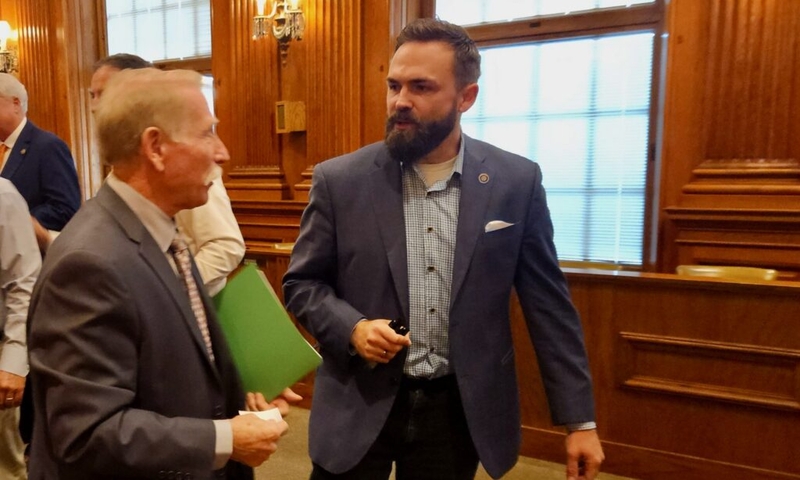
State Sen. Nick Schroer, a Republican from Defiance, right, speaks Thursday with state Sen.-elect Sam Alexander, a Republican from Bolivar, after being elected Senate Majority Leader for the upcoming session (Rudi Keller/Missouri Independent).
Missouri Senate Republicans will return to Jefferson City in January with fewer seats, a flood of newcomers and new leaders who say they heard voters’ frustration Tuesday — even as they have yet to settle on what to do about it.
Sen. Jason Bean, a Republican from Holcomb chosen Thursday to serve as Senate president pro tem, said the election results made clear the party needs to reassess its approach.
“They weren’t real fond of what we’ve been doing,” Bean said of voters. “So we’re going to look at changes.”
Sen. Nick Schroer, a St. Charles County Republican selected as majority floor leader, offered a more specific diagnosis: Republicans lost because they failed to deliver on their promises, not because their agenda was too conservative.
“Voters are sick and tired of spineless politicians that promise the world and produce nothing,” Schroer said.
Democrats, meanwhile, believe the election was a rejection of the GOP’s priorities, not simply its ability to accomplish them.
“Voters are screaming that they don’t like what Republicans are doing in Jefferson City,” said Democratic Sen. Stephen Webber of Columbia, who was chosen Thursday as minority floor leader.
The competing interpretations will help shape a legislative session that begins under significantly different political circumstances.
Democrats flipped two Senate seats Tuesday, defeating Republicans in eastern Jackson County and Springfield to end the GOP’s two-thirds supermajority. Republicans will hold 22 of the chamber’s 34 seats.
The losses were part of a broader Republican setback that also saw Democrats flip 16 House seats and end the GOP’s supermajority in that chamber.
‘We’ve got to listen’: Missouri Republicans confront fallout from historic election losses
House Republicans interviewed Wednesday were divided over whether their losses reflected national political headwinds or voters’ frustration with an unpopular legislative agenda. Some have urged the party to abandon personal pet projects and focus on issues that matter more to constituents.
Schroer rejected the suggestion that Republicans need to move toward the political center, arguing that even moderate GOP lawmakers suffered defeats Tuesday.
Democrats didn’t win on Tuesday, Schroer said, “I think, in my opinion, Republicans lost.”
He said Republicans should focus on delivering tax cuts, education reform and policies addressing public safety and the cost of living.
Bean was less willing to draw conclusions about what went wrong. Asked specifically whether he shared Schroer’s view that the party needed to be bolder rather than more moderate, he declined to embrace either interpretation.
“Let’s let the dust settle,” Bean said. “Let’s take a look at everything, look at what the people voted for, what they didn’t vote for.”
Republicans will gather next week in Kansas City to discuss their priorities for the coming session.
Webber argued the losses cannot be explained solely by a national political backlash against Republicans.
He pointed to the overwhelming defeat in August of Republican-backed proposals to overhaul the state’s tax system and make constitutional amendments harder to pass, followed Tuesday by voters rejecting a proposed abortion ban and a Republican congressional map.
“It was a national dumpster fire that Missouri Republicans poured gas on,” Webber said.
The election also imposed new constraints on the GOP’s legislative agenda.
Voters approved Amendment 6, which sharply limits lawmakers’ power to alter citizen-approved measures and prohibits them from weakening the initiative petition process. Any legislative proposal to change a voter-approved initiative now requires support from 80% of both chambers before going back to voters.
Schroer said Republicans still intend to pursue changes to the initiative petition process and policies aimed at restricting abortion, despite voters rejecting their proposals on both issues.
But he acknowledged Amendment 6 could complicate those efforts, saying attorneys are examining its legal implications and the possibility of a court challenge.
“What happens with Amendment 6,” Schroer said. “I think will dictate what happens with the life issue in and of itself.”
A Senate full of newcomers
Beyond the political disagreements, the new leadership team faces the practical challenge of managing a chamber in which nearly half the senators will be newcomers.
Bean said his immediate priority is building relationships, particularly among lawmakers who have never served together.
“I’m a big believer in getting to know people outside of politics,” he said, describing plans for dinners and opportunities for senators to learn about one another’s families.
He also wants incoming senators to spend time presiding over the chamber and learning its procedural rules.
Schroer, whose role as majority floor leader will give him control over which legislation comes up for debate, promised a “no nonsense” approach to negotiations.
“If you’re going to negotiate in bad faith, lying, you know, dragging your feet to try and address an issue, there are going to be consequences,” he said.
Missouri Republicans suffer biggest electoral setback in a generation
But he also stressed the importance of communication across party lines, citing his friendship with former Democratic Sen. Karla May of St. Louis as an example of lawmakers who can clash over policy while maintaining a productive relationship.
The budget could provide an early test.
Schroer said lawmakers must confront the state’s fiscal problems after years of spending he believes was excessive.
He pointed to video lottery terminal legislation as another issue that will require negotiations across party lines.
“The budget iss going to be key,” he said. “That’s one that we’re going to have to have buy-in from both parties.”
Sen.-elect Keri Ingle, a Lee’s Summit Democrat who defeated Republican House Speaker Jon Patterson on Tuesday, agreed that the budget should be a priority but blamed Republican fiscal policies for threatening public education and Medicaid.
She also identified child welfare as an opportunity for bipartisan cooperation, saying she intends to pursue recommendations from Gov. Mike Kehoe’s task force examining the state’s troubled child protection system.
“I certainly hope that people can put politics aside and do what’s best for the children of the state,” Ingle said.
Webber said he is optimistic about working with the incoming Republican leadership, provided the majority is willing to focus on affordability and public schools.
The enlarged Democratic caucus, he said, will bring additional experience and a stronger voice to those debates.
But the greater opportunity may come from the sheer number of new senators, giving both parties a chance to reconsider how the chamber operates after years of bitter partisan and intraparty disputes.
“I think it’s a really good opportunity for the Senate,” Webber said. “It’s an opportunity for us to sort of reset.”
The Independent’s Rudi Keller contributed to this story.

Jefferson City, MO