Kansas may surprise the nation and elect a Democrat to the US Senate. MAGA politics reshaped state.
Oct 11, 2026 | 4:33 am ET
Description
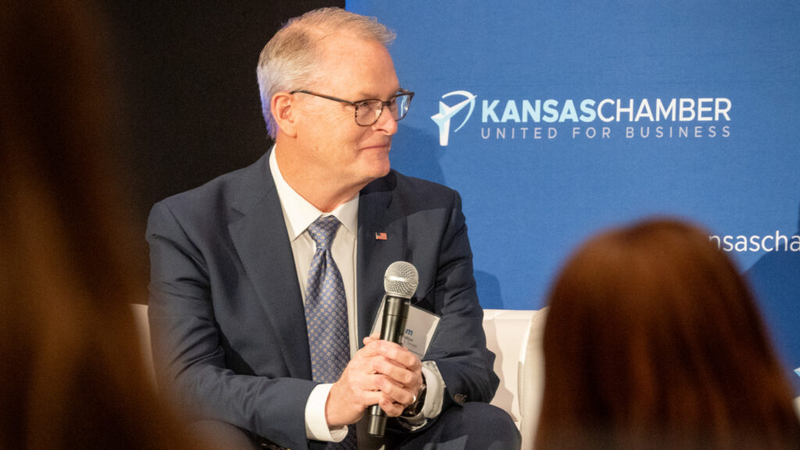
Adam Hamilton answers questions at a Kansas Chamber forum on Aug. 27, 2026, in Olathe. (Photo by Anna Kaminski/Kansas Reflector)
In 1932, Kansas voters elected Democrat George McGill to the U.S Senate. In the 32 senate elections since then, voters have consistently elected Republicans to represent them.
This historic streak makes Democrat Adam Hamilton’s bid to prevail in his challenge to the reelection of U.S. Senator Roger Marshall an uphill climb. However, Marshall’s embrace of MAGA politics has changed the dynamics of the race and given Hamilton a credible shot at a dramatic upset.
History shows that the leading GOP senators Kansas voters sent to Washington have been genuine legislators — pragmatic, problem-solving, middle-of-the-road Republicans who have chosen bipartisan solutions for public issues.
Adam Hamilton says “we need to stop the chaos and corruption in Washington by actually listening to people and working together to get things done for Kansas families.”
He vows to “lead from the middle” and avoid extreme positions on the right or the left.
His philosophy closely aligns with Kansas’ Republican senators over past years.
Let’s take a closer look.
Kansas voters have elected and reelected 11 individuals as Republican senators since 1932. The first four of those had served as governor of Kansas before their election to the U.S. Senate. Three of the four (Arthur Capper, Clyde Reed and Frank Carlson) had roots in progressive-era politics. They were activists and problem solvers who understood the give and take of the legislative process — experience that served them well in the U.S. Senate.
Kansas Senator Jim Pearson, first elected in 1962, was characterized by a dedicated staff member as a “man in the middle” who worked effectively with leading Senate Democrats.
Pearson and Democrat Walter Mondale initiated reform of the filibuster rule in the U.S. Senate, which eventually led in 1983 to lowering the threshold to close debate in the chamber from a two-thirds to a three-fifths vote.
As ranking member of the aviation subcommittee of the Senate Commerce Committee, Pearson joined forces with committee Democrats to establish an airport-airways trust fund, similar to the highway trust fund, to provide for modernization of the nation’s airports and airways, while also protecting the aviation industry in Kansas.
Bob Dole evolved over his five elections to the U.S. Senate, 1968 through 1992, from a fierce partisan and Nixon ally into a formidable bipartisan force to address critical issues and get things done.
In 1977, for example, Dole and Democrat George McGovern, respectively ranking member and chair of the Senate Agriculture Committee, worked hand in hand to build bipartisan support and substantially reform and expand the food stamp program.
Most importantly, in the early 1980s, Dole worked with Democrat Patrick Moynihan to break a legislative gridlock that eventually led to major reforms and secured future funding of Social Security.
Nancy Landon Kassebaum, first elected in 1978, partnered with Democrat Ted Kennedy in securing enactment of legislation that helped to assure that employees losing their jobs would not lose health insurance.
Kassebaum also championed the protection of public lands through the establishment of the Tallgrass Prairie National Preserve in the Flint Hills of Kansas.
Kansas Senator Roger Marshall stands in stark contrast to these Kansas senators. During his 10 years in congress, he has gravitated toward unyielding partisanship and become a proponent of MAGA’s culture wars.
Marshall lent critical support to Republicans’ One Big Beautiful Bill, which the Congressional Budget Office estimates will slash more than $1 trillion in spending from Medicaid and food assistance for the next 10 years, primarily by restricting eligibility for aid. Ten to 12 million people will be cut from Medicaid, and those qualified for food assistance will drop as well.
Marshall gave his approval to Trump nominees who were unqualified for their positions, such as Robert Kennedy Jr, Kristi Noem and Pete Hegseth, among others.
He has given unqualified support to Trump’s war on Iran, which has raised pump prices to $4 and diesel to $6. He has repeatedly voted to block congressional measures to end the war.
Marshall has stated that Trump’s chaotic on-again-off-again tariffs are working, when in fact those actions are elevating inflation at the grocery store for everyday Kansans. He appears to represent the Trump administration rather than Kansans in the U.S. Senate. He avoids public forums with Kansans, which he claims to be “dangerous.”
His partisan conduct has given Kansas voters a clear choice in the U.S. Senate race.
Voters may just choose to break from the streak of the past 32 senate elections and surprise the nation.
H. Edward Flentje is a professor emeritus at Wichita State University and formerly was director and professor in the Hugo Wall School of Public Affairs at the university. He has written and edited numerous publications, including most recently co-writing and co-editing “Reform and Reaction: The Arc of Kansas Politics.” Through its opinion section, Kansas Reflector works to amplify the voices of people who are affected by public policies or excluded from public debate. Find information, including how to submit your own commentary, here.
Topeka, KS