Judge rejects request for special prosecutor to investigate ‘Operation Midway Blitz’ abuses
May 21, 2026 | 7:37 pm ET
Description
A Cook County judge has rejected a petition for the appointment of a special prosecutor to investigate alleged abuses during Operation Midway Blitz.
CHICAGO — A Cook County judge on Thursday denied a petition to appoint a special prosecutor to investigate and prosecute alleged abuses by federal immigration agents during the Trump administration’s Chicago-focused “Operation Midway Blitz” mass deportation campaign last fall.
The ruling alleviates — at least for now — months of pressure on Cook County State’s Attorney Eileen O’Neill Burke to launch such probes herself.
Cook County Judge Erica Reddick sided with Burke’s long-argued position that her office has limited legal authority to initiate investigations without a request from law enforcement, ruling that the state’s attorney’s office “does not bear responsibility” for doing so, as those pushing for a special prosecutor had claimed.
Read more: Judge delays decision on special prosecutor for ‘Operation Midway Blitz’ to review new developments | Mid-May ruling set for special prosecutor demand to investigate alleged ‘Operation Midway Blitz’ abuses | Legal battle intensifies over appointing special prosecutor for alleged ‘Operation Midway Blitz’ abuses
“Since the state’s attorney does not have the authority to initiate a widespread investigation, it cannot be shown that the state’s attorney, at least at this point, has abandoned her duty,” Reddick said, echoing language from a March 12 petition seeking the appointment of a special prosecutor.
Crucially, the judge emphasized that even if a special prosecutor were to be appointed, that person would be subject to the same limitations as the state’s attorney. Reading her opinion from the bench, Reddick said that “if the state’s attorney does not have the authority” to initiate investigations, “a special prosecuting attorney would similarly be prohibited from doing so.”
But the judge also noted that petitioners gave compelling evidence that “many people in Cook County … were victims of criminal wrongdoing” at the hands of federal immigration agents, which she said was “violent and appeared to be unprovoked.”
Read more: Judge hesitant to grant dismissal of lawsuit over immigration agents’ use-of-force tactics in Chicago | Restrictions on federal immigration agents’ use of riot control weapons extended indefinitely
The group of more than 400 community leaders and elected officials who signed onto the petition had argued that Burke’s “inaction in the face of clear, premeditated crimes” both “abandons her duties” to Cook County residents and created a conflict of interest — the second condition necessary for appointing a special prosecutor to handle cases a state’s attorney can’t.
Lawyers for the petitioners argued Burke had a “political alliance” with federal law enforcement. They cited an internal email from August 2025 in which her then-spokesperson declined an invitation for Burke to sign onto a letter condemning President Donald Trump’s threats to deploy National Guard troops to Chicago.
The email expressed concern about the president’s “rhetoric” but said the office’s “top priority remains combating illegal guns, and to continue doing that effectively we need to maintain our excellent working relationships with the local ATF and other federal partners.”
Reddick on Thursday said that email and other comments from the state’s attorney “do not rise to a conflict of interest,” though she did note the statements may “raise questions.”
However, the judge pointed out that in February, Burke ultimately developed guidelines for handling future investigations of federal agents, which Reddick said indicated not only Burke’s willingness to take on investigations once forwarded from law enforcement, but also further diminished arguments that the state’s attorney has a conflict of interest.
The protocol, which was written with guidance from Illinois Attorney General Kwame Raoul, stipulates the state’s attorney’s Law Enforcement Review Unit can help investigate once a law enforcement agency “believes that there is sufficient evidence to support felony charging and is seeking felony review.”
Reddick also cited the state’s attorney’s recent commitment to taking on a case initiated by the Illinois State Police late last month over the fatal shooting of Silverio Villegas González in September. Villegas González was killed by a U.S. Immigration and Customs Enforcement agent during a traffic stop in Franklin Park, a near-west suburb of Chicago, just a week into Operation Midway Blitz.
Read more: Illinois State Police investigating fatal ICE shooting of Silverio Villegas González
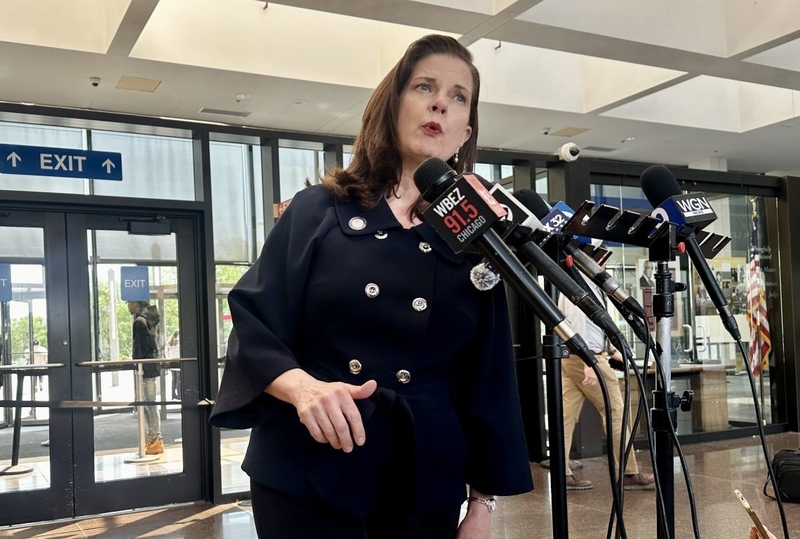
Speaking to reporters after Thursday’s ruling, Burke blasted the “meritless petition” to appoint a special prosecutor, saying she can’t direct law enforcement to do criminal investigations, but that the state’s attorney’s office is “open to bringing charges when it’s appropriate” — as a “second step” after a law enforcement investigation.
“So, if anyone says the state’s attorney’s office has abdicated her duty, they clearly do not have the facts,” Burke said. “That’s what Judge Reddick found today.”
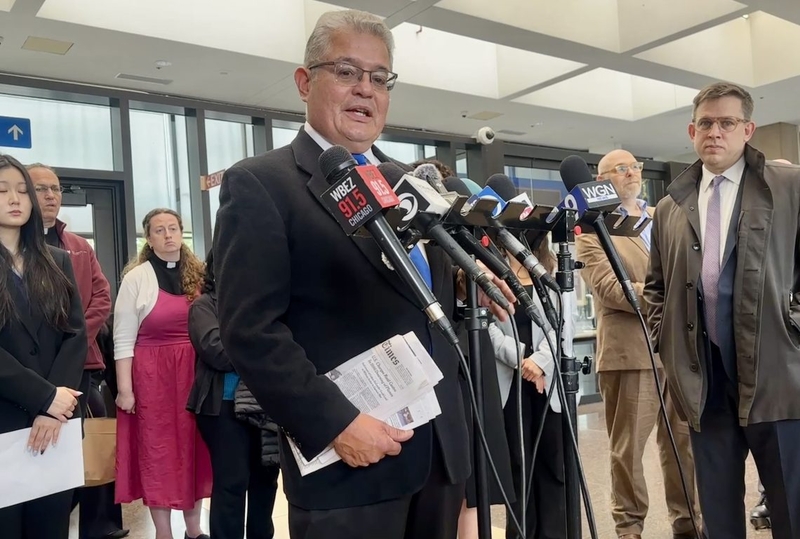
Lawyers pushing for a special prosecutor had a muted reaction to Thursday’s ruling. Locke Bowman, an attorney with Chicago-based civil rights law firm Loevy & Loevy, told reporters he “could not be more disappointed” by the judge’s ruling, characterizing Reddick’s reliance on Illinois Supreme Court precedent as “a path of technicality.”
However, he declined to directly answer whether the coalition planned to appeal Reddick’s decision, instead repeating that those who believed they were victimized by immigration agents during Operation Midway Blitz must go file police reports, which could then be forwarded to the state’s attorney’s office.
“Judge Reddick has told us the path that has to be taken, in her view,” Bowman said. “We have no choice now. We have no choice. We will not abandon the path. We will insist on accountability.”
During arguments over the petition last month, Bowman and his colleagues relied on a Freedom of Information Act request they’d filed with the Chicago Police Department seeking documentation of any Operation Midway Blitz-related investigations the police had initiated.
Former U.S. District Judge Rubén Castillo, who was appointed by Gov. JB Pritzker to chair the Illinois Accountability Commission to memorialize alleged abuses by federal agents in 2025, said the panel heard multiple occasions where civilian complaints to law enforcement didn’t result in anything.
Read more: Accountability Commission refers federal agents for investigation, possible prosecution for conduct last fall | State commission finds agent abuses were ‘greenlit by Washington’ for Operation Midway Blitz
“A lot of people went to police officers and were told by police officers, ‘There’s nothing we can do. Because they’re federal agents. We can’t investigate them,’” Castillo said. “So they did not write down the complaints, and that is why there’s no written record, but the oral complaints were made.”
Castillo said that includes the 911 call from Marimar Martinez, a Chicago woman who was shot by a U.S. Border Patrol agent five times in October, and vowed to “walk her to the police station myself” to submit a report.
Capitol News Illinois is a nonprofit, nonpartisan news service that distributes state government coverage to hundreds of news outlets statewide. It is funded primarily by the Illinois Press Foundation and the Robert R. McCormick Foundation.
Springfield, IL