Judge blocks Pinal County Attorney’s rogue ICE deal, says he exceeded his authority
May 15, 2026 | 9:26 pm ET
Description
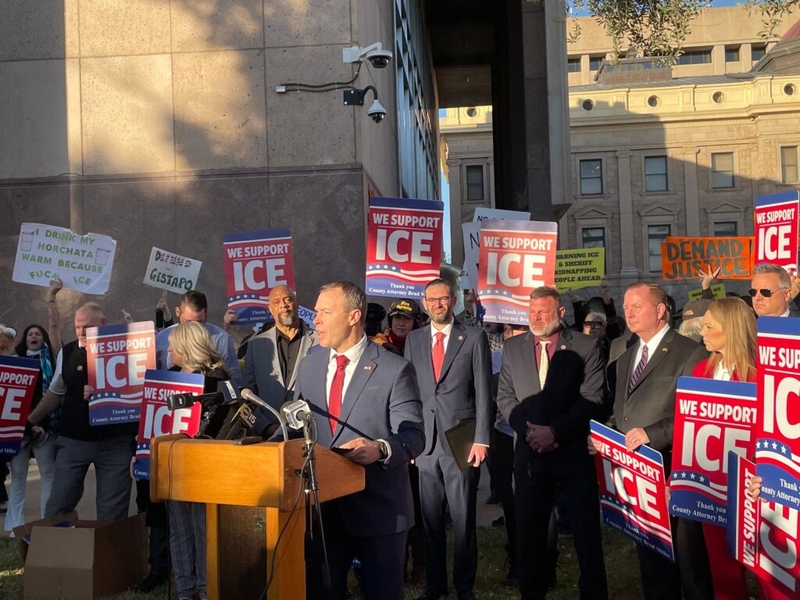
Pinal County Attorney Brad Miller speaks outside the Arizona Senate on Jan. 12, 2026, about upcoming legislation to criminalize interference with U.S. Immigration and Customs Enforcement. Protesters shouted him down, and Miller and GOP lawmakers had to retreat inside the Senate building to finish addressing the media. (Photo by Gloria Rebecca Gomez/Arizona Mirror)
A Maricopa County Superior Court judge on Friday shot down an attempt by Pinal County Attorney Brad Miller to use his office to help President Donald Trump’s mass deportation effort, blocking a partnership that would have turned the county attorney’s 10 investigators into de facto immigration agents.
After a nearly three-hour long hearing, Judge Michael Gordon issued his ruling from the bench, saying that Miller has no legal authority to enter into agreements with the federal government without permission from the Pinal County Board of Supervisors.
“The county attorney has exceeded his authority,” Gordon said.
The decision is a blow for Miller and other Republicans, who had been banking on a state law that bars local governments from “limit(ing) or restrict(ing) the enforcement of federal immigration laws” to open a path for immigration hawks to support Trump’s mass deportation campaign even in the face of opposition from governing bodies.
Last year, Miller entered his office into a 287(g) task force agreement with U.S. Immigration and Customs Enforcement. While Miller has said he views the agreement as mainly an opportunity to share information with the federal government, it expressly allows the county’s 10 investigators, who are responsible for building cases for the county to prosecute people who commit crimes in Pinal County, to question and arrest people they suspect of being in the country without authorization.
The vast majority of 287(g) agreements are between the federal government and law enforcement agencies. The Pinal County Sheriff’s Office, which also joined the lawsuit against Miller, has had its own agreement in place — and it has been approved by the board of supervisors since 2008.
Miller’s move to unilaterally enter into his own agreement alarmed critics, who warned that local criminal cases would go unprosecuted and county investigators would risk alienating witnesses and victims. After fierce public backlash, the board in January ordered Miller to terminate the agreement. When Miller refused to do so, the board and sheriff’s office filed a lawsuit.
PCAO: Arizona law “encourages” local involvement with federal immigration law
The key argument advanced by Miller’s legal team is that Arizona law prohibits the board of supervisors from restraining his ability to participate in federal immigration enforcement. State law bars any county, city or town from limiting or restricting the enforcement of federal immigration laws to “less than the full extent permitted by federal law.”
Republicans have sought to weaponize that statute, a remnant of SB1070, the state’s notorious “show me your papers law,” to challenge anti-ICE policies adopted in Phoenix and Pima County. Those challenges have so far proven unsuccessful, with Arizona Attorney General Kris Mayes concluding that, while the law forbids restricting federal immigration enforcement, it doesn’t mandate cooperation.
The lawsuit against Miller is the first time the law has been tested in court.
Linley Wilson, an attorney for Miller, argued that the lawsuit should be thrown out because the Arizona law that forbids the county from restricting federal immigration enforcement means it has never had a say in deciding when local officials like the sheriff or the county attorney can get involved in supporting federal immigration goals. The fact that the county approved the sheriff’s 287(g) agreement is irrelevant because the board never actually had the option to reject it, she said.
“The board does not have discretion to tell these officers in the executive branch what sorts of decisions they should make about federal immigration policy,” Wilson said.
Gordon was skeptical, saying he read the law as a prohibition on attempts to act against federal immigration authority, but not as automatically greenlighting a bid to get involved with enforcing it at the local level.
Wilson claimed it does both. She added that the law, which is referred to as the “preemption statute,” supplements and protects the supremacy of federal immigration law. And because federal law gives the U.S. Attorney General the ability to authorize partnerships between ICE and law enforcement agencies, that means that all Miller had to do was have his agreement approved for it to be valid under state law.
“Arizona law encourages cooperation in these agreements through the preemption statute itself,” Wilson said. “Although it’s framed as a prohibition, it implicitly authorizes political subdivisions to enter into these agreements if they are deemed qualified by the United States Attorney General.”
Can county attorneys enter partnerships, arrest people?
Wilson also sought to convince the judge that Miller’s position as the county attorney made him eligible to join a partnership with the federal government in the first place. The board’s attorneys argued that no state law authorizes Miller to enter into intergovernmental agreements or contracts without the board’s permission, voiding the 287(g) agreement entirely.
Federal law surrounding the adoption of 287(g) agreements describes them as partnerships between ICE and the “state or any political subdivision of the state.” Under Arizona law, the board of supervisors is the state’s political subdivision, not the county attorney. And state law also explicitly reserves the ability to enter into intergovernmental agreements to a county’s governing body, not its executive officers.
Wilson argued that federal law has a broader understanding of what constitutes a “political subdivision” and said that the approval of Miller’s 287(g) agreement means his office has effectively been recognized as one. She pointed out that the sheriff’s office’s own agreement is further proof that Miller’s office counts as a political subdivision with the ability to sign onto federal partnerships.
Gordon grilled Wilson on how the county attorney’s office can fulfill the demands of the task force agreement, which includes the authority to make arrests. Wilson replied that the job descriptions of county investigators also include the ability to arrest people, if necessary, and she pointed out that the board has long approved budgetary language including that fact. And while state law doesn’t expressly outline arrest authority in the list of a county attorney’s enumerated powers, it’s implied, Wilson said.
“His duty to conduct prosecutions necessarily implies arrest authority to aid in prosecution,” she said.
Wilson argued that arrest powers aren’t exclusive to the sheriff, pointing out that FBI and ICE agents often conduct arrests across the state without being regarded as encroaching on the powers of local law enforcement agencies.
Board: implied powers don’t count
The bulk of the argument from the attorneys for the board of supervisors centered around pointing out that Miller’s claims were speculative, and that the powers they claimed he has don’t exist in state law — and are actually explicitly granted to either the board or the county sheriff.
Attorney Brett Johnson said that if the state legislature wanted to make Miller’s office a political subdivision of the state or imbue his position with the power to make arrests or enter into agreements without the board’s input, it would have done so. He noted that the ability of investigators to make arrests is limited — they must first be approved by a magistrate — unlike the power granted to sheriffs, who can conduct arrests based on a reasonable suspicion.
“If the legislature wanted to give that arrest authority to the prosecutor or the dogcatcher or the recorder or the treasurer, the legislature knew how to do it because the legislature gave it to the sheriff,” Johnson said.
And Johnson dismissed the idea that the preemption statute encourages involvement in federal immigration enforcement actions, calling the argument a “red herring” raised to distract from Miller’s unlawful decision to enter into an intergovernmental agreement. The board hasn’t even had the opportunity to act on the agreement, he added, because Miller never presented it to the board for a vote.
In opposing the 287(g) agreement, the board isn’t infringing on federal immigration enforcement, Johnson said, but rather reining in a rogue official.
“We’re ‘hindering’ an individual’s unilateral decision to make up a power that he doesn’t have and then say, ‘You can’t stop me from using this because of this statute,’” he said.
In a last-ditch effort to preserve Miller’s 287(g) agreement, his legal team claimed that it doesn’t qualify as an intergovernmental agreement — which only the board can adopt — because it’s entitled a “Memorandum of Agreement.” But Johnson rebutted that it meets all the criteria to be regarded as an intergovernmental agreement under Arizona law, including a termination clause, purpose, financial considerations and an expiration date.
Judge blocks 287(g) agreement
Gordon, who is retiring at the end of the month, provided his ruling minutes after the attorneys wrapped up their arguments. He said he was unconvinced that Arizona’s preemption law invalidated the lawsuit and approved a permanent injunction against Miller’s 287(g) agreement.
Earlier in the hearing, he pressed Wilson over whether preventing Miller’s office from operating under the agreement would make a difference to its ability to cooperate with federal immigration officials. At the start of litigation, Miller agreed not to use the agreement to carry out arrests and to limit his office’s involvement with it to information sharing.
Wilson argued that forcing Miller to terminate the agreement would negatively impact his ability to share that information, but Gordon said he was unconvinced, and his final ruling reflected that he didn’t believe the county attorney’s ability to communicate with the federal government would be significantly impeded.
Gordon added that the Pinal County Attorney’s Office is not a political subdivision under Arizona law, so it has no power to enter into intergovernmental agreements on its own. And in doing so, he said, Miller was infringing on the powers of other elected officials. The judge ordered Miller to stay within his enumerated authority.
“The county attorney is intruding upon authorities authorized and provided to the sheriff and is also exposing the county to additional liability,” Gordon said. “I find there is harm that cannot be remedied because of those issues, and it advances public interest and public policy to require that the county attorney comply with his statutory obligations and to stay within his statutory authorization.”
Gordon acknowledged that the state’s public policy, as determined by the Republican-majority legislature, is in favor of promoting local involvement with federal immigration enforcement. But he said that because the preemption statute doesn’t include a way for officials like Miller to enter into partnerships with the federal government on their own, other state laws control the legal landscape instead.
“The court acknowledges that there is a contravening public policy, as expressed by the legislature in (state law),” he said. “Because that statute does not authorize the independent entering into an (intergovernmental agreement) in this case, it is overridden by the other public policies.”
In a post on social media, the Pinal County Attorney’s Office signaled it is considering an appeal. The statement reiterated that Gordon’s ruling prevents the agency from sharing information with federal officials and claimed it will negatively impact public safety.
“The Pinal County Attorney can no longer share information with federal officials under the Task Force Model agreement to assist ICE in locating and arresting dangerous violent criminals in the community before they commit a crime,” reads the statement, which included the emphasis. “Instead, we must now wait until those individuals create another victim and end up back in jail on a new charge under the Sheriff’s Jail Agreement.”
Phoenix, AZ