Jewish woman’s challenge of Kentucky’s abortion ban gets green light from appeals court
Jul 15, 2025 | 1:42 pm ET
Description
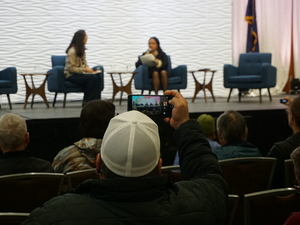
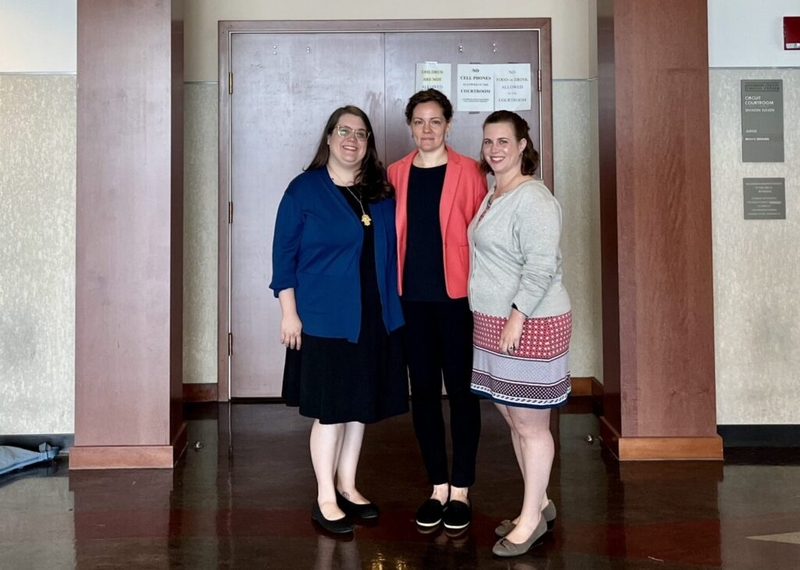
Plaintiffs Lisa Sobel, right, Sarah Baron, center, and Jessica Kalb, left. (Kentucky Lantern photo by Sarah Ladd)
A Court of Appeals panel has ruled that one of three Jewish women suing the state has standing — the right — to challenge Kentucky’s abortion ban.
Chief Judge Larry E. Thompson and judges Susanne M. Cetrulo and Jeff S. Taylor all agreed on Friday: two of the three women — Lisa Sobel and Sarah Baron — don’t have standing, while the third, Jessica Kalb, does.
This is because Kalb has nine frozen embryos right now that she’s paying to preserve as part of the in vitro fertilization (IVF) process and doesn’t know how she can proceed with the process under the state’s restrictions on abortion and definition of life.
Kalb also canceled having an embryo implanted in 2022 “due to her uncertainty surrounding Kentucky’s abortion laws,” according to the ruling, shared with the Lantern by the women’s lawyers.
The case now returns to Jefferson Circuit Court, where Judge Brian Edwards can rule on its merits rather than the issue of standing. Standing is the question of whether plaintiffs’ circumstances meet legal standards entitling them to challenge the law. In 2023, the Kentucky Supreme Court ruled that abortion providers could not challenge the ban on behalf of their patients. The U.S. Supreme Court, too, has avoided ruling on the merits of abortion bans and instead focused on standing.
‘Between rock, hard place:’ Will anyone ever have standing to challenge Kentucky’s abortion ban?
One of the lawyers, Benjamin Potash, said the women’s legal team doesn’t agree with the decision that Sobel and Baron don’t have standing, but “we’re happy to move forward with what we’ve got.”
“I think what we’ve got now is a very solid chance of clearing up this ambiguity in the law and making this law a little bit fairer for everyone involved,” Potash said.
In a statement shared with the Lantern, Kalb said “I need to call on everyone who stands for religious freedom, women’s rights and those who believe medical decisions should happen in the sacred space between a doctor and their patient to stand with us as we try to explain why these laws are unjust.”
“I want so badly to grow my family. The current (presidential) administration has claimed to support IVF without understanding how limiting my access to reproductive healthcare is damaging,” Kalb said. “The fact that lawmakers who don’t understand healthcare or my religious beliefs have more rights to my body than I do is sickening.”
Attorney General Russell Coleman, who is a defendant in the case, said in a statement that “Kentucky law is clear” on this issue.
“Access to IVF is fully protected for Kentuckians hoping to grow their families,” Coleman said. “We are confident the circuit court will agree once again.”
‘Not a speculative issue’
Kalb previously told reporters that she has polycystic ovary syndrome (PCOS), which can cause cysts to form in the ovaries and lead to infertility. This condition also means her pregnancies are more likely to end in miscarriage and that she might need an abortion or other complicated interventions.
Under the state abortion ban that took effect in 2022 after the U.S. Supreme Court overturned the federal right to abortion, a patient must be at risk of death or the permanent impairment of a vital organ.
Meanwhile, “Ms. Kalb is paying money to keep the embryos frozen,” the appeals court ruling states. “Should she continue to do so in perpetuity because the government will not clarify what she can and can’t do with them? No.”
She “needs the court to clarify her rights,” the ruling states.
“This is not a speculative issue because these embryos currently exist, and Ms. Kalb is entitled to know her options without fear of potential legal peril,” the judges wrote. “As to Sobel and Baron, there is no impending threat.”
Sobel said she has mixed feelings about the ruling that she and Baron lack standing to challenge the abortion ban.
“On the one hand, I am glad that the case is moving forward, and I can understand why they supported Jessica in having standing because she does have frozen embryos currently,” she told the Lantern. “On the flip side, though, it feels like they don’t fully understand how the process of IVF works.”
Sobel is 41 and wants another child, but attempting to have one is a “gamble,” she said. During her first round of IVF, she got four embryos, none of which were viable, she said. In her second round, she got two embryos.
“I transferred both of those, and only have one living child,” she said. “Knowing that I create non viable embryos more so than I create viable embryos, I don’t want to start down that financial and emotional burden until I understand what the law truly means for somebody like me.”
Sobel said the ruling that she doesn’t have standing to continue in the case leaves a “big hole” in her community. She is hoping the remaining defendant’s case can proceed quickly and offer her clarity.
“We hope that (Edwards) will feel pressure to give us a ruling sooner, because our lives are on hold,” Sobel said. “I’m not getting any younger. I’m 41 now, and through the miracles of science, I can probably have a child up until I’m 50. But … we know that that brings extra complications to it, just because of pure biology.”
‘Preference to Christian values’
The women have argued that Kentucky, in heavily restricting abortion, has imposed and codified a religious viewpoint that conflicts with the Jewish belief that birth, not conception, is the beginning of life.
In other words, the appeals court said, they allege the state is “giving preference to Christian values to the detriment of their Jewish faith.”
The attorney general’s legal team argued in court that since Kentucky’s law defines pregnancy as a fetus inside a woman, disposing of embryos created during the IVF process doesn’t fall under abortion purview.
The women’s lawyers, on the other hand, contend that isn’t clearly defined in the law.
In the coming months, Potash said, the team will need to clear “procedural hurdles” and eventually hold oral arguments again focused on the merits of the case, not standing. Meanwhile, he’s happy the appeals panel found “very little nuance” in Kalb’s standing.
“We did not have a liberal panel; we did not have a conservative panel. We had a little bit of everything: we had a woman judge; we had two men judges,” Potash said. “We had liberals, we had conservatives. And what it boiled down to is that they studied the law and they got it right. And you can’t ask for more from judges than that.”
Even though she doesn’t have standing to continue in the IVF lawsuit, Sobel said she will stand “shoulder to shoulder” with Kalb as the case progresses.
“The IVF community is waiting,” she said. “The Jewish community is waiting to know how this lawsuit will pan out, and we deserve a ruling.”
Frankfort