The JAIL Act: Political theater disguised as public safety
Feb 21, 2026 | 6:03 am ET
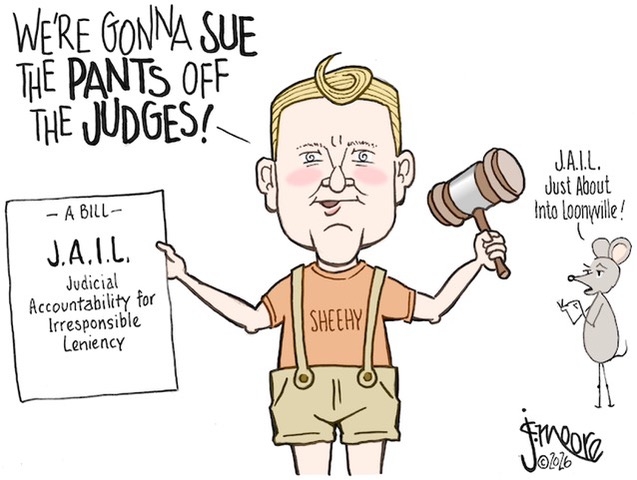
Description
Cartoon by John Moore.
Sen. Tim Sheehy, a Republican from Montana, has introduced a bill that is unconstitutional on its face, unworkable in practice, and breathtakingly unserious in purpose. The Judicial Accountability for Irresponsible Leniency (JAIL) Act is not a good-faith attempt to make communities safer. It’s political theater—red-meat legislation designed to thrill a far-right base that prefers blame over solutions, and slogans over law.
This isn’t leadership. It’s a stunt.
The premise of Sheehy’s bill is simple-minded and seductive: When violence happens, find a villain in a robe. Judges, he argues, are the real problem—“soft,” “radical,” and supposedly responsible for crime because they don’t keep enough people locked up, long enough, without bail. Reality, the Constitution, and 150 years of settled law be damned.
Here’s the inconvenient truth Sheehy seems eager to ignore: Judges are not fortune tellers. They make bail decisions based on evidence, statutes, constitutional requirements and the presumption of innocence. Sometimes terrible crimes still happen. That tragedy does not magically convert a judicial decision into negligence, much less grounds for personal civil liability.
And since the Senator appears to need a refresher, let’s offer one.
The presumption of innocence is not a trendy talking point invented by defense lawyers last Tuesday. It is older than the United States. Older than the Senate. Older, frankly, than most of the political outrage machine now fundraising off it.
Roman jurists understood the danger of punishing first and proving later. English common law absorbed that lesson. Enlightenment thinkers made it explicit: The state must prove its case; the individual does not have to prove a negative. By the time America was founded, the idea was bedrock.
William Blackstone—whose writings shaped American law—put it plainly: Better that 10 guilty persons escape than that one innocent suffer. That principle is not softness. It is civilization.
The Framers built that protection into the Constitution through due process and fair trial guarantees. The Supreme Court said it outright in Coffin v. United States: The presumption of innocence is a foundational principle of American criminal law.
Translation for the JAIL Act crowd: We do not lock people up because we’re nervous. We do not detain citizens because a politician wants applause. We do not treat accusation as conviction.
Presumed innocent means presumed innocent. Not “innocent unless Twitter is mad.” Not “innocent unless it’s an election year.” Innocent.
If Sheehy believes judges should jail people simply because they might commit a crime someday, he is not arguing for public safety. He is arguing for preventive detention untethered from proof. That is the logic of authoritarian systems, not constitutional democracies.
Fear is not evidence. Outrage is not proof. A tragic outcome is not retroactive guilt.
But never mind that pesky Constitution. Sheehy’s bill explicitly strips judicial immunity, a cornerstone of judicial independence recognized by the Supreme Court since the 19th century. Courts have been crystal clear: Judges cannot be sued for decisions made in their official capacity—even wrong ones, even unpopular ones. Congress does not get to repeal the Constitution by naming a bill “JAIL” and hoping voters don’t notice.
This is politics at its worst—and a politician at his worst.
Instead of grappling with the real, complex causes of violence in America, Sheehy chooses a scapegoat — judges. The reality is much more difficult: Too many guns, too easily obtained. Guns in the hands of people with histories of violence. Untreated mental health and substance use disorders. Poverty. Housing instability. Trauma. Lack of opportunity. Underfunded schools. Threadbare social services. None of that fits neatly on a bumper sticker, so out it goes.
Blaming judges is easier than governing. Suing judges is easier than legislating. Yelling “lock them up” is easier than building a safer society.
If the JAIL Act were somehow passed and upheld—an almost laughable hypothetical—the consequences would be disastrous.
First, good luck finding anyone willing to serve as a judge when every ruling comes with a personal financial gun to the head. Second, expect a massive expansion of pretrial detention, exploding jail populations, and billions in new costs to taxpayers. Third, watch as more of our neighbors, friends, and family members—innocent and guilty alike—sit in jail simply because judges are terrified of being sued.
That’s not public safety. That’s fear-based governance.
Here’s a radical idea: Instead of investing in more jails, let’s invest in people. Affordable housing. Accessible healthcare. Mental health treatment. Schools, libraries, and safe activities for kids. Evidence-based violence prevention. And yes, common-sense gun regulations that reduce risk without shredding the Constitution.
Senator Sheehy could choose to do the hard work of governing. Instead, he’s chosen to play judge-and-jury in the court of political outrage.
It may make for good applause lines.
It makes for terrible law.
Blame is easy. Governing is hard. Senator Sheehy chose easy.
Helena, MT