It’s not (just) location: Why gas is so high in NV even though US is a net exporter of oil products
May 13, 2026 | 8:52 am ET
Description
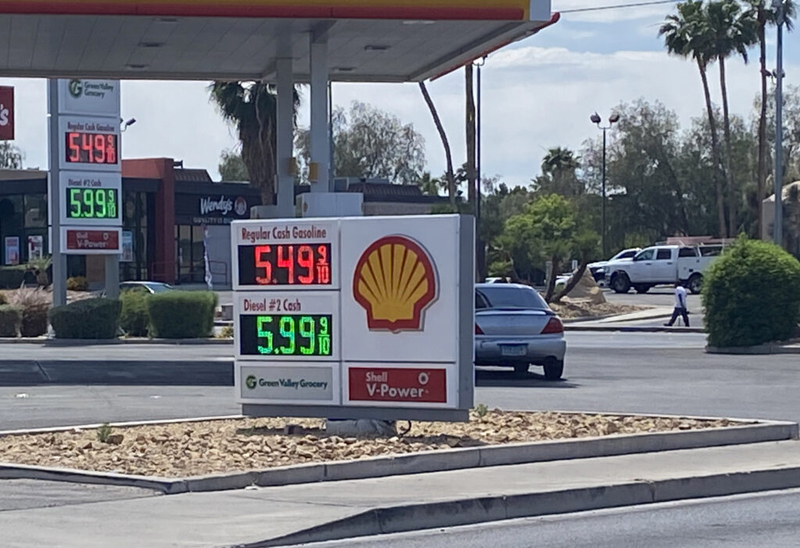
(Photo: Hugh Jackson/Nevada Current)
Regular unleaded gasoline was 29% higher in the U.S. in April than it was in April 2025, according to consumer price index (CPI) data — the inflation report — released by the Bureau of Labor Statistics Tuesday.
Relatedly, airline fares are 21% higher than they were a year ago, an increase driven primarily by the cost of jet fuel, according to the CPI report.
The U.S. exports more petroleum products than it imports. Thanks in part to that domestic production buffer, the impact of the Iran war on fuel prices is not nearly as painful in the U.S. as it is in African, Asian, and European nations.
But it is still deeply troubling for U.S. households, especially in Nevadan and other Western states which are captive to the California gasoline market.
The overwhelming majority of gasoline purchased in Nevada is refined in California. Critics in both states argue California’s environmental regulation of both the oil industry and auto emissions make refining more costly, which in turn has been blamed for refineries closing in California.
Since sufficient infrastructure for alternative supplies was never developed, Nevada remains bound to the California market, and Nevadans typically pay about 20% more for gas than the national average.
The U.S. is a net exporter of petroleum products primarily because it exports a tremendous amount of liquefied natural gas.
But the U.S. is still a net importer of crude oil.
Nevada Republican Gov. Joe Lombardo is among those who have suggested California environmental policies are as much if not more to blame than Trump’s war in Iran for spiking gasoline prices in Nevada.
Last year, 23% of the oil refined in California was drilled in California, according to the California Energy Commission. Another 16% came from Alaska. The rest came from Canada, South America, Guyana, and the Persian Gulf states of Iraq, Saudi Arabia, and United Arab Emirates.
The Gulf states together accounted for nearly a third of oil refined in California in 2025.
Refineries throughout the U.S. also rely on imported crude, at least partially, to use to blend with domestic oil while making assorted products (regular gas, diesel, jet fuel, etc.).
When U.S. refiners import crude oil from other nations, they are competing with purchasers the world over, and have to pay a price that is being set by the international market.
As it was in the 20th century, the U.S. oil (and gasoline) market remains intertwined with and reliant on global oil shipments. That’s why the average price of gas in Nevada, according to AAA, is about $1.20 per gallon higher than it was a year ago, and why gas prices are higher not just in Nevada, but around the nation and the world.
At least two fuel companies are exploring pipeline expansions that would help Nevada wean itself from such heavy reliance on the California gas market. That effort is lauded by state officials from the standpoint of reliability, and also as potential means to put Nevada’s gas prices a little more in line with national averages.
Meanwhile, unleaded gas and jet fuel weren’t the only costs to see substantial increases in the most recent CPI report.
Coffee was 18% more expensive last month than in April 2025. Other items with year-over-year double-digit percentage increases include video streaming service (17%), steak (16%), jewelry (16%), computer software and accessories (14%), and fresh vegetables (11.5%), the latter largely driven by the whopping increase in the price of tomatoes (39.7%).
Like many other items, from car parts to dishes, the tomatoes especially reflect higher diesel (transportation) costs combined with another inflationary consequence of U.S. policy: tariffs.

Las Vegas, NV