ITC seeks public input on power line project as landowner opposition persists
Jun 09, 2026 | 4:40 pm ET
Description
Getty Images
In the next phase of a project aimed at expanding electricity transmission across the midwest, a Novi-based company is planning a new route which would stretch from Oneida Township in Eaton County to Cohoctah Township in Livingston County.
In 2024, the Midcontinent Independent System Operator, or MISO, approved the second tranche of its plan to improve energy reliability in the midwest by developing a 765 kilovolt backbone encompassing 3,631 miles of transmission. As part of the $21.8 billion plan, ITC, which owns the energy transmission system for much of the Lower Peninsula, is aiming to build a new 50-mile line connecting its Oneida substation to a new station in Livingston County.
Under Michigan law, any transmission company looking to build a line that’s longer than five miles with a voltage of 345,000 volts or more must seek a Certificate of Public Convenience and Necessity from state energy regulators, ITC Michigan President Charles Marshall told reporters on Tuesday.
As part of that process, the transmission line owner must file a construction plan with the Michigan Public Service Commission, provide that plan to any impacted municipalities and offer to meet with their highest elected official, and host public meetings in each municipality where they would build a transmission line.
In order to file their application with the public service commission, the company needs to identify a preferred route and alternatives, Marshall said, pointing to community engagement as a way for the company to collect information and refine their routes.
Ben Tirrell, a regional manager for local and government affairs for ITC, said community conversations on the project started with local officials and community leaders in 2025.
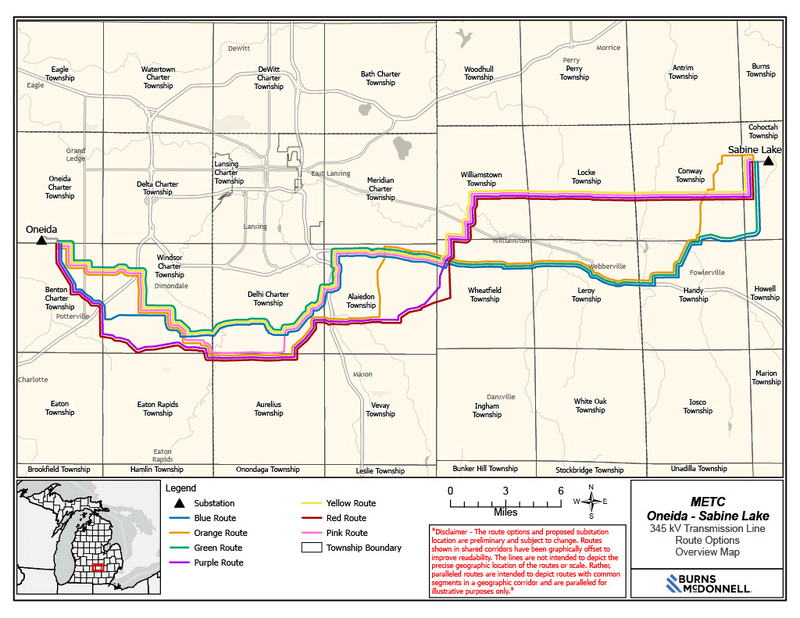
“We invited them to meetings to share their perspectives. We presented them with a blank map of really the greater Lansing region and asked them what type of things ITC should consider. What are areas that we should avoid, where would there be potential opportunities for such a line, and took all that information back,” Tirrell said, telling reporters that input was used to develop a series of proposed routes across the region.
More community meetings were held in January and February of this year, and will continue as the company hosts a series of landowner open houses in July for anyone living within a mile of the proposed routes. After that, the project will move to its final stage of public engagement, Tirrell said, which is expected to begin in the first quarter of 2027.
According to the project’s spring newsletter, the company plans to file its construction plan this fall, with public meetings to follow in 2027. After those meetings, ITC will seek siting authority to build the project and the Michigan Public Service Commission will review and approve a final route.
Tirrell also pointed to the project’s public feedback dashboard, where residents can identify specific areas and locations along the proposed routes and leave a comment. They can also provide comments via email.
“I think as a company our goal was to meet folks where they are and trying to engage them and get their input on this project,” Tirrell said.
Past concerns on engagement continue to simmer
While seeking the go-ahead on two previous projects, approved by MISO in 2022, ITC, doing business as as the Michigan Electric Transmission Company, drew the ire of many residents and was reprimanded last year by the Michigan Public Service Commission for a lack of public engagement over the projects, with one commissioner saying “it would be generous to call METC’s public engagement lackluster.”
Paramount among those residents’ concerns was whether their land would be seized through eminent domain, a government’s power to take property for public use while providing just compensation.
In response, the commission developed new voluntary guidelines to improve public engagement.
During their previous applications to the commission, Marshall said there were lessons learned and the company had taken a step back to reevaluate and revise its approach to public engagement.
Stephon Bagne, an attorney at the Clark Hill Law firm representing 140 parcels of land impacted by those projects, told Michigan Advance on Tuesday he’s already received outreach from individuals who may be impacted by the Oneida-Sabine Lake project.
In his experience, Bagne said he’s found public engagement generally ends with property owners getting upset earlier, as utility companies have a fairly standard playbook for getting the right of way for their projects.
“A lot of times that community engagement is telling only one side of the story, in an effort to get property owners to sign away their rights without knowing what they’re signing away or oftentimes giving away,” Bagne said.
Property owners who engage with professional right-of-way agents face a tremendous disadvantage as eminent domain is a highly technical area of law, Bagne said.
“Here’s my analogy: If you’re having problems with your heart, you’re better off going to a podiatrist than nobody,” Bagne said. “But if you’re faced with an eminent domain acquisition, if you go to an attorney who doesn’t specialize in eminent domain, that’s the equivalent of going to the podiatrist. And not going to anybody is the equivalent of going on Chat GPT and thinking that you can solve your heart problem by taking some aspirin.”
For property owners whose land sits along the proposed routes, Bagne emphasized that there are substantial benefits to not just having their own counsel, but counsel for as many people as possible, noting that having more people on board creates more negotiating leverage.
“Whether it’s me or some of my friendly competitors, there are attorneys who specialize in representing these property owners, we do it on a contingent fee basis,” Bagne said. “We don’t charge people to hire us.”
Additionally, legal counsel can help landowners identify the legal matters that are outside of their control, Bagne explained.
“If there’s things that they can’t do anything about, it’s better for them to know that from somebody who’s on their side,” Bagne said, explaining that while Michigan is not particularly friendly to landowners seeking to halt a project, it is among the friendliest when it comes to just compensation issues.
Williamstown Township and Meridian Township, two communities located along the proposed transmission routes, have adopted resolutions opposing the construction of new lines in their communities. However, a certificate from the Public Service Commission like the one required for the Oneida-Lake Sabine project preempts local zoning, Bagne said.
“Those type of resolutions are largely symbolic,” Bagne said.
Lansing, MI