Immigrant rights lawyers send complaint to ICE over conditions at North Lake detention facility
May 15, 2026 | 4:00 am ET

Description
The North Lake Processing Center in Baldwin, Michigan. April 21, 2026 | Photo by Erick Dia Veliz/Michigan Advance
The mother of a man detained at the North Lake Processing Center, an ICE detention facility in Baldwin, Michigan, said Thursday that she has not spoken to her son since the end of November. She’s had to use detainee locator tools just to figure out if he is alive. His mental and physical health have now deteriorated to a point where he has gone completely mute and cannot communicate, she said.
“It’s been an undescribable torture,” she said in her native Spanish, translated for reporters in a news conference organized by the ACLU and the Michigan Immigrant Rights Center.
The mother was only identified as Heydi C. in the conference out of fear of potential retaliation against her or her son by ICE or staff of GEO Group, who owns and runs the detention center.
Michigan Immigrant Rights Center provided Michigan Advance documentation verifying that he was detained at the North Lake detention center.

Ruby Robinson, a senior managing attorney with the Michigan Immigrant Rights Center, which represents her son and many other Baldwin detainees, also told reporters that he has gone mute.
In January, she was told that her son, who has been transferred from North Lake to facilities in Florida, Texas and Louisiana, would be deported. He has not been deported and is currently detained in Louisiana after returning to the Baldwin facility for a short period.
On that phone call, she said, “The worst pain was having to hear my son there completely sedated and out of it.”
As of Thursday, the Michigan Immigrant Rights Center said that they had been told by ICE Enforcement and Removal Operations that Heydi’s son had been moved to a dedicated medical facility in order to receive additional care.
“We appreciate that ICE is now taking his care seriously but it does confirm that North Lake was not equipped to handle his needs over the past eight months,” Christine Sauve, a spokesperson for the organization, said in an email.
The ACLU of Michigan and the Michigan Immigrant Rights Center have sent a letter to Kevin Raycraft, the director of ICE’s Detroit Field Office, filing a complaint that the constitutional and legal rights of detainees in Baldwin are not being met.
The letter states that those denied rights include access to adequate medical care, access to legal counsel and visitation rights, and access to judicial proceedings.
“We recognize that operating a large detention facility housing a significant number of individuals presents logistical challenges,” it reads. “However, these challenges do not diminish ICE’s obligations to ensure that all individuals in its custody receive adequate medical care and meaningful access to counsel, as required by the Constitution and federal detention standards.”
ICE did not respond to a request for comment on the letter.
Most of the kinds of retaliation that we see involve sort of taunting or bullying from staff members or placing someone in isolation or solitary confinement. Those are the kinds of measures that we see.
Robinson noted that over the past year — the facility in Baldwin reopened as a detainment center in June 2025 — the number of people in ICE custody in Michigan has increased six-fold.
“People in our communities are being arrested and detained at unprecedented rates and fewer people are being released from detention. With more people detained for longer periods of time, the care they received during their detention is critically important,” he said.
But that care is not being provided, said Ewurama Appiagyei-Dankah, the West Michigan Legal Fellow at the ACLU of Michigan. She told the story of a mother in her 40s who was not getting necessary blood pressure medication at regular intervals. That led to her experiencing heart palpitations and she eventually collapsed in a hypertensive emergency. Detention center staff ignored her attempts to ask for medical attention until she had to be hospitalized, Appiagyei-Dankah said. The woman has since been released from detention but “still bears emotional and physical scars from her time in detention,” Appiagyei-Dankah said
“People detained at North Lake are experiencing serious threats to their health and horrific emotional distress,” Appiagyei-Dankah said, noting that the letter requests systematic screenings for medical vulnerabilities as well as a mandatory protocol for immediate medical response to emergency calls from housing units. “This should focus on ensuring that all people, like the woman who collapsed in her cell, can receive timely care when needed.”
Pastor Ricardo Granado of the Lutheran Church Hispanic Ministries, Michigan District also said that he has been denied access to detainees on at least two occasions, even after identifying himself as a member of the clergy — something he said did not happen in the early months of the detention center being opened. Family members and lawyers are also sometimes denied access to detainees, he said.
“Many of these detained people don’t have any way of making phone calls to keep in contact with their family or to pay for an attorney,” Granado said in Spanish, translated by an interpreter. “Many pro bono attorneys make a lot of efforts to be able to attend to many families, but they cannot attend to all of them.”
The Baldwin facility is privately owned by GEO Group, a company which contracts with ICE at a number of detention centers nationwide and whose former executive was named the acting head of ICE on Wednesday.
The letter was sent a day after reporting from the Detroit Free Press revealed that a Macomb Township man, Sanan Atou, was deported to Iraq just days after speaking to U.S. Reps. Haley Stevens (D-Birmingham) and Hilary Scholten (D-Grand Rapids) while they toured the Baldwin facility.
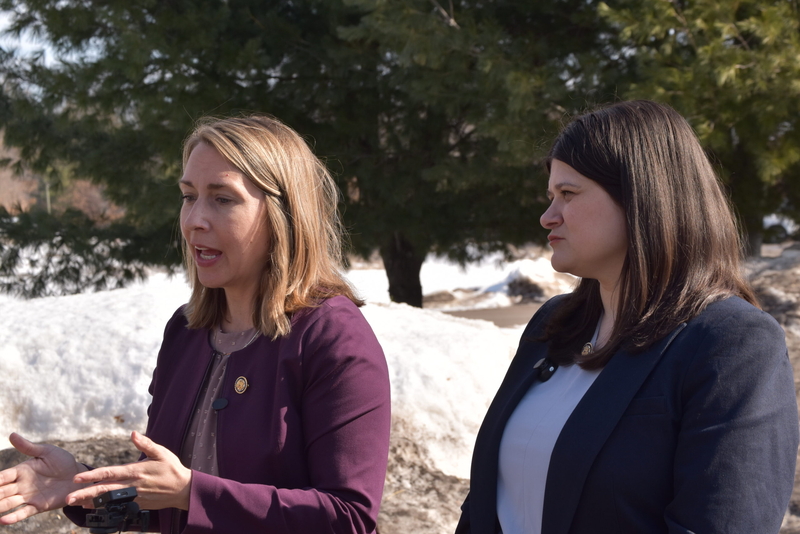
Both members of Congress said that one male detainee from Macomb County, likely Atou, had expressed fears of retaliation after describing his experience in essentially solitary confinement where he was “kept in a freezing room where he couldn’t feel his toes and having his food just thrown into his cell,” Scholten said at the time.
Atou’s brother described his deportation as a “death sentence” to the Free Press.
Sauve said, “Most of the kinds of retaliation that we see involve sort of taunting or bullying from staff members or placing someone in isolation or solitary confinement. Those are the kinds of measures that we see. We are afraid of retaliation like the case that was reported on, but I don’t know that we have other direct examples of that.”
However, Robinson added that the fear of retaliation is pervasive through the facility and makes it harder for detainees to share concerns about the conditions at the detention center with family members and lawyers.
Lansing, MI