How to make officials care about public records reform? Wait till their requests are denied.
Sep 23, 2026 | 5:10 am ET
Description
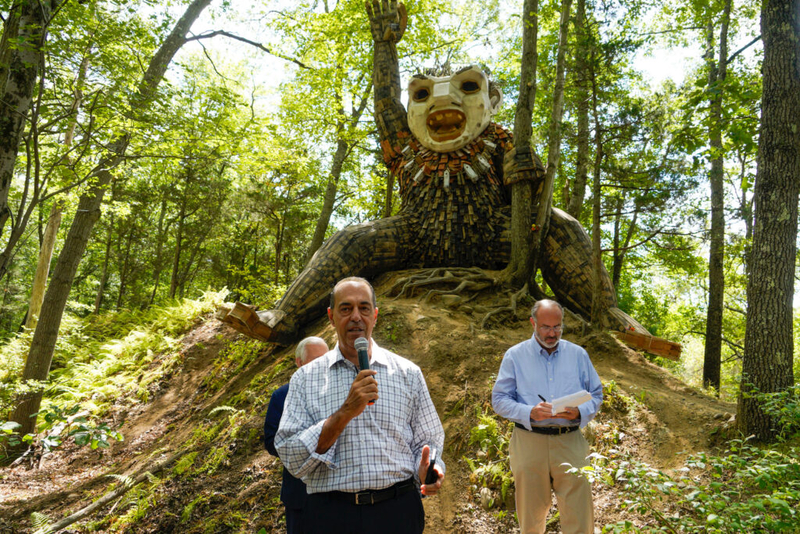
North Kingstown Town Manager Ralph Mollis, shown speaking at the dedication ceremony for the Iver Mudslider troll in Ryan Park in North Kingstown in August 2025, has hit a wall with two state agencies that refused to release public records, or quoted large fees to fulfill the request. At right is then interim Commerce Secretary Stefan Pryor. Behind Mollis is U.S. Sen. Jack Reed. (Photo by Laura Paton/Rhode Island Current)
Ralph Mollis is no stranger to Rhode Island’s Access to Public Records Act.
As North Kingstown town manager, he receives up to 10 requests a week from residents, media outlets and private companies looking for information they believe is protected by the state’s public records law.
But Mollis seldom makes a request from another public agency. In fact, he could not give any examples of another time it happened during his nearly 10-year career with the town.
“I’m sure I have, but I don’t remember any,” Mollis said. “We’re usually the ones receiving the APRA requests.”
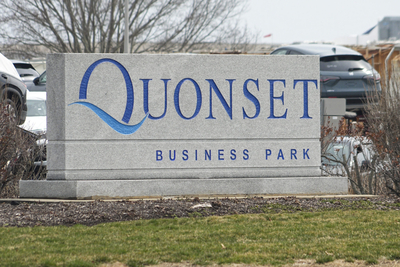
Which might be why Mollis was not expecting to encounter resistance when North Kingstown submitted records requests to two quasi-public state agencies involved in reviewing the now-paused sludge processing project in Quonset Business Park.
“I was somewhat surprised by the lack of ease in providing these documents to legal counsel,” Mollis said in a recent interview. “The town of North Kingstown doesn’t function that way. We try to be as open and transparent as possible.”
But Quonset Development Corporation and the Narragansett Bay Commission refused to provide all or most of the internal emails, project documents and other materials North Kingstown, through outside law firm Desautel Browning, asked for in May. The quasi-public agencies cited confidentiality protections in the state law as reasons why certain portions of Desautel Browning’s request cannot be fulfilled, or at least not without hundreds of hours of staff time and thousands of dollars.
Whose interpretation of state law is correct — and, more importantly, whether North Kingstown’s lawyers can retrieve the documents needed in preparation for a potential lawsuit against the U.S. Environmental Protection Agency — now lies with the Rhode Island Attorney General’s office, following appeals submitted in August from North Kingstown.
But the problem of a vague and loophole-ridden public records law persists, despite repeated attempts to rectify it.
“There is a lot of subjectivity under the existing law with how agencies can comply,” said John Marion, executive director for Common Cause Rhode Island. “If they want to be forthcoming, the law doesn’t prevent them from being forthcoming.”
But they don’t have to. Rhode Island’s 1979 public records law, last updated in 2012, gives agencies discretion to deny records requests with little or no explanation.
“Unfortunately, the custodian of the record has the advantage of knowing what’s in the record and making the decision under the 30-plus exemptions they have at their disposal,” Marion said. “It can be abused.”
Quonset Development Corporation, which oversees development in Quonset Business Park, for example, cited attorney-client relationship and trade secret or confidential information — both exempt under the state public records law — as reasons why it could not provide some of the records North Kingstown wanted. And, it refused to identify which records were being withheld, despite follow-up requests for such a list.
“How can I know what we’re talking about, or if the withholding is justified, if I don’t have a list?” said Marisa Desautel, partner at Desautel Browning.
But, as Quonset’s attorneys noted in their written response, the state public records law does not require any kind of “privilege log,” or itemized list of records withheld from the requestor.
“QDC takes its obligations of transparency seriously, which is precisely why it produced more than 3,000 pages of responsive documents,” Ryan Gainor, counsel for Quonset, wrote in a Sept. 9 rebuttal to the AG. “However, black letter law must be interpreted as written. Public interest in a particular subject matter does not override the express statutory exemptions that the General Assembly has enacted. To hold otherwise would render those exemptions meaningless.”
Hundreds of hours, thousands of dollars
State law also does not limit the fees public agencies can charge, or how long it will take to dig up the information requested.
Narragansett Bay Commission, which was looking to send sludge from its municipal wastewater plants to be treated in Quonset, initially told North Kingstown’s law firm the records request would cost $2,287.50, based on the 152.5 staff hours to fulfill it. When Desautel’s firm responded, calling the fee “unreasonable,” the commission’s legal counsel said its estimate was “conservative.” The actual amount of work, 762.5 hours, would cost $11,437.50 based on the $15 hourly charge, had the commission not chosen to “absorb the difference to further the goals of transparency under APRA,” Holly Ialongo, chief legal counsel for Narragansett Bay Commission, wrote in the letter.
In a later submission to the AG’s office, Ialongo further defended the cost and time estimate based on the “impermissible fishing expedition” submitted by Desautel’s firm.
The initial request included all correspondence, including emails, between commission staff and third-parties involved in the sludge project; all notes, summaries, recordings or other documentation of project meetings that commission staff attended; all permits, applications, approvals, denials and supporting materials; and “any other records, files or materials” related to the project.
The commission suggested Desutel’s firm could narrow the rerecords request as a way to cut hours and cost. Desautel’s firm asked that the first hour of records retrieval — free under state law — be fulfilled before it determined how to narrow the request.
“I’m not suggesting what I am asking for is easy, but to add on hundreds of hours of work, that’s just insulting,” she said. She continued, “The fact that’s a municipality trying to get records makes it all the more upsetting. We’re not a private party seeking private trade information trying to get a competitive advantage.”
Unfortunately, the custodian of the record has the advantage of knowing what’s in the record and making the decision under the 30-plus exemptions they have at their disposal. It can be abused.
Yet, residents and journalists butt up against access issues often. Three different media outlets in Rhode Island were charged three different amounts — ranging from zero dollars to $450 — when asking the Rhode Island Department of Transportation for emails between state officials about the Washington Bridge closure.
When journalists sought internal emails from Gov. Dan McKee’s administration about the botched state business trip to Philadelphia in March 2023, McKee’s office refused to hand over the documents, citing personnel and investigatory exemptions. It wasn’t until the AG’s office intervened that the email was released, unveiling a damning narrative about the state officials who took the trip that cost one his job and later, a $5,000 ethics fine.
“Oftentimes, when people win appeals, things are revealed that could have been reasonably segregated out and made public,” Marion said.
And while Rhode Island authorizes the AG’s office to intervene in public records denials — a less onerous and expensive route than taking a public agency to court — residents don’t always have the time, legal expertise or financial means to pursue recourse, Marion said.
Reform bills get stuck in committee
North Kingstown has spent over $100,000 since retaining Desautel Browning as its legal consult in late April.
Marion praised Attorney General Peter Neronha for applying state records law “liberally” in some instances, often when it suits his political interests, such as exposing McKee to criticism. But Marion noted that Neronha, who is term limited and not seeking reelection, has declined to offer the same protections in appeals over police misconduct records and body camera footage.
Tim Rondeau, a spokesperson for Neronha’s office, said in response that the office’s open government unit, which deals with public records appeals, operates mostly independently.
“The Open Government Unit is comprised of dedicated attorneys who are experts in application of the APRA and [Open Meetings Act] and the Attorney General recalls one or two instances over both of his terms where he disagreed with their decisions,” Rondeau said. “To suggest they are motivated by anything other than correctly interpreting the [laws] is plainly wrong.”
Rondeau also provided examples of Neronha’s commitment to transparency, releasing detailed reports of internal investigations into Gov. Dan McKee’s former chief of staff and the Roman Catholic Diocese of Providence while ruling in favor of those seeking public records on police misconduct by the Narragansett Police Department.
“That record does not square with the claim of politically convenient transparency,” Rondeau said.
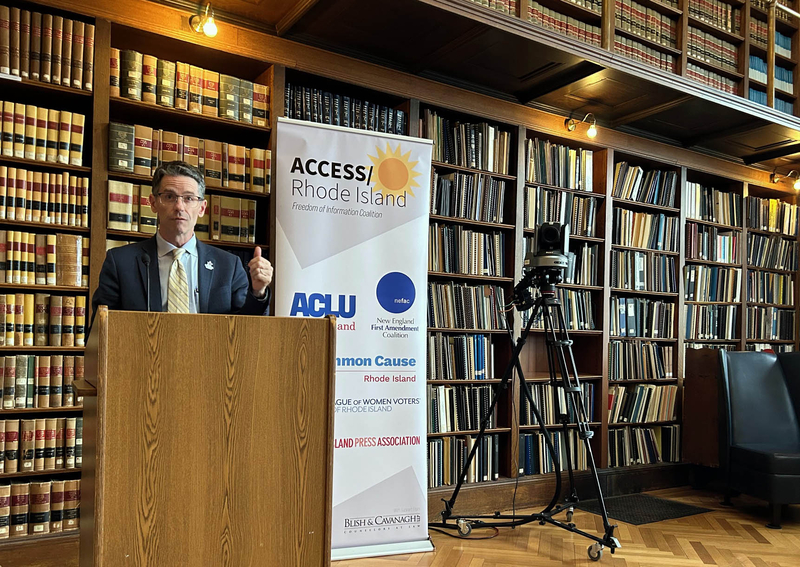
But an even better solution than depending on the whims of public officials: fix the law. Advocates with ACCESS/RI have sought for years to update the state’s public records law, proposing an ever-expanding list of changes meant to close loopholes, increase public access and account for more modern public records like text messages and body-worn cameras. Yet the perennial legislative proposal has failed to advance out of committee in either chamber of the Rhode Island General Assembly, including this year, buried by objections from the public agencies subject to the records law.
North Kingstown has never written or testified in favor or against the legislation during bill hearings, and Mollis said he was not familiar enough with the reform bill to comment. But the Rhode Island League of Cities and Towns, representing all the state’s municipalities, is a routine objector, citing the administrative burden of expanded public records for short-staffed and cash-strapped municipalities.
Yet the proposed fixes, if approved, could have helped North Kingstown get the records it seeks. For example, the reform bill includes a mandate for a privilege log when exemptions are wholly or partially denied. On fees, it states that waivers “shall” be granted when the records requested are in the public interest, versus the existing language that fees “may” be waived for public interest purposes.
The town’s request, intended to aid in its argument that federal regulators failed to assess the air pollution from the proposed Quonset sludge plant before granting a permit, seems a likely contender for a public interest argument, Marion said.
“This is categorically a clear rationale for why Rhode Island’s APRA law needs to be upgraded,” said Sen. Lou DiPalma, a Middletown Democrat and sponsor of the reform legislation.
There is no deadline for the AG’s office to issue a decision on the appeal, Rondeau said.
But time is ticking for North Kingstown officials and residents, anxious about the fate of the controversial sludge plant and what that means for their community. The project is under moratorium until a state legislative panel issues recommendations to the Rhode Island General Assembly in April.
“We thought we’d have the records by now,” said Desautel.

Providence, RI