Voters to decide fate of state taxes this fall
Sep 23, 2026 | 5:00 am ET
Description
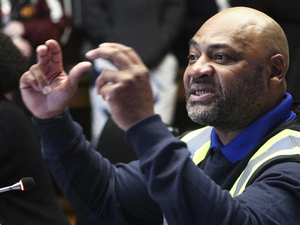
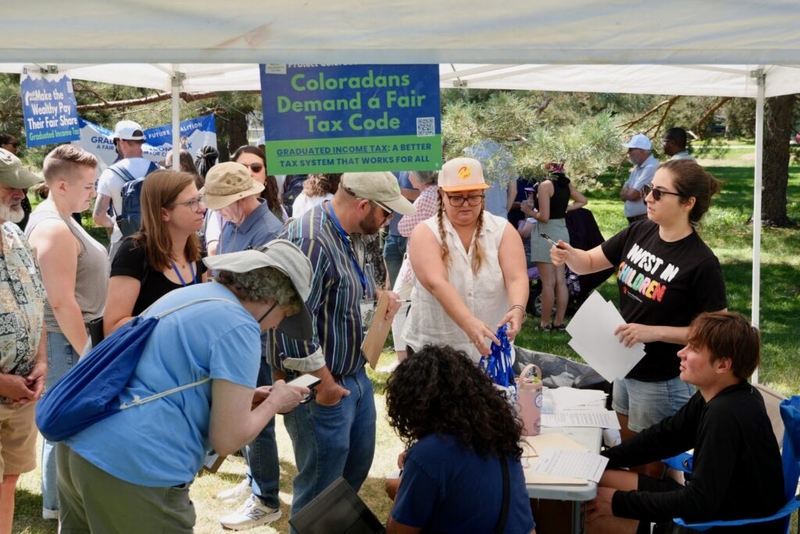
Canvassers in Denver received petition packets as they prepared to gather signatures in support of a graduated income tax measure that will appear on the Colorado ballot in November. Colorado is one of at least nine states that will decide whether to cut, cap or raise taxes this fall. (Photo by Chase Woodruff/Colorado Newsline)
This fall, voters in at least nine states will decide whether to cut, cap or raise taxes through ballot measures that will give them a direct hand in steering state tax policy in a conservative or progressive direction.
Some states, such as California, will weigh whether to tax — or untax — their wealthiest residents. Others, such as Florida, are considering a myriad of mostly conservative-backed measures to cut property or income taxes.
“The California wealth tax is part of a broader conversation regarding the wealthy having to pay their fair share,” said Janelle Fritts, senior policy analyst at the Tax Foundation, a nonpartisan tax analysis and research organization. “Florida is reflecting the broader conversation about property taxes right now.
“Any kind of tax elimination is going to require a lot of tradeoffs.”
Below is a rundown on the states where tax measures are on the ballot, and how they could reshape the money available for communities to spend on public services.
Taxing the rich
California voters in November will weigh a measure no other state has tried: a one-time wealth tax on billionaires.
Proposition 40 would take 5% of billionaires’ net worth in order to raise tens of billions to close budget holes the state’s Medicaid, food assistance, education and other programs. The measure is largely a response to the loss of federal funding from President Donald Trump’s 2025 budget law, the so-called One Big Beautiful Bill Act, according to the California Budget & Policy Center.
California’s 250 billionaires are collectively worth $2.3 trillion, equal to the entire income of all 20 million California taxpayers, according to a September letter written in support of Proposition 40 by a group of six Nobel Prize-winning economists.
A billionaire wealth tax in California, they said, could “kickstart a movement to tax ultra-high-net-worth individuals in other states.”
A handful of other states, including Maine, Massachusetts, New York and Washington, already have a so-called millionaire tax that taxes earnings above the $1 million mark at higher rates, Earlier this year, Hawaii joined the group by passing a law that added a 13% income tax bracket for joint filers earning more than $1 million, while also preserving some income tax cuts for lower-income filers.
But California is going further with its one-time 5% tax.
The state’s Democratic leaders are divided. California Gov. Gavin Newsom, a Democrat, is against the proposal, as are some state education and medical associations.
Critics say the tax could push billionaires to leave the state entirely, leading to a dramatic loss in future income tax revenues and fewer business investments. Some say it would face myriad legal challenges. And because the tax is earmarked, some groups oppose it because the funds couldn’t be used to support programs including affordable housing and subsidized child care.
The state Democratic Party has narrowly endorsed it. Other supporters include some labor organizations, as well as California U.S. Rep. Ro Khanna, a Democrat.
Billionaire opponents, including Google cofounder Sergey Brin, have funneled enormous sums into opposing the tax and supporting competing ballot measures. Two constitutional amendments also on the ballot, Propositions 41 and 42, could undo parts or all of Proposition 40, as long as they receive more “yes” votes, according to California’s Legislative Analyst’s Office.
One new poll found that just 45% of likely voters approve of taxing California’s wealthiest residents, according to polling from Politico and the University of California, Berkeley.
California voters also will consider another measure, Proposition 3, that would extend higher tax rates for the state’s three highest income brackets. Those rates contribute $10 billion a year to state coffers, according to the Institute on Taxation and Economic Policy, a tax policy nonprofit.
In Colorado, voters will decide on a similar measure, which would raise taxes on the state’s highest-income households and cut taxes for nearly everyone else by replacing the state’s flat tax. But like in California, a competing ballot measure could undo this one if it receives more “yes” votes.
In Washington state, a ballot measure would repeal that state’s new millionaire tax. Earlier this year, the Democratic-led state legislature created a 9.9% tax on incomes above $1 million per year, but a “yes” vote on the new ballot measure would repeal it. Complicating the issue are new findings from the state that the tax — if voters keep it in place — will bring in more than previously expected, about $3.1 billion the first fiscal year and about $8.3 billion from 2029-2031.
Unpopular property taxes
The Florida legislature is asking Floridians to make one of the most significant changes to their property taxes in decades. A constitutional amendment, if passed, would gradually reduce any property taxes that don’t benefit school districts by increasing the state’s homestead exemption.
“Property taxes are always unpopular, but they’re especially unpopular this year,” Fritts said.
That’s partly because they’re among the most “visible” taxes, she said. Most people don’t know how much they paid in sales tax last year, but they almost certainly know the total on their property tax bill.
And Florida doesn’t have a personal state income tax, meaning property taxes are more squarely in the crosshairs for those wanting to cut taxes.
While the state GOP endorses the proposed amendment, other groups — including law enforcement, child welfare advocates and municipal government officials — say it would blow a massive hole in local governments’ budgets. State and local coffers could take a hit of up to $12 billion each year beginning in 2031, according to state projections.
And yet, in a poll conducted earlier this month of more than 900 Florida voters, fewer than half said they supported it.
In August, a Florida circuit court judge ruled that much of the proposal’s ballot language — which was initially drafted by Republican Gov. Ron DeSantis’ administration and later amended by GOP legislators — was “akin to a political slogan” and violated state law because it was misleading. The judge ordered Florida Attorney General James Uthmeier to rewrite it.
In North Carolina, a proposed ballot measure that would cap how much cities and other local governments can grow their revenue sailed through the House and Senate. It was a priority for Republican leadership focused on addressing constituent complaints over rising property taxes.
“Property taxes are out of control,” said North Carolina state House Speaker Destin Hall, a Republican, in a March post on social media.
“Levy limits will stop runaway property tax hikes and protect NC taxpayers.”
The amendment would require the state legislature to pass a law limiting how much local governments can grow their revenue through property taxes every year.
Critics say North Carolina’s proposal could torpedo local budgets: Property taxes are the largest single source of revenue for local services including public school buildings, libraries, parks and emergency services, according to the North Carolina Budget & Tax Center.
Fritts of the Tax Foundation said such levy limits, which a number of states already have, are one of the most effective ways to limit property tax increases.
In Wyoming, voters will decide whether to cut state property taxes through a new program that would exempt half of a primary residence’s assessed value from being taxed.
And Oklahoma voters will decide whether to reduce annual increases in property tax values.
Reining in legislators
Earlier this year, Missourians overwhelmingly rejected a ballot proposal — supported by Missouri Republican Gov. Mike Kehoe — that would have required state lawmakers to eliminate the state’s income tax.
“We already saw a big income tax cut go down in flames in Missouri because voters weren’t happy about the tradeoffs it would require, namely higher sales taxes and worse public services,” said Aidan Davis, state policy director at the Institute on Taxation and Economic Policy, said in a statement to Stateline.
“It remains to be seen if voters in other states are going to view those tradeoffs the same way.”
Other states are targeting income taxes through ballot measures. And some are looking to rein in the power of lawmakers to push taxes higher.
In North Carolina, voters will consider a constitutional amendment to cap state income taxes at 3.5%, which is half of the current maximum rate of 7%. Critics say it would cement tax cuts that mainly benefit the wealthy and corporations.
It’s similar to a proposed Colorado measure that would cap that state’s flat 4.4% corporate and personal income tax rate.
Both would prevent lawmakers from enacting higher taxes on higher earners to generate funds for public services.
An Iowa ballot initiative also would make it harder for legislators to tinker with taxes: it would require a two-thirds supermajority of state lawmakers to raise personal or corporate income taxes.
Iowa’s Republican-led legislature voted the proposal onto the ballot as a “common sense” way to rein in taxes. But critics say it benefits wealthier households and could push the state to raise other taxes when it needs revenue, such as sales tax increases that have a bigger impact on low- and middle-income families.
An August poll showed Iowa voters split on the issue, with about a third of likely voters planning to vote in favor, 36% planning to vote against, and another 30% undecided.
Finally in Massachusetts, a “yes” vote on Question 5 would change how the state’s tax revenue limit is calculated. Currently, state law caps how much tax revenue the state can keep annually, and any extra beyond the cap must be refunded to taxpayers as credits. But if voters approve changing how the state calculates tax collections, taxpayers would be more likely to get money back in a given year. Proponents say it would slow down state spending, while opponents say it leaves less money available for public services.
Editor’s note: This story was updated to correct the spelling of Aidan Davis and of Ro Khanna. Stateline reporter Anna Claire Vollers can be reached at [email protected].