House panel appears to back bill easing limits on lawmakers holding second jobs
Apr 08, 2026 | 5:22 am ET
Description
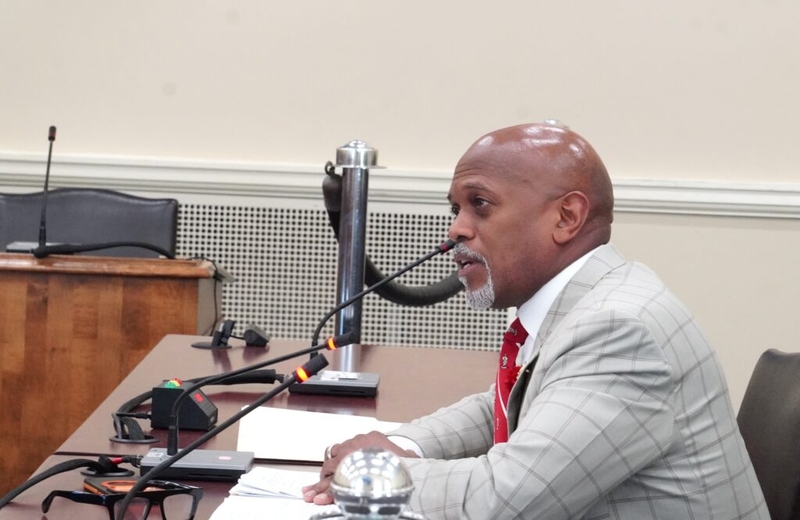
Sen. Ron Watson (D-Prince George's) testifies Tuesday before the House Government, Labor and Elections Committee on behalf of his bill that would let legislators take jobs with state or local governments, while remaining inoffic. (Photo by William J. Ford/Maryland Matters)
Sen. Ron Watson (D-Prince George’s) appeared to have a receptive audience when he pitched his bill to ease restrictions on state legislators working second jobs with the state or county or local governments to a House committee Tuesday.
“As somebody this has impacted directly for eight years … I want to tell you that this is such an important piece of legislation,” said Del. Jen Terrasa (D-Howard), who was term-limited to three, four-year terms on the Howard County Council from 2006 to 2018. “I couldn’t continue that [public] service and do this.”
Terrasa, who doesn’t plan to seek reelection to the General Assembly this year, was speaking to Watson during his testimony before the Government, Labor and Elections Committee in support of Senate Bill 618.
Watson serves as lead sponsor on the bipartisan bill that would ease the current restriction on a state lawmaker holding another state job or working for a county or municipal government, if that person had served at least one full term in office and “objectively satisfied the minimum education, licensure and experience requirements” of the job.
Watson said that the current restrictions can make it financially difficult, if not impossible, for someone to serve in the General Assembly.
Ethics, lead shot, housing and gender identity: Lawmakers plow through bills on crossover day
“We must be candid: Serving in elected office carries significant financial tradeoffs. Careers are interrupted. Professional networks shift. Private sector advancements may slow. Retirement contributions may be impacted,” he said. “We want our teachers, small business owners, young professionals, mid-career leaders and community advocates to see legislative services as possible and not financially punitive.”
Watson insisted that the state has “strong conflict of interest” laws, procurement safeguards, lobbying restrictions, disclosure requirements and independent ethics reviews in place to protect against problems with a lawmaker, for example, holding the purse strings for an agency that pays his full-time salary.
He sponsored the bill, with Sen. Johnny Ray Salling (R-Baltimore County), after the legislature’s ethics committee determined in an October letter that state law prohibited Watson from holding a job as interim senior adviser to the Prince George’s schools superintendent. He resigned from the position in December.
The current law carves out exceptions for legislators who held a government job before being elected or appointed to office, for a person who provides “education instruction” and for a “career promotion, change, or progression that is a logical transition from a pre–existing relationship,” among other provisions.
Watson’s bill would add the exceptions for an elected official who’s served at least a term in office, meets the qualifications of the second job, and complies with a regulation the prevents them from using the “prestige of office” for private gain for themselves or another.
On March 20, the Joint Committee on Legislative Ethics voted 10-2 to recommend that an amended version of the bill could pass ethical muster.
Three days later, the full Senate passed SB 618 by a 32-10 vote with bipartisan support from Salling and one other Republican, Sen. Mike McKay (R-Western Maryland). According to the vote tally, Sen. Alonzo Washington (D-Prince George’s) was the only Democrat to vote against it.
Sens. Arthur Ellis (D-Charles) and C. Anthony Muse (D-Prince George’s) did not vote, according to the tally. Sens. Joanne C. Benson (D-Prince George’s), Mary-Dulany James (D-Harford) and Bryan Simonaire (R-Anne Arundel) had excused absences.
The same House committee heard testimony in February on a similar House version that’s sponsored by Del. Andrea Fletcher Harrison (D-Prince George’s). No action has been taken on that bill since.
On Tuesday, several members of the committee, including Del. Sheree Sample-Hughes (D-Dorchester and Wicomico), asked if a person’s full term would begin when the bill goes into effect Jan. 13, 2027. That’s when the legislature’s next four-year term begins.
“It’s not proactive. It’s retroactive,” Watson said. “So if you have served one full term, you qualify once this bill goes into effect.”
Del. Brian Chisholm (R-Anne Arundel) asked if the legislature needs to pass a bill or “could ethics [committee] make this change on their own?”
Since being in the legislature in 2019, Watson said he didn’t receive a clear answer.
“I decided to use our leverage we have as legislators to force the ethics committee to sit down, have an in-depth conversation and come up with what I think is a reasonable compromise,” he said. “If we hadn’t done it this way, I’m not sure it would have happened anytime soon.”
Annapolis, MD