House panel advances charter school moratorium legislation, sending it to House floor
Jun 08, 2026 | 7:38 pm ET

Description
A mural inside Segue Institute for Learning, an independent public charter school in Central Falls. (Photo by Alexander Castro/Rhode Island Current)
More than four months after its introduction, the Rhode Island House’s version of a bill to impose a three-year moratorium on new charter schools passed the chamber’s Committee on Education in an 8-3 vote Monday.
The education panel passed an amended version of H7415 — sponsored by Rep. Mary Messier, a Pawtucket Democrat — alongside the bill’s Senate companion, S2787 by Sen. Melissa Murray, a Woonsocket Democrat, which passed its originating chamber in a 31-6 floor vote last Thursday, June 4. The identical bills would disallow new charter school approvals in the state for three years, as well as reduce the statewide cap on charters from 35 to 28.
The no votes came from Rep. Richard Fascia, a Johnston Republican; Rep. Joshua Giraldo, a Central Falls Democrat; and Rep. Ramon Perez, a Providence Democrat. Reps. Julie Casimiro; Susan Donovan; Thomas Noret; and Sherri Roberts were absent for Monday’s vote.
Both bills can now go before the entire House for floor votes. While floor votes were not immediately scheduled as of Monday evening, those floor votes may happen Wednesday, according to House spokesperson Larry Berman. The legislative session is expected to end on Friday.
Supporters of the legislation — including House Education Chair Rep. Joseph McNamara, a Warwick Democrat — cite the measure as one which will pause the expansion of charter schools amid strained municipal budgets for public schooling — the outcome of an aging school funding formula which has been increasingly targeted as inadequate for local district’s costs, especially when it comes to high-cost special needs students.
“The funding formula for us schools presently is not as dependable or as equitable as it should be for both charter schools and regular public schools,” McNamara said at Monday’s meeting. “We desperately need a more equitable formula. This would give us time, because we cannot continue to develop, nor can we afford, to have two parallel school systems in the state…It’s financially impossible.”
Rhode Island Foundation panel urges R.I. to rewrite school funding formula, boost state share
Under current state law, when students enroll in a public charter school, the per-pupil allocations from both state and local sources “follow” that student, and the charter gets the funding tied to that student. To compensate for this loss in money, local education districts are permitted “holdbacks” whereby they can reduce the local payment a charter will receive, allowing the public school to recoup fixed costs like maintenance, staffing or other expenses that linger even when a student leaves for a charter.
A January Blue Ribbon Commission report led by the Rhode Island Foundation and its current CEO, the former U.S. Rep. David Cicilline, attempts to retool the now-antiquated funding formula for Rhode Island’s public schools. But despite an early push from Cicilline at the State House, the legislation to institute that revised funding scheme has been replaced, via the state budget, by an order for the state education department to study the findings of the study commission.
In the meantime, legislators have turned to a charter school moratorium as a stopgap measure before the state’s K-12 funding can be more thoroughly interrogated. McNamara, a longtime member of the education panel, told his colleagues that the charter school system was originally meant to be “a laboratory for public schools,” with “innovative teaching and techniques” developed in these spaces and eventually exported to traditional public schools.
That has not happened, McNamara suggested.
“What we have seen is…almost a complete system that is cannibalizing financially our public schools,” McNamara said. “I mean, we just can’t continue to do it.”
But the moratorium measure has prompted vocal opposition from charter school supporters who have spent tens of thousands of dollars on radio ads, billboards and digital ads.
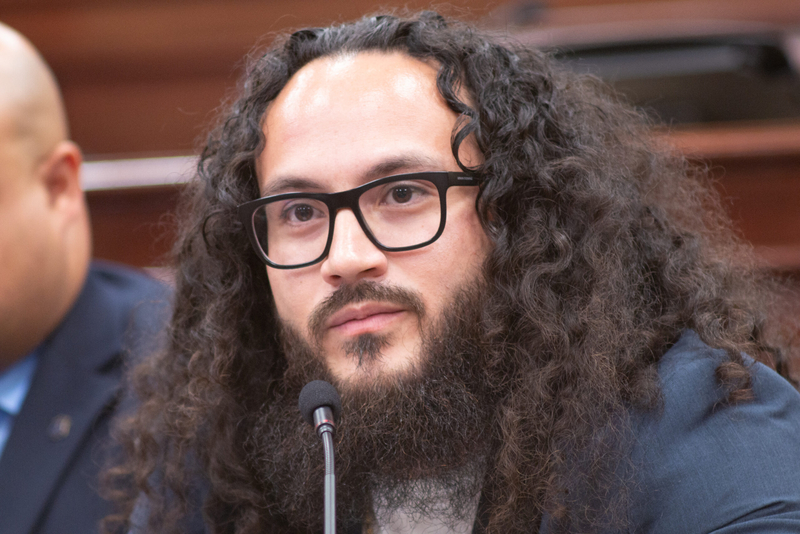
But are the kids learning?
Monday’s committee vote came after about a spirited half-hour of discussion that seemed tame in contrast to the Senate’s heated and uncommonly raw floor debate on Thursday, June 4, over Murray’s bill.
“I rise with venom in my veins on this issue,” Sen. Jonathon Acosta, a Central Falls Democrat and former public school teacher, said during Thursday’s floor debate. “Whenever I talk about schools — public, public charter, private — it’s through one filter: academic achievement. Do they produce learning?”
In Rhode Island, they largely do not, the senator argued. Acosta gave the example of Barrington, a relatively affluent town where, he noted, only about 60 to 70% of kids are at the requisite grade level in math or reading.
“That’s not a poverty problem, that’s not an MLL [multilingual learner] problem,” Acosta said. “We suck at teaching. When are we going to talk about that?”
According to state education department data for fiscal year 2024, there were about 12,887 Rhode Island students attending public charters, around 9% of the school’s 135,689 public school students overall.
Senate panel advances charter school moratorium despite vocal opposition campaign
“Our schools suck, and this is what we talk about right now,” Acosta continued. “The folks that enroll (9%) of students.”
Still, Acosta did not spare charters. “I want to close bad charters. There are charters that suck,” he said at one point. Still, he thought that union organizers’ outsized focus on “how the corporate greedy charters are coming to take your kids” represented “a misuse of our mobilization capacity, of our power.”
Murray acknowledged the Blue Ribbon model for school funding’s value on the floor, but she noted that it could not be acted on immediately, hence her bill, which she defended against Acosta’s comments.
“I am in no way trying to imply that our charter schools do not care deeply and passionately about their students, but unfortunately, in contrast, the only time that I regularly see charter schools engaged in advocacy is when the issue directly affects charter schools,” Murray said, noting the routine State House presence of teachers’ unions when it comes to various child and education-related bills.
‘Discriminating against the Spanish people’
Already at Monday’s committee hearing, the House was already divided somewhat.
Rep. Ramon Perez, a Providence Democrat, said he was “fine with the moratorium.” But he expressed concern that the De La Comunidad Bilingual Charter School, which received preliminary approval to open in 2027 to serve over 600 students from Cranston, Pawtucket and Providence, could not open if the moratorium legislation succeeds.
“I think this bill is discriminating against the Spanish people,” Perez said, arguing that the General Assembly should help bilingual students “get the education they need.”
Perez later added that state lawmakers profess support for education and bilingual students while simultaneously “chasing away the people” he believes are trying to improve schools in the frequently embattled Providence school district.
The state budget the House passed on Friday includes an increase in funding dedicated for multilingual learners, McNamara said
“It looks to me like we’re only taking on the weak people,” Perez concluded. “They can’t defend themselves because they don’t speak English.”
Rep. Joshua Giraldo, a Central Falls Democrat who noted during the bill’s initial hearing in April that his own child attends a charter school, asked where the three-year benchmark came from. How would the state know if the moratorium produced enough useful data?
“After the three years, how are we going to know, ‘Yep, that worked. That was what we were looking for’?” Giraldo asked the committee.
McNamara said he didn’t have that information, but could “only hypothesize” that the General Assembly moves slowly when it comes to making major changes.
“I think legislatively, if we want to make major changes, three years is kind of realistic, and that’s just my opinion,” McNamara said.
Rep. Rebecca Kislak, a Providence Democrat, told her colleagues that until the Blue Ribbon Commission’s suggestions can be acted on, the charter moratorium seems a “solid compromise.”
“One thing I think everybody in this room can agree on is we don’t invest enough in our kids,” Kislak said.
Stephanie Mandeville, a spokesperson for the National Education Association Rhode Island, which supports the moratorium bill, said Monday in an email that the charter pause will give the state time to devise a new funding formula. NEARI Executive Director Mary Barden “proudly served” on the Blue Ribbon Commission, she added.
“Rhode Island is on the verge of undertaking a major overhaul of its education funding formula” based on the commission’s recommendations, Mandeville said. “The Commission’s recommendations and fiscal modeling were developed based on the current educational landscape. Allowing significant changes to enrollment patterns and funding flows during this process could complicate implementation and undermine assumptions that informed the Commission’s work.”
Jeremy Sencer, a representative and spokesperson for The Rhode Island Federation of Teachers and Health Professionals, agreed in a phone call Monday.
“Part of the reason we believe there has to be an immediate moratorium and cap is because if we’re looking at implementing changes to the funding formula, it doesn’t make sense to have variables in the spending,” Sencer said. “We need predictable spending…And there’s still about 2,000 seats that have still been approved for charters, and those seats are still going to be filled, even if the moratorium passes.”
Sencer said his union was “surprised by the pushback” from charters this year, as the moratorium bill has been submitted in previous years and has even passed the Senate before.
Lynzi DeLuccia, a spokesperson for the Rhode Island League of Charter Public Schools, wrote in an email on behalf of the League Monday that the moratorium bill is an attempt to preclude access for students and families.
“Legislators hold a coveted seat with deep responsibility to their constituents — but we continue to feel as though Rhode Islanders asking for more access to high-quality public education are being ignored,” DeLuccia wrote. “Students and families want — and should have — more access to the public school that best meets their needs.”
Monday’s committee votes place both chambers’ moratorium bills before the full House. The Senate will still need to pass the House’s bill before the legislation can go to Gov. Dan McKee, whose office did not respond Monday to inquiries about his position on the legislation.
Providence, RI