House lawmakers advance bill banning warrant resolution clinics
Apr 23, 2026 | 8:24 pm ET

Description
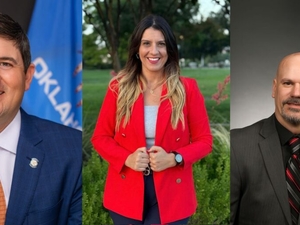
Ralph Hall, the father of Ashley Marie Hall, who was killed in an April 10 shooting, told reporters at the Iowa Capitol April 23, 2026 he disagreed with links made by some Republican lawmakers between his daughter's death and the Polk County free Warrant Resolution Clinic. (Photo by Robin Opsahl/Iowa Capital Dispatch)
An Iowa House panel introduced and approved legislation Thursday banning “warrant resolution clinics” in the aftermath of reports that a person whose arrest warrant was canceled at a Polk County clinic was accused of committing homicide a week later.
The Polk County Attorney’s Office, alongside the Polk County Criminal Justice Coordinating Council and other organizations and local agencies, hosted a free warrant resolution clinic April 3 at Polk County River Place in Des Moines. The event was aimed at allowing individuals who have low-level, nonviolent warrants such as traffic offenses, misdemeanors or failure-to-appear warrants issued within Polk County to either resolve their cases or reschedule court appearances.
Individuals with felony warrants or warrants issued in other counties were not eligible for the clinic. According to a news release, the event was an effort to help clear the current 8,200 outstanding non-felony warrants in Polk County and reduce bookings at the Polk County Jail.
But the event drew more attention after one individual who attended the clinic, Sharneeka Evans, was charged with first-degree murder days later in the shooting death of Ashley Marie Hall, a 36-year-old from Des Moines. Evans, 46, had attended the warrant resolution clinic to have a warrant for a lesser charge removed.
House Study Bill 780, which was passed by the House Government Oversight Committee in a 8-3 vote, was brought forward by Republicans who linked the death of Hall to the Polk County clinic. Rep. Steve Holt, R-Denison, told reporters Evans was held up as a “poster child” for the clinic, as she was featured in news articles about the event.
“She stated that she had been living in the shadows, and that as a result of her arrest warrant being recalled, she could now live her life more freely,” Holt said. “So, I think you can see the direct cause and effect between the fact that when her warrant for arrest was recalled, she modified her lifestyle — able to live freely again not in the shadows — but seven days later was arrested and is alleged to have committed the murder of a mother of three.”
The bill would ban public entities from funding, hosting or sponsoring warrant resolution clinics in the future, in addition to stating that a person can only resolve an outstanding warrant by surrendering themselves to law enforcement, appearing at a scheduled court hearing or through a written motion filed by the individual. Public officials and employees found in violation of the law would be subject to a simple misdemeanor charge, and counties involved in such clinics would not be entitled to court debt funds.
Holt said the decision to withdraw Evans’ warrant, and the warrants of others who may have previous charges that involve violent crimes, shows the flaws in providing this pathway to resolving outstanding warrants.
“Those involved in withdrawing this warrant — the Polk County Attorney’s Office, the judge who signed off on it — failed in a profound way, in my opinion, to take into account the violent criminal history of those to whom they were giving a break,” Holt said. “This resulted, allegedly, in a murder that was completely avoidable.”
Victim’s father disputes link to clinic
Ralph Hall, the father of Ashley Marie Hall who was killed April 10, came to the Capitol to speak on the measure. He said he did not believe there was a “direct connection” between the clinic and his daughter’s death. Hall said the legislation came as a “surprise,” as Republican lawmakers did not reach out to his family as the bill was introduced Wednesday.
“I personally don’t know much about the warrant clinics, but I just do know that it doesn’t have any direct connection with what happened with my daughter,” Hall said.
Officials involved in organizing the Polk County clinic also disagreed with Republicans’ argument that resolving Evans’ warrant enabled the crime to take place. Justin Allen, who serves as the first assistant at the Polk County Attorney’s Office, said the clinic was not a “‘get out of jail free’ card or a ‘get out of trouble’ card,” but a way to get more individuals to take accountability for their crimes.
“By providing a controlled environment for individuals to voluntarily resurface, we transitioned approximately 50 people from evaders back to defendants,” Allen said. “We require them to face a judge, schedule a court date and answer to their charges. Staff from our license reinstatement program, court debt repayment program were also available and signed up several people to put them on the path to driving legally and paying their debts.”
Regarding Evans’ case, he said the warrant resolved during the clinic was not related to the crime she was later accused of committing.
“I’m limited in what I can say about an active prosecution, but it’s important to understand how warrants work,” Allen said. “The individual in question had an active warrant for over two years and three months. During those 826 days, there was no contact by law enforcement and no arrests, successfully avoiding law enforcement for all that time. It is false logic to presume that she would have been arrested in the seven days between the clinic and the unfortunate events of April 10.”
However, county officials argued, the clinics could prevent acts of violence against law enforcement by deescalating potential altercations caused by a person having an outstanding warrant. Allen said during his 22 years working as a prosecutor, he knew of cases where a law enforcement officer was injured as a person fled after being pulled over for a routine traffic stop because they had an outstanding warrant, or “sometimes they just think they have a warrant out for their arrest and they flee,” he said.
But Holt said warrant clinics provide an incentive for people to avoid turning themselves in, saying that these events encourage individuals to “just wait it out” and have their warrant withdrawn at a clinic instead of being arrested. He also criticized the Polk County event for having “little consideration” of the criminal histories of individuals who attended the clinic.
He also highlighted the case of Hall’s death to show the need to pass other “tough on crime” legislation aimed at penalizing repeat offenders, passed by the House earlier this session. This included House File 2542, a proposal to create a “three strikes” system for committing certain crimes, in which a person would face a minimum 20-year prison sentence if they accumulate three “points” by being found guilty of committing multiple crimes.
Holt said if the House GOP “three strikes” proposal was in law, “Sharneeka Lynn Evans would have been in prison,” because of her criminal history, which he said included charges such as assault causing bodily injury, harassment, child endangerment and theft.
“To answer the growing lack of accountability in our criminal justice system, we now have a warrant resolution clinic that withdrew the warrant of a career criminal with a violent history, who seven days later, has allegedly shot and killed a mother of three,” Holt said. “Those are just the facts. This is inexcusable, and it must never happen again.”
The measure is available for debate on the House floor.
Des Moines, IA