Homeowner property tax relief depends partly on choices by counties, and the debate is beginning
Apr 28, 2026 | 12:50 pm ET
Description
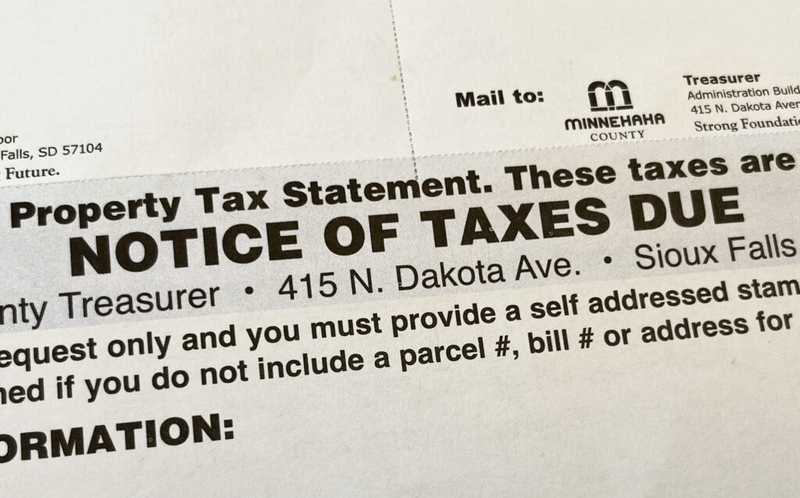
A Minnehaha County property tax bill delivered in early 2026. (Photo by Makenzie Huber/South Dakota Searchlight)
South Dakota has two new laws intended to reduce homeowner property taxes, but one of them depends on counties opting in.
The reaction of county commissioners across the state runs the gamut from opposition to uncertainty to eager support.
Republican Gov. Larry Rhoden signed a bill into law in March permitting counties to implement up to a half-percent sales tax and use the revenue to reduce the county-imposed portion of homeowner property taxes. When the law takes effect in July, it will be the first opportunity for South Dakota counties to charge a sales tax.
Thirty-nine of the state’s 66 counties could collect enough from sales taxes to replace the entire county share of homeowners’ property tax bills, Rhoden’s office estimates, while the others could replace a portion. Homeowners would still pay property taxes to schools, cities, townships and other local entities such as water and fire districts, but the county portion of homeowners’ property taxes would be eliminated or reduced. If a county has extra revenue from the sales tax after eliminating the county portion of homeowner property taxes, the extra revenue must be used to reduce taxes on agricultural and commercial properties.
Statewide, according to the Governor’s Office, the average homeowner property tax savings from implementing the county sales tax would be an estimated $660.
South Dakota homeowners have complained about owner-occupied property taxes since the COVID-19 pandemic, when a surge of in-migration and other factors drove up taxes along with home prices.
Yet that doesn’t necessarily mean South Dakotans favor the use of higher sales taxes to reduce property taxes. A recent poll commissioned by South Dakota News Watch and the Chiesman Center for Democracy found 49% opposition when registered voters were asked whether counties should have the option to raise sales taxes in exchange for lowering property taxes, with 33% support and 17% undecided.
The other law adopted by Rhoden and lawmakers during the recently concluded legislative session relies on next year’s expiration of a temporary state sales tax rate reduction. The revenue from allowing the tax to rise from 4.2% to 4.5% will be captured and used to reduce school-imposed homeowner property taxes statewide.
Some commissioners eager to move quickly
Many county commissioners plan to discuss the new sales tax option with their colleagues and county residents in the coming months.
The county sales tax can be implemented by commissions or a vote of the public. In counties that enact a sales tax, homeowners will see the property tax reduction as a credit on their property tax bill.
Members of the Lincoln County Commission discussed the potential half-percent sales tax at the board’s March 24 meeting. Lincoln is the fastest growing county in the state based on the percentage increase in its population, according to U.S. Census Bureau data, and its homeowners pay the highest average property taxes in South Dakota, according to the state Bureau of Finance and Management.
Lincoln County homeowners would save an average of 12% on their property tax bill if the optional county sales tax is adopted, according to the Governor’s Office. That’s about $579 of savings on a home valued at $325,000.
“I think it’s critical we discuss this and we get on this as quickly as possible,” Commissioner Jim Schmidt said.
Commissioner Betty Otten said she would ask county staff to draft an ordinance ahead of the July 1 effective date of the new state law.
Schmidt told South Dakota Searchlight he expects a majority of the five-member commission to support the idea — it’s a matter of whether the sales tax should be implemented by the board or by a vote of the people.
Commissioner Joel Arends told his colleagues the proposal “doesn’t pass the common sense test” because it trades one tax for another, but he wants to see the issue taken to a public vote.
“There’s good, there’s bad, it’s suboptimal,” Arends said, “and we need to hear from the public.”
Custer County — the third fastest growing county in the state, based on its percentage increase in population — should “start acting on this right away,” said Commission Chair Jim Lintz. Homeowners in the county would save an average of 12% on their property tax bill, or $428 on a home valued at $325,000, according to the Governor’s Office.
A sizable portion of the sales taxes in Custer County would be paid by Black Hills tourists.
“This doesn’t make the problem go away,” Lintz said, adding that valuations still remain high in the county and agricultural property taxes are also rising. “We’re still going to be looking at a problem, but this is a start.”
Pennington County Commission Chair Ron Weifenbach said he supports the sales tax option “100%.” He thinks residents would largely support the sales tax increase, since Rapid City and the Black Hills collect some of the highest sales tax revenues in the state, thanks to tourists and other visitors. Weifenbach said the board will consider the change carefully and ask for public input.
“Overall, it’ll have a lot of traction,” Weifenbach said. “I look at this as a positive step to alleviate taxes for people who are getting taxed out of their houses.”
Other counties deliberate
Interest in the sales tax proposal will depend largely on each county’s individual need for homeowner property tax relief, said Eric Jennings, a commissioner in Lawrence County in the northern Black Hills, and vice president of the South Dakota Association of County Commissioners. Tax increases on homes have not been as pronounced in some rural areas.
“I’d be surprised if there are very many counties away from the interstates that adopt this,” Jennings said.
He hesitates to take a position, since people with lower incomes pay a larger share of that income on sales taxes than wealthier people, and the county sales tax would come on top of the statewide sales tax increase.
“I’m back and forth every day,” Jennings said.
Minnehaha County Commission Chair Dean Karsky said he isn’t convinced Minnehaha, which includes Sioux Falls, will implement a sales tax, but the commission “needs to have a discussion.”
Karsky added that many counties will “wait and see” what happens in other counties before moving forward.
“It’ll be a lot of waiting on the fence to see what happens, waiting to see what our constituents want us to do,” Karsky said.
Some residents in lesser-populated counties across the state are concerned they’ll foot the tax bill for residents in more populated counties that implement the tax. Rep. Will Mortenson, R-Fort Pierre, warned lawmakers during the legislative session that the plan imposes a higher burden on people from smaller communities that won’t benefit from the property tax relief if their county doesn’t implement the plan.
“When we hear about these visitors, they don’t just come from out of state, they come from rural communities,” he said. “Because this bill is structured so that the property tax cut goes where the economic activity goes, you know who’s getting the biggest tax cut? The people in the biggest houses, in the biggest towns.”
Chad Erk, chair of the Butte County Commission, said the board will discuss the possibility of a sales tax increase, but he is opposed to the “tax shift.” Erk would rather cut spending within the county government to provide property tax relief.
Butte County is a rural, agricultural area just north of the Black Hills. It wouldn’t be able to take advantage of tourist sales tax spending to the extent some other counties could.
“So we’d literally just be taxing ourselves, but in a different way,” Erk said.

Pierre, SD