On his way out of office, AG Neronha proposes agency overhaul and public option insurance
Oct 29, 2026 | 6:04 pm ET
Description
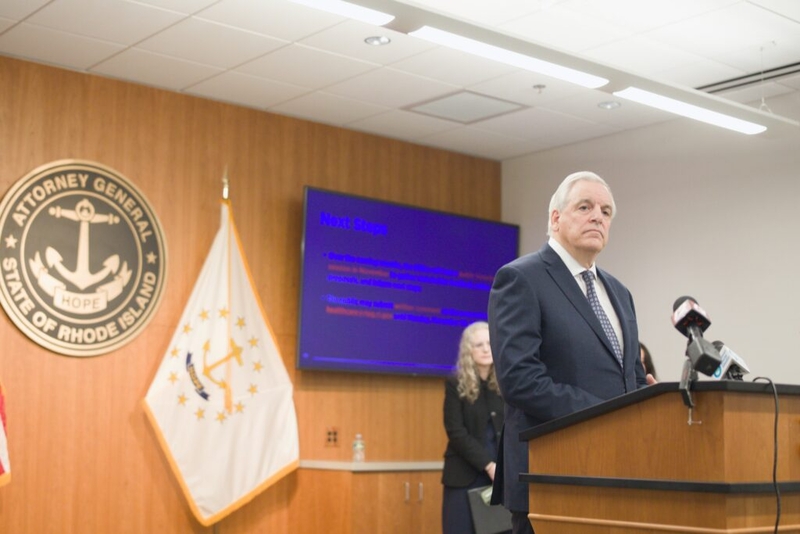
Rhode Island Attorney General Peter Neronha discusses proposals to restructure state health agencies and create a public health insurance option at a press conference in Providence on Oct. 29, 2026. (Photo by Alexander Castro/Rhode Island Current)
Term-limited Rhode Island Attorney General Peter Neronha will leave his post in January, but the state’s top attorney and prosecutor still has a few ideas left on how to fix healthcare in the Ocean State.
“We have to build the roof before we fix the kitchen,” Neronha told reporters during a press conference Thursday morning to outline a pair of proposals he believes are needed by Rhode Island’s health care system.
One would create a state-run, public insurance option at a cost of roughly $398 million annually in subsidies alone with nearly 134,000 Rhode Islanders projected to enroll by 2028. The other would restructure the state’s health care and human service agencies.
Both depend on legislative approval. Should the General Assembly quickly decide to OK his public insurance plan, Neronha’s office estimated it could begin operating as early as 2028.
Neronha’s agency restructuring proposal seeks to eliminate the Executive Office of Health and Human Services (EOHHS) and replace it with two cabinet-level agencies plus a new independent office that would undertake long-term healthcare planning duties for the state.
The separate public insurance proposal was crafted in concert with researchers at Brown University’s School of Public Health. It would serve as an alternative to private insurance and could be purchased by both individuals and employers. Neronha is posing the public insurance as a shield against the widespread coverage losses anticipated due to changes in Medicaid, the joint federal-state health insurance program.
Neronha cited his office’s role in oversight of hospital mergers and his involvement in the protracted sale process of safety net hospitals Roger Williams Medical Center and Our Lady of Fatima Hospital as evidence the state has trouble evaluating the system as a whole.
Not all hospitals are “in crisis,” Neronha conceded. “But they are facing strong headwinds.”
The state’s largest hospital system, Brown University Health, provides “tens of millions of dollars, if not hundreds of millions of dollars” yearly in care to patients without insurance, he said.
“You wonder how a system can survive delivering that amount of charity care, work for which they are not paid,” Neronha said. “And I think in many ways in Rhode Island we have come to the point where we want a healthcare system that we haven’t yet decided we want to pay for.”
Neronha’s proposed solution to the underinsurance issue is a state-administered program which would allow individuals and employers to enroll in plans with benefits comparable to those available to state employees. The state would directly control plan premiums, as well as subsidies and provider payments, and it would ideally reduce the state’s reliance on private insurers to carry out its healthcare priorities.
These plans would compete with private insurers, while Medicare and Medicaid would be left intact. Impending losses of Medicaid coverage resulted from changes to the program made by H.R.1 last year. An estimated 33,600 Rhode Islanders could lose Medicaid coverage under new federal work requirements and restrictions affecting certain immigrants.
But the program is not a single-payer strategy, Neronha cautioned.
“We also know that Rhode Island may not be ready for that now or ever, and the challenges of that are pretty high,” he told reporters.
Similar public option-esque plans have been adopted in Washington, Colorado and Nevada, although those programs rely on private insurers operating under state rules — different from the state-run model Neronha is proposing.
Researchers at Brown University’s Center for Advancing Health Policy through Research (CAHPR) worked with Neronha’s office on the proposal and estimated it could enroll 133,952 people by 2028, including 52,025 who would otherwise lack insurance.
The researchers estimated big savings for some individual enrollees too, with premiums falling by approximately 80% from the projected 2028 baseline, at least, for some individual market planholders. Employers, meanwhile, saved less under the same model, with projected savings of approximately 2.4% to 7.6%.
This model estimated the state would need to add approximately $397.9 million to the state budget annually to subsidize this insurance program. Depending on how the state would work out subsidies, provider reimbursements and agreements with employers, the amount could rise to about $469 million annually.

Breaking up EOHHS
EOHHS comprises a broad network of agencies and programs, including public health, behavioral health, child welfare, public assistance, aging, veterans services, and the state Medicaid program.
Neronha’s proposal would split the umbrella agency into two cabinet-level entities.
“Whenever you see an organizational structure with that many lines going in that many directions, it is a recipe for stagnation, at best,” Neronha said.
He calls for a new Health Administration and Financing Agency to consolidate healthcare oversight duties from the Department of Health, Medicaid, the Office of the Health Insurance Commissioner, health plan marketplace HealthSource RI, and the Department of Behavioral Healthcare, Developmental Disabilities and Hospitals.
A separate Human Services Agency would oversee programs involving child welfare, public assistance, aging and veterans services.
An additional, independent office — the Office of Health Policy and Planning — would collect and analyze healthcare data across these agencies and help to develop long-term policies. That would ideally help the different healthcare agencies understand what they can do.
Neronha finds the state’s existing structure for regulating healthcare lacking. “It has powers that it may not even know that they have, but they don’t use them,” he said.
Lee Staley, who leads the attorney general’s health care unit, estimated the new planning agency could require approximately $10 million to $12 million annually, a figure based on the operating costs of comparably-sized agencies in other states. That estimate could change with more concrete staffing, hiring and technology needs factored in. The proposal also anticipates one-time transition costs but offers no price tag for such expenses.
EOHHS did not participate in the crafting of Neronha’s proposals Thursday, spokesperson Stephanie Menders confirmed.
“EOHHS was not consulted in advance of the report’s release and will review its recommendations,” Menders said in an email.
And the legislature says what?
Legislation has already been drafted by Neronha’s office for both the public option program as well as the reorganization of state health agencies. He acknowledged either proposal would see substantial revision and public comment before it could be transformed into law.
“I’ve learned that over the last eight years that you know, if you propose legislation, as we have on occasion…they [the legislature] pick the sponsors, not you,” Neronha said.
The AG said he briefed House and Senate leadership recently, but no sponsors had been lined up yet.
In a joint statement Thursday, House Speaker Christopher Blazejewski and Senate President Valarie Lawson described the proposals as “thoughtful and ambitious.”
“[T]hey complement our work in the Legislature to improve access to affordable health care and to stabilize our health care system,” the legislative leaders said, although they did not explicitly commit to advancing the proposals in the upcoming legislative session. “We look forward to continued conversations about health care.”
Senate Health and Human Services Committee Chairwoman Melissa Murray gave a more specific answer about the proposals’ future.
“I anticipate that the Attorney General’s proposals will be reviewed by the Health and Human Services Committee in the 2027 session,” Murray said in a statement Thursday, adding that the bills would likely be part of a “strong package of bills to strengthen our health care system and improve access and affordability for all Rhode Islanders.”
Rep. Susan Donovan, a Bristol Democrat who chairs the House Health and Human Services Committee, said Thursday afternoon that she hadn’t reviewed the proposals yet.
And what about the incoming Attorney General? Will that person go to bat for Neronha’s healthcare campaign?
Josh Block, campaign manager for Democratic attorney general candidate Kim Ahern, said in an email that Ahern “applauds Attorney General Neronha’s tireless advocacy for strengthening Rhode Island’s healthcare ecosystem.”
“She looks forward to spending more time digging into these proposals and discussing the path forward with AG Neronha after next week’s election,” Block said.
Alan Gordon, the office’s Republican contender, said via email Thursday that he thinks the proposed public insurance option is a bad idea — a very bad idea.
“In my view, creating another major state-managed health care program before confronting Rhode Island’s corruption and failures of oversight is one of the worst ideas I’ve heard,” Gordon wrote. “We need to clean house first.”
Gordon was more on board with “overhauling Rhode Island’s health care regulatory agencies,” but noted his approach would be different, and firmly rooted in financial transparency.
Providence, RI