Kansas Republicans assert state agency improperly shifted cash among disability service programs
Sep 04, 2026 | 4:50 pm ET
Description
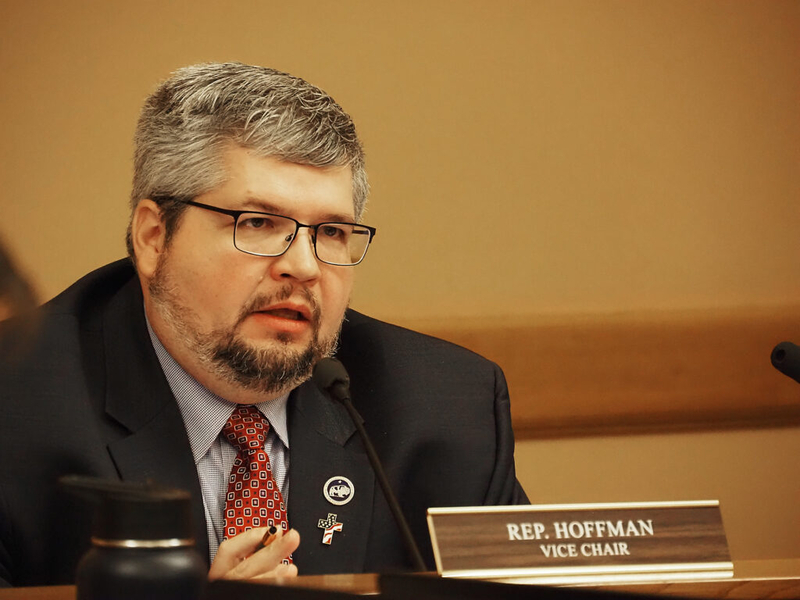
Rep. Kyle Hoffman, a Coldwater Republican on the Kansas Legislature's joint budget committee, is among GOP lawmakers questioning the transfer of $24 million by the Kansas Department for Children and Families from among several disability service programs. This image is a 2022 photo of Hoffman at the Capitol. (Photo by Sherman Smith/Kansas Reflector)
TOPEKA — Republicans on a legislative budget committee renewed discontent Friday with Gov. Laura Kelly’s administration, which reallocated millions of dollars that could have benefitted Kansans with intellectual or developmental disabilities.
Instead, GOP lawmakers said, approximately $24 million that should have been targeted at 5,300 people on the state’s I/DD waiting list was transferred internally by the Kansas Department for Aging and Disability Services. The cash was used to expand aid to Kansans with severe brain injuries, the frail elderly and people requiring technology assistance to grapple with a disability. A majority of the reallocation, approximately $19 million, was dedicated to needs of frail elderly Kansans.
“That’s the frustration,” said Rep. Kristey Williams, an Augusta Republican. “We have to trust our agencies to use the money as it was appropriated, and it was not.”
Rep. Kyle Hoffman, a Coldwater Republican, said the Legislature included in bill form an expectation that KDADS would shrink the I/DD waiting list to 4,800 in fiscal year 2024-2025 and to 4,000 in fiscal year 2025-2026. The waiting list has grown to 5,357, officials said. The state provides financial support to 9,800 people with developmental and intellectual disabilities.
Hoffman said KDADS Secretary Laura Howard shouldn’t have interpreted past conversations with House and Senate committees about reappropriating the $24 million as formal permission to do so. He said KDADS’ decisions conflicted with language in House Bill 2513, which was passed by the Legislature and signed by the governor.
“It kind of feels like that you’re saying. ‘Well, the law says I have to do this, but we don’t have the money so we’re not going to do that,'” Hoffman said. “There’s a big difference in having a discussion in a budget committee that this is what we’d like this money to go towards, than … what the actual bill said. To me, you’re misappropriating what (House Bill) 2513 says.”
Howard said movement of the one-time funding was endorsed by House and Senate lawmakers through a transparent oversight process tied to Medicaid spending. She said KDADS didn’t withdraw services from Kansans with intellectual or developmental disabilities. Nor, she said, did KDADS deny funding specifically appropriated by the Legislature to add slots within the I/DD system.
“Every slot that was authorized by the Legislature was filled,” Howard said. “Again, we requested the use of one-time funding from the Legislature and were approved. Everything we’ve done regarding this has been a very, very transparent process.”
Howard said the $24 million was drawn from unspent state appropriations tied to the I/DD and physical disability programs.
In the past, the Legislature adopted a budget proviso directing KDADS to shrink the waiting list to no more than 4,000. In some cases, Kansans continue to wait up to 10 years to receive I/DD services due to a persistent shortage of professionals willing to provide those services and access to direct state appropriations by the Legislature to reserve new slots in Medicare programs.
“The problem with the proviso is it doesn’t provide any funding to reduce the waitlist,” Howard said. “Where am I supposed to take that funding from my budget? Should I take it from mental health services?”
In August, House Speaker Dan Hawkins, R-Wichita, sounded an alarm about the KDADS’ maneuvering. He accused the agency of engaging in a “blatant bureaucratic shell game, and families waiting years for services deserve answers.”
Sen. Rick Billinger, a Goodland Republican who chairs the joint Legislative budget committee, said the service-delivery challenge with I/DD programs had historically been framed as a lack of providers rather than a shortfall in state funding.
“I think this is the first time I’ve heard that we’re lacking in funding,” Billinger said. “It’s always been the capacity, rather than the funding.”
Sen. Pat Pettey, D-Kansas City, said the Legislature should appreciate that addressing the I/DD wait list required direct financing from state government.
“Even though we all want to see an I/DD list that has no one on it, every person moving off the I/DD list always has a cost involved. That’s not a one-time cost. It’s unfortunate that this has become somewhat of a political football that’s being thrown around.”
Topeka, KS