Here’s how the House GOP’s proposed Medicaid cuts could impact Minnesota
Jun 12, 2025 | 6:10 pm ET
Description
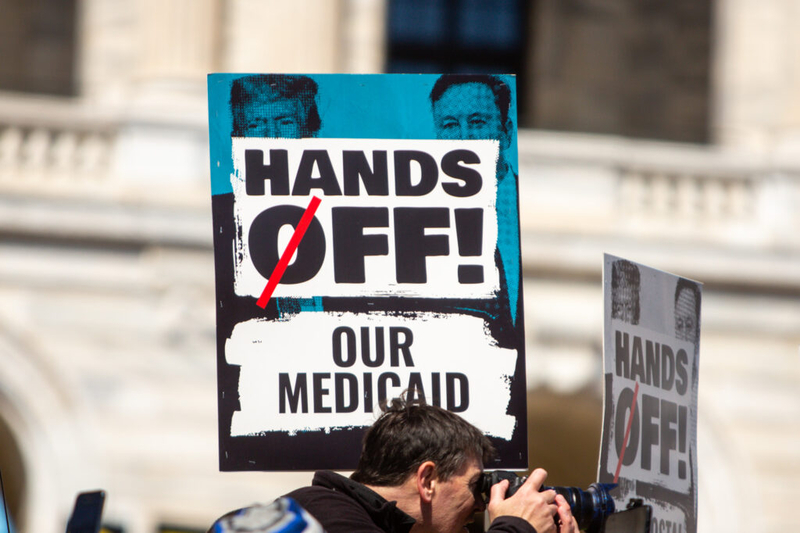
Thousands of protestors gathered at the Minnesota State Capitol as part of the nationwide "Hands Off" protests condemning several actions of the Trump administration Saturday, April 5, 2025. (Photo by Nicole Neri/Minnesota Reformer)
Minnesota could lose up the half a billion dollars annually if a GOP-backed tax bill becomes federal law, Minnesota’s Medicaid director warned Thursday.
That could mean fewer services or tighter restrictions on eligibility, affecting health care for hundreds of thousands of Minnesotans and the hospitals and other providers that treat them.
The bill, which has already passed the U.S. House on a 215-214 vote, is still far off from becoming law; Senate Republicans are drafting their own version, and the GOP remains deeply split over how to pay for tax cuts, which is their ultimate goal. For now, the House legislation is the most detailed public plan for how Republicans will fund an extension of President Donald Trump’s 2017 tax cuts, plus a bunch more.
The tax cuts passed by the House would decrease federal revenue by about $3.7 trillion over the next ten years, according to the nonpartisan Congressional Budget Office. To offset the loss of income, Republicans want to cut spending by $1.3 trillion, mostly by targeting Medicaid and SNAP, which helps low-income people buy food. (The $2.4 trillion gap between the revenue and spending cuts would be added to the federal debt, which will in turn increase what taxpayers must shell out in interest payments, which have surpassed $1 trillion annually.)
Medicaid pays for health care for the elderly, low-income and disabled. The cost is shared between states and the federal government; last year, Minnesota spent $18 billion on Medical Assistance, which is Minnesota’s version of Medicaid. The federal government covered $11 billion of that.
More than 1.2 million Minnesotans rely on Medical Assistance, and deep cuts would cause “serious harm” to Minnesotans, said John Connolly, Minnesota’s Medicaid director.
“Our position at the Minnesota Department of Human Services is that the bill currently on the table is inefficient, ineffective and fundamentally unfair,” Connolly said during a press briefing.
Minnesota is already grappling with how to pay for care for an aging population as health care costs continue to rise.
The state Legislature made $270 million in cuts to Medical Assistance this year, as spending on the program has risen faster than tax revenues.
DHS estimates that if the U.S. House tax bill were to become law, the state would lose out on $500 million per year. The bill would cause between 152,000 and 253,000 Minnesotans to lose health insurance, according to Kaiser Family Foundation.
It would also push costs onto state and local governments, Connolly said, by requiring county and tribal governments to verify participants’ eligibility twice as often as they do now, and increasing the administrative burden for the state.
The largest chunk of the possible cuts to Minnesota comes from a provision that would reduce Medicaid reimbursements for states that subsidize health insurance for undocumented people. The Legislature voted this week to remove eligibility of undocumented adults for MinnesotaCare, a state- and federally-funded health insurance program for the working poor that is separate from Medical Assistance.
As long as undocumented children remain eligible for MinnesotaCare — and if the House language becomes law — Minnesota would still have its federal funding cut by about $330 million, according to DHS.
Senate Republicans are wary of deep Medicaid cuts, and are instead expected to target SNAP, the New York Times reported Thursday. The Senate has not yet introduced its version of the tax bill.
A proposal to shift 25% of federal SNAP benefit costs onto states would shift up to $220 million annual cost to Minnesota, according to the state Department of Youth and Family Services.
More than 440,000 Minnesotans rely on SNAP benefits, according to DCYF. More than one-third are children, 18% are seniors and 14% are adults with a disability.
If these federal cost shifts and cuts become law, the Minnesota Legislature would likely be forced to return to St. Paul for a special session to either raise taxes, cut services or move money around to fulfill lawmakers’ constitutional obligation to balance the budget.

Saint Paul, MN