Here’s an easy 2026 resolution for Oklahoma lawmakers: Stop creating do-nothing advisory boards
Jan 05, 2026 | 6:29 am ET
Description
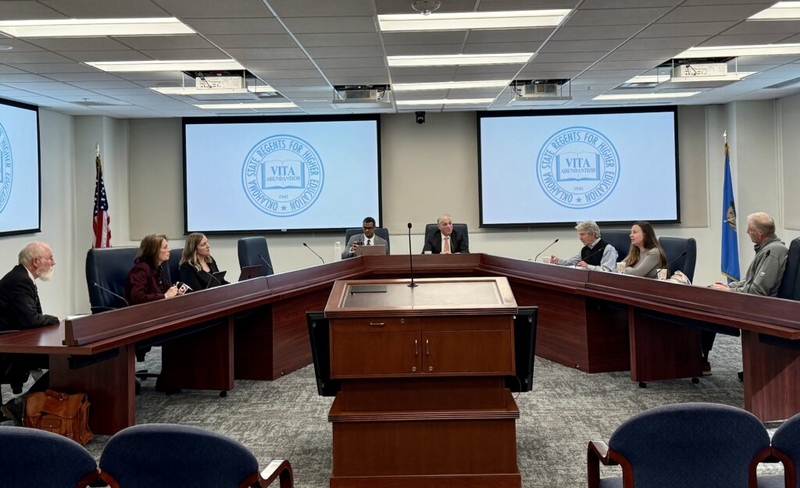
Members of the Oklahoma Free Speech Committee gather for a meeting on Dec. 9, 2025 at the State Regents' offices in Oklahoma City. (Photo by Emma Murphy/Oklahoma Voice)
I have an easy New Year’s resolution for Oklahoma lawmakers: Vow to reject any legislation in 2026 that creates do-nothing advisory boards.
Pretty much every annual legislative session, senators and representatives pat themselves on the back for creating another government panel that seems to have no enforcement or regulatory power, much less do anything to make our state a better place.
Take the higher education Free Speech Committee, for example.
It’s been in the headlines recently because Oklahomans want to know what this body is doing about the fact that our state’s three largest universities have each been hammered with allegations of First Amendment violations, ranging from political and religious speech discrimination to press censorship.
Lawmakers created the board in 2022 to ensure that First Amendment rights are protected on Oklahoma college campuses, but gave it the power to only review policies and complaints and then make recommendations to universities on improvements to policies and free speech training. Chad Caldwell, who authored the legislation, has said the committee is needed because free speech matters continue to grow in importance, affect everyone universally and need to be protected.
But rather than being bastions of free speech, this nine-member board gives the sense that they have no sense of urgency to protect the First Amendment rights of university students and employees.
Instead of serving as a watchdog, this group has largely relegated themselves to the sidelines, opting instead to be cheerleaders, allowing universities to police themselves.
Meanwhile, our universities have faced serious free speech accusations.
A dispute at Oklahoma State University gained national attention after a staff member reportedly criticized a student for wearing a hat emblazoned with “No. 47” – symbolizing President Donald Trump’s second administration – while ironically giving a speech about free speech on campus at a nonpartisan event.
Leadership at the University of Central Oklahoma is facing accusations that they’re attempting to censor the press by stopping the print edition of their student newspaper, The Vista. The paper continues to publish digitally.
And the University of Oklahoma is facing a dispute over whether a student, who received a failing grade after she cited the Bible in an essay about gender conformity in a psychology class, can claim religious discrimination. It has led the university to put two educators, including a teaching assistant who gave a student a zero for her work, on leave. The university, by the way, is now also facing accusations from a national group that they infringed on the rights of the teaching assistant. Just before Christmas, the university said that person who graded the essay was stripped of instructional duties.
As the Freedom From Religion Foundation put it, OU is a public university, which cannot privilege a certain religious viewpoint.
This state committee, meanwhile, has been largely silent throughout it all.
That raises concerning questions about whether board members actually know what they’re doing, and if they even could recognize a First Amendment violation.
During its most recent meeting, the Free Speech Committee only mentioned the OU dispute, which continues to play out, just before adjoining. The board chair asked the board if anyone wanted to address it as part of the board’s new business. Caldwell, who serves on the committee he helped create, commended the university for using the free speech processes in place.
Committee member Andy Lester also praised OU after the meeting, but lamented at one point that “it’s hard to balance these things.”
Indeed. But that, dear sir, is the onerous task this committee should be undertaking.
He also recommended that people pursue free speech complaints at the campus-level rather than with his committee because their “process takes some time.”
That’s not encouraging for people who deserve to have their First Amendment rights protected and enforced by what should be a neutral body or for our universities that deserve vindication if they did not commit a violation.
If this board is not equipped to quickly sort through complaints, why do it at all?
Caldwell said he supports it continuing to be an advisory committee. He argues they don’t need enforcement powers to force changes, and said that the committee was designed to be collaborative rather than adversarial with the universities it works with.
Board members have been busy combing through institutions’ free speech policies and making seemingly minor revision recommendations.
I question if this committee has the expertise — and willpower — needed to recommend changes that will strengthen free speech protections.
As an advisory board, they definitely don’t have the power to require needed change.
Which makes it a prime example of the ridiculousness of advisory boards and commissions.
So I hope as lawmakers begin drafting their 2026 legislation, they ask themselves if another advisory board will legitimately make lives better for their constituents.
If the answer is no, then let’s resolve in 2026 to take a hard pass on creating new ones and to seriously consider the continued need for those that already exist.
Oklahoma City, OK