Hawaiʻi Is Losing Therapists Before They Even Start. A New Law Could Help
Jun 29, 2026 | 6:01 am ET

Description
Photo courtesy of Honolulu Civil Beat
Angela Mulligan graduated with a master’s degree in marriage and family therapy last March, hoping to become a couples therapist for clients on the Big Island and give back to the community she calls home.
Instead, she made a difficult decision to build her career online while working toward full licensure, serving clients based in Colorado. Under Hawai‘i’s current system, pre-licensed therapists cannot bill insurance during the thousands of hours they have to work to become licensed, so serving Hawaiʻi patients would mean working for little to no pay, a reality Mulligan cannot afford.
“I didn’t have the option of not working for money,” she said.
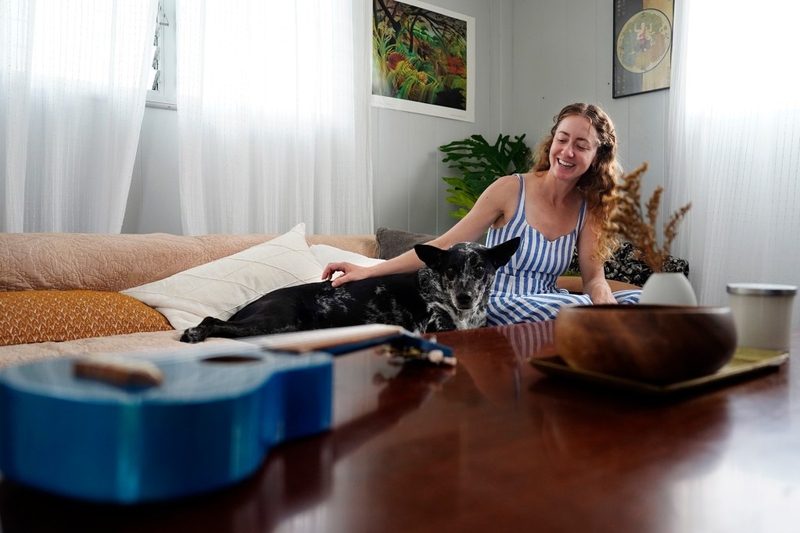
“Sometimes, I have guilt because I prefer to be serving where I live, but it hasn’t been possible until now," she said.
The situation for budding therapists will soon change.
A new state law taking effect Wednesday aims to bridge this chasm by removing the financial barrier driving local therapy graduates out of state. Act 93, signed by Gov. Josh Green in June 2024, creates provisional, associate-level licenses for marriage and family therapists, mental health counselors, and psychologists in training. It allows them to legally bill insurance providers while accruing the clinical hours required for full autonomous licensure.
Applications for the new pathway officially opened through the Department of Commerce and Consumer Affairs on June 2. But there has been confusion over application technicalities and who needs to apply for the license. Some question how much this law will actually help retain local therapists.
Hawaiʻi has long grappled with a mental health workforce crisis. The federal government designates the entire state as a Mental Health Professional Shortage Area. A 2022 survey by Community First Access to Care found that mental health counseling was the state's most critically needed medical specialty, cited by 78% of local healthcare providers.
The preamble to the bill reads: “This model of living is unsustainable and causes many of these practitioners to permanently move from Hawaii to one of the many other states where insurance reimbursements are allowed.”
'Brain Drain'
Experts say that aspiring therapists in Hawaiʻi often underestimate the financial and bureaucratic obstacles that await them after graduation.
Under the current system, depending on the therapy license, post-graduate therapists have to accrue 1,000 to 3,000 hours of supervised experience — the equivalent of 25 to 75 40-hour weeks — over a minimum of two years before getting fully licensed.
The problem is that the new therapists cannot get paid for their work. Since there is no mechanism to bill insurance, in most cases, private practices and community clinics have to pay the fledgling therapists out of their own pockets, which many cash-strapped practices can’t afford.
Graduates are left with the choice of working those hours for little to no pay, taking on a second or third job, getting licensed in a state with associate licensing pathways or switching professions altogether, said John Souza, an assistant professor specializing in marriage and family therapy at the University of Hawaiʻi Mānoa.
Data collected by Souza illustrates this systemic toll. According to his preliminary findings, pre-licensed postgraduate therapists named licensing and bureaucratic barriers as top obstacles to practicing in Hawaiʻi. During grad school, 75% of students identified as local, compared to 33% percent of people surveyed who had graduated from their programs in Hawaiʻi. The research found that around 44% of therapists working toward licensure were paying for supervision in addition to working for free, at an average cost of roughly $8,400.
“These students are kind of walking into this fog,” Souza said. “It’s like they’re going into this blindly and not aware of just how much it’s going to cost for them to enter this career.”
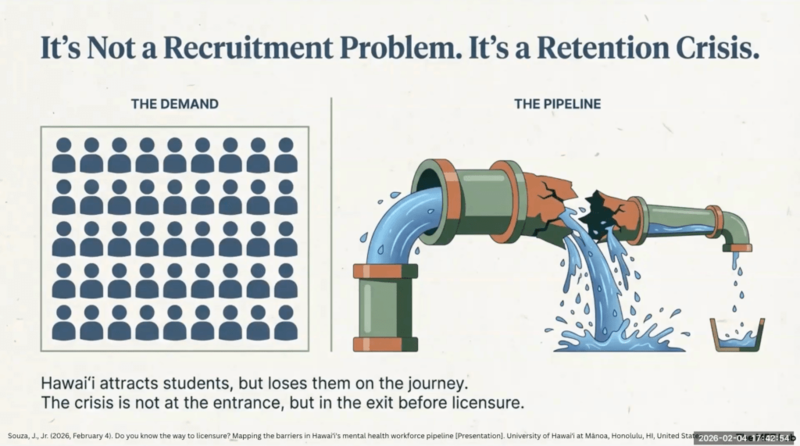
Advocates warn that this financial bottleneck results in a loss of talent that directly impacts the competence of care available to Hawai’i locals.
“You have a terrible brain drain where people are leaving Hawai‘i because they can’t afford to work another year with either no income or very low income,” said Alex Lichton, legislative chair for the Hawai‘i Psychological Association.
And the system ends up perpetuating socioeconomic disparities.
Due to the inability to bill insurance, some younger therapists pursuing full licensure choose to work for private practices that mainly serve wealthier people who are able to pay for therapy in cash, creating even greater disparities in access to care.
“The people that survive the whole process disproportionately tend not to be Native Hawaiian, it’s disproportionately Caucasians,” Lichton said, adding that he received financial support from his family while pursuing licensure.
That demographic imbalance carries heavy clinical consequences. A study published in the Journal of Counseling Psychology demonstrated that racial and cultural mismatch between patient and therapist significantly increases premature dropout rates in therapy.
In Hawai'i, where Native Hawaiian and Pacific Islander populations face disproportionately high rates of historical trauma, the lack of homegrown and Indigenous therapists widens existing healthcare inequities.
Kawaiolaakealiʻi Kapuni, born and raised on Maui, had a white woman as her first therapist whom she was paired with under her insurance at the time.
“I felt like I had to do more explaining about fundamental concepts before getting to the problem itself,” she said. When she switched therapists to a non-Indigenous woman of color, she had a similar experience.
She has never been able to see a Native Hawaiian therapist. “I don’t know how many kānaka ʻōiwi see a future for themselves in that field because there are so many barriers,” said Kapuni, adding that the bill doesn’t go far enough to address how healthcare inequities exist for Native Hawaiians.
In terms of one day having a Native Hawaiian therapist, she thinks there would be a level of intimacy that would make them better able to connect with their clients. “I think it would be life-changing," she added.
Joanne Okika Shigeko Qinaau, a former PhD student in clinical psychology at UH Mānoa, wrote about the challenges facing local therapists in written testimony supporting the bill.
“The status quo is unsustainable and particularly challenging for those of us from underprivileged backgrounds,” Qinaau wrote, adding, “This bill would improve on-the-job training and cultivate homegrown talent - encouraging folx to stay in Hawai'i and meet the unique needs of our community.”
Uncertainties Remain
The state Office of Wellness and Resilience hosted a town hall meeting on Thursday to answer questions about the new law.
The comment section in the Zoom room flooded with confused applicants. Many worried that a surge of applications could take a long time to process, meaning clinicians whose applications are still in process on Wednesday can be in violation of the law if they continue treating their clients.
“Passing the national licensing exam was the easy part," said Alexandra Love, who was born and raised in O’ahu and now runs her own private practice in Maui, about the time she applied for her license in 2016. She added that dealing with the department in charge of licensing was, "the true test, because everything is so slow.”
She expressed concern for her supervisees, who are applying for these associate licenses.
Cindy Matsushita, licensing administrator at the Department of Commerce and Consumer Affairs, or DCCA, said during the town hall that the office has received 42 applications and 25 of them have been approved or are “in the process” of being approved, as of noon on Thursday. Previously, DCCA estimated that it would receive between 200 and 300 applicants during the initial one-month rollout window of the new program.
Tia Roberts Hartsock, director of the Office of Wellness and Resilience, wrote in a statement to Civil Beat: "We are aware of the issue and are working to resolve it.”
It is also unclear how much private insurance companies like Hawaii Medical Service Association and Kaiser Permanente will reimburse. While the new law allows associate billing, it does not mandate specific reimbursement rates.
Kathleen Kozak, Medical Director at UHA Health Insurance, declined to share UHA’s reimbursement rates, but said that “CMS reimburses different levels of providers, and we tried to come up with something that was similar in percentages.”
A spokesperson for HMSA said that “eligible services provided by practitioners in training are reimbursed at a lower rate than services provided by fully licensed providers, which reflects their licensure status and supervised role in care delivery.”
If commercial insurance companies set associate reimbursement rates too low, private practices may still struggle to offer livable wages to graduates.
Mulligan, the pre-licensed therapist on the Big Island currently accruing her hours online in Colorado, is in no rush to apply for the associate license.
With only eight months left before she qualifies for full autonomous licensure via her out-of-state remote work, she is uncertain how much applying for the program will change her current situation.
“Even if I can take insurance here, if they offer low rates to associates, I might as well wait to go through all of the paperwork later,” she said.
Civil Beat's health access reporting is supported in part by the Atherton Family Foundation.
Honolulu, HI