Haunting mystery in Nebraska town: How a federal Native American boarding school lost its dead
May 30, 2026 | 6:15 am ET
Description
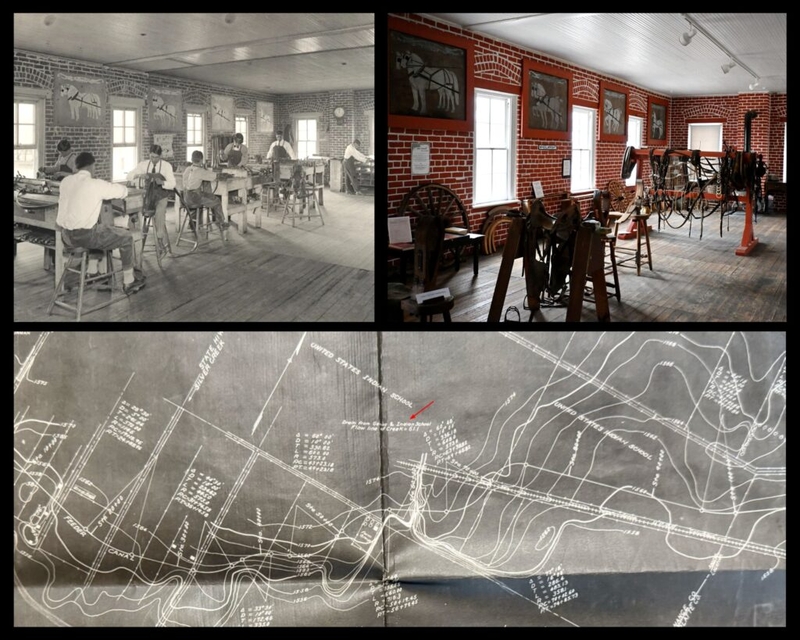
Students at a Native American boarding school in Genoa, Nebraska, work inside the school's manual training building. (Courtesy of Genoa Historical Museum)
GENOA, Nebraska — No one can find the graves.
For 50 years, Native American children from across the country were brought to the Genoa U.S. Indian Industrial School, a federally run boarding school in rural Nebraska. Multiple generations were stripped of their language, physically abused and isolated from their communities in the name of forced assimilation.
At least 86 students are known to have died there. Records show nine students were buried in the now-missing school cemetery. The remains of 37 others were sent home to their tribes. The final resting place of 40 is still unknown.
Researchers have scoured archives across the nation. They’ve pored over federal documents, letters and newspaper clippings. Archeologists used ground-penetrating radar on the former school campus, dug into the earth — and found nothing but dirt.
Instead, those who search for the school’s burial ground stumble upon a haunting question: How did a federal institution that once held nearly 600 children lose its dead?
The canal and the dig
The fourth-largest federal boarding school in the nation, the Genoa U.S. Indian Industrial School operated from 1884 to 1934. Children from more than 40 tribes were brought to the sprawling campus in Genoa, Nebraska, a small community 110 miles west of Omaha.
The institution was one of hundreds built across the country in the late 19th and early 20th centuries with the mission of forced assimilation and colonization.
In 1933, as the school entered its final years in operation, leaders of the newly formed Loup River Public Power District were just getting started on an ambitious man-made power canal that would run from Genoa to Columbus. The project would drastically shape the future of public energy in Nebraska.
On Nov. 18, 1933, school Superintendent Herman Bogard typed a letter to the Commissioner of Indian Affairs in Washington D.C. He said the Loup River Public Power District wanted to lease a piece of school property for the building of the canal. There were a few details to iron out.
“First, I want to strongly indorse (sic) and recommend that the Indian Office cooperate with the Loup River Public Power District in every way to bring this project to a successful conclusion,” Bogard wrote. “There are a few obstacles in the way with respect to the canal crossing our school farm near Genoa.”
The campus would need a new drainage ditch. A bridge would have to be built across the canal. And something would have to be done about the school’s cemetery.
“The canal must either be diverted north or south to miss this graveyard,” Bogard wrote, “or the bodies if possible will have to be removed to another area.”
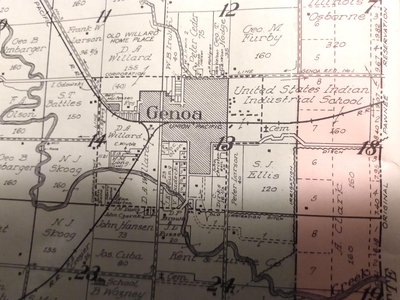
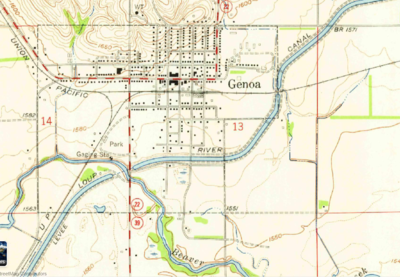
It’s unclear which course of action the Loup River Public Power District and school leaders took. But there are a few theories, said Rob Bozell. The former state archeologist led ground-penetrating radar surveys near the canal in 2021. He was guided by an 1899 Nance County map that indicates the cemetery’s location was on the eastern side of the former campus.
“The map shows where the cemetery is right next to this canal, like right next to it,” Bozell said. “And, in fact, kind of how you plot it, it could be either side of it, or it could be in the middle of (the canal).”
There’s also a slight curve where the canal was built on the former school campus, Bozell said. He’s heard theories that the deviation in the waterway could have been made to avoid the graveyard.
The Loup Power District (the organization’s current name) did not respond to multiple requests for comment from Nebraska Public Media.
There is no doubt among archeologists and researchers that a cemetery once existed on the school campus. Multiple references to children buried in the school graveyard have been found in newspapers, letters and in the recollections of former students.
Following Bozell’s retirement, current State Archeologist David Williams was asked to continue the search by Judi gaiashkibos, executive director of the Nebraska Commission on Indian Affairs.
Williams led the excavation of a potential gravesite on the outskirts of Genoa in July 2023. There were several pieces of evidence guiding him to that location.
The site was marked on historic plat maps that offered an approximate location of the school cemetery. A team of specially trained cadaver dogs indicated the possible presence of human remains underground. Ground-penetrating radar surveys of the spot showed four anomalies below the ground surface.
Despite the mounting evidence, Williams and his team found no indication of a grave when they dug into one of the anomalies. Despite appearing on radar as an elongated grave-like shape, Williams said it’s possible the anomaly in the soil was caused by old tree roots or construction.
“We call them anomalies because we just don’t know what they are,” Williams said. “It’s something different about the soil texture and composition below the ground surface.”
Nebraska researchers believe that all who attended the Genoa school are now deceased.
When Superintendent Bogard sent that 1933 letter, his role as leader of the federally run boarding school was coming to an end. The institution closed within the next year, and the 625-acre campus was transferred to the State of Nebraska.
Farmland and houses filled in. Any headstones that once marked the school cemetery were lost decades ago.
“We know there’s a cemetery, Williams said. “We know there are burials out there somewhere, but we don’t know where.”
Complicated legacy
Remnants of the school are scattered among the modern-day city of Genoa. The wooden beams of an old dairy barn still hold the carved names of students. A smokestack stands at the end of a house-lined street. And a brick building once used for classes in blacksmithing and saddle-making now serves as a museum.
The search for the cemetery is personal for descendants like gaiashkibos. A citizen of the Ponca Tribe, her mother and other relatives attended the school.
“It’s a big responsibility that I don’t take lightly,” gaiashkibos said. “I look into my grandchildren’s faces, and I look back to my grandfather’s and my mother and my great aunts that went to the school. I have two generations that went to that school. I have to walk forward and learn from the past.”
When the school closed in 1934, documents were scattered across the United States. If a letter or document exists pointing to the fate of the cemetery, it has not been found in the state or national archives, nor in the limited historic records held by the Loup Power District.
In 1990, a handful of Genoa residents established the Genoa U.S. Indian School Foundation. They opened a museum in the school’s former manual training center, a well-preserved two-story brick building not far from Genoa’s main street. It holds artifacts and documents available for public viewing.
Summer Copeland became the Foundation’s first Native American president in early 2026. She walked through the doors of the museum for the first time in 2021.
“The weight hit me pretty quickly upon entering the door — the reality,” Copeland said. “Oddly enough, what struck me the most was the original wood floors.”
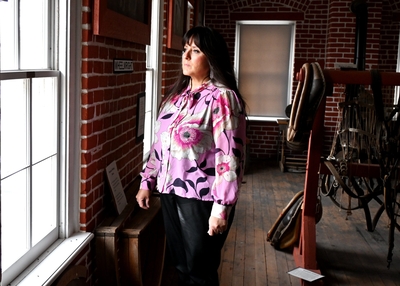
Copeland aims to transform the museum into a center for healing and education, a place where Natives and non-Natives can learn the true story of Genoa’s Native American boarding school.
She was on her own long journey of discovery when she first visited Genoa. Copeland is a descendant of the Omaha Tribe but was raised by her adoptive white grandparents who didn’t acknowledge her or her brother’s Native American heritage. Under their care, Copeland said a cycle of abuse continued.
She searched for identity as a young adult. Her biological mother found sobriety and for the first time told Copeland of her family on the Omaha reservation. Copeland was in her late 40s when she enrolled in the Omaha Tribe. She would later learn that her great-grandparents attended the Genoa school.
“My personal history reflects the experiences of cultural loss like many descendants of forced assimilation and cultural genocide,” Copeland said.
There was a lot taken from the children of the nation’s Native American boarding schools. Their hair was cut, clothes and tribal belongings whisked away, and any attempt to communicate in languages other than English could be met with physical punishment.
A few years ago, Copeland took something back — an Omaha name.
“Umonhons (Omahans) usually receive their name on the fourth day of their new lives,” Copeland said. “I didn’t receive mine until I was almost 50 years old.”
Her name is Uthéamoⁿthiⁿ. She said the meaning traces back to a time when herds of buffalo traveled across the land, leaving deep tracks so they could always find their way home.
A path forward
Williams and gaiashkibos are still searching.
The dig in July 2023 excavated an area that included part of one of the four anomalies shown on ground-penetrating radar. There’s still three to go.
“Our hope is we can get those permissions and guidance and assistance and get back out there to open a larger area,” Williams said. “If we need to then, you know, shift our efforts to looking somewhere nearby or somewhere else entirely out there.”
Historians and government officials in recent years have scratched the surface of the nation’s boarding school era. Spurred by the discovery of unmarked graves at similar schools in Canada in 2021, The Interior Department under Secretary Deb Haaland launched an investigation into the federal and church-funded boarding school systems.
The department’s published findings estimate at least 18,000 children were taken from their tribes and forced to attend schools founded in the name of assimilation. It also documented nearly 1,000 deaths and 74 gravesites associated with the more than 500 schools. Historians believe that the true death toll is likely much higher.
In Nebraska, gaiashkibos works to ensure the story of the Genoa school is told.
In 2022, she advocated for the Nebraska Legislature’s passage of a resolution designating Feb. 20 as the annual day of remembrance for those impacted by the Genoa Industrial School’s legacy.
“I keep praying that these children, somehow, their voices are going to lead us to where we can find them,” gaiashkibos said, “Or at the minimum, resolve that we cannot find them, and then decide how that honor can be given to them.”
This story was originally published by Nebraska Public Media News, a network of local reporters working with a National Public Radio station based in Lincoln.
Lincoln, NE