Arizona Supreme Court strengthens public records law in ruling against U of A
Sep 18, 2026 | 9:30 pm ET
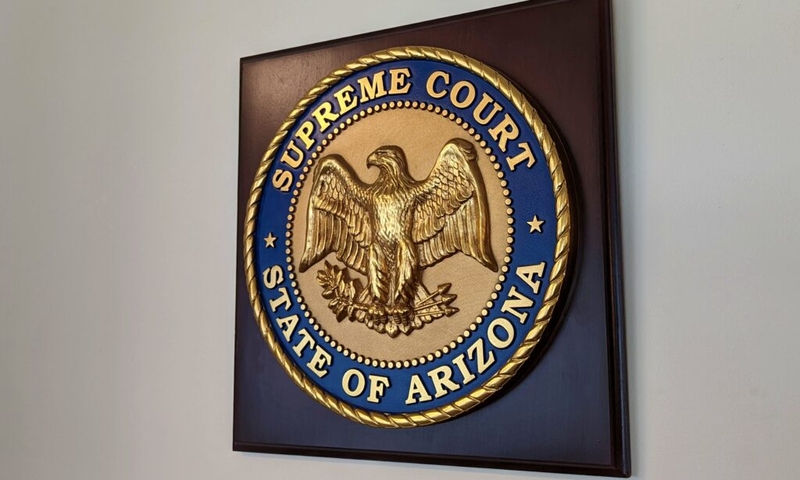
Description
(Photo by Jim Small/Arizona Mirror)
Destroying a public record after a member of the public requests it should land government agencies in legal trouble, the Arizona Supreme Court ruled today.
Matthew Abraham, a former English professor at the University of Arizona, sued the Arizona Board of Regents after the university denied access to a list of records pertaining to hiring practices — including a committee meeting recording destroyed by the university despite an outstanding record request.
In a unanimous decision, the Arizona Supreme Court on Friday ruled that destruction of a public record sought by a member of the public constitutes a denial of access. And, the justices said, it needs to be courts, not government agencies, who determine whether a withholding or redacting public records is in line with public records law.
“This decision makes clear that public entities cannot avoid their disclosure obligations by destroying requested records, delaying production, or simply deferring to their own determinations about what the public is entitled to see,” Benjamin Rundall, an attorney for Abraham, said in a statement. “This is an important victory not only for Dr. Abraham, but for every Arizonan who relies on public records to understand what their government is doing.”
In 2017, Abraham was a member of the committee on faculty governance, known as the “Committee of Eleven.” He raised concerns about the university’s adherence to an Arizona law prohibiting hiring and admissions based on race, sex or gender.
And after Abraham was rejected from program director positions, he started filing public records requests related to the university’s appointment and hiring practices from November 2018 to September 2020.
Among his requests were survey data, records pertaining to the search and selection process and an audio recording of an October 2019 Committee of Eleven meeting.
The university produced some records with redactions and withheld others outright, citing privacy, confidentiality and an exception in Arizona public records law that shields records from public view if withholding them is in “the best interest of the state.”
The university first denied his request for the audio recording, but then said it would allow Abraham to listen to it in a private space — though it refused to give him a copy. Abraham denied that offer and persisted in his request.
Abraham eventually hired an attorney, who sent a demand letter to the Arizona Board of Regents renewing his past requests for records. And with attorneys now involved, the university reversed course in some instances, acknowledging it incorrectly withheld some records.
But the university stood its ground on withholding other records. And it informed Abraham the recording of the meeting was no longer available because it had been destroyed.
Then, Abraham took the issue to court.
A trial court judge ruled that, although the university initially violated public records law by withholding some of the documents, it “cured” its fault by eventually turning them over. The judge also said the university was empowered to decide which records it chose to withhold or redact. And the trial court found Abraham’s claim regarding the destroyed committee meeting recording was no longer valid because the record no longer existed.
The judge also ruled that Abraham was not entitled to any attorneys fees because his lawsuit did not result in any more records being provided.
The Court of Appeals agreed with the lower court, concluding that the Arizona Board of Regents had acted within its discretion to redact and withhold certain documents. It also took no issue with the destroyed record.
Abraham’s appeal left the Arizona Supreme Court grappling with destruction of records, the standard of review for records disputes and how to discern who truly won a public records case when sorting out attorneys fees.
The high court saw it differently than the appellate and trial court.
In an opinion authored by Justice Clint Bolick, the court deemed the post-request destruction of a document to be the “ultimate denial,” and an illegal one at that.
Bolick wrote that the destruction of the recording “seems an obvious violation of the statutes,” finding Abraham had the statutory right to listen to the recording and to obtain a copy. And, he wrote, ABOR had the obligation to maintain the record after it was requested.
“Given that it was the subject of a public records request, it surely had further legal value, making its destruction improper,” Bolick wrote. “An agency’s retention policy must yield to the statute. The destruction and concomitant failure to produce were therefore a wrongful denial of a public record.”
The justices further found that the court must look at and decide public records access cases with fresh eyes, not simply deferring to the government agencies denying the records in the first place.
And as for attorneys fees, the Supreme Court said that courts must also take into account the legal action taken before a lawsuit is filed when deciding whether a plaintiff “substantially prevailed.”
“A contrary reading would frustrate the purposes of the public records laws by allowing a public entity to stonewall a request until just before a lawsuit is filed without financial penalty,” Bolick wrote. “Thus, the court should consider the requester’s overall success, not merely any additional success that might accrue after the lawsuit is filed.”
Rundall said the ruling “reaffirmed that our public records laws exist to ensure government transparency and accountability.”
Attorneys for two groups who filed amicus curiae, or “friend of the court” briefs, celebrated the ruling, too.
Nicholas Ansel, an attorney for the Arizona Center for Law in the Public Interest, said the ruling clarified and reinforced the importance of public records law and government accountability. It cements the fact that agencies can’t just “destroy documents and then wipe your hands of it.”
“It’s really the court’s role to police the government’s withholding of what qualifies as public records, and the extent to which a confidentiality interest that the government serves can outweigh the people’s right to see what the government’s up to,” Ansel said.
Parker Jackson, an attorney for the Goldwater Institute, noted the Arizona Supreme Court’s recent pattern in reinforcing public records law.
He pointed to a recent ruling in the Goldwater Institute’s case against the City of Phoenix, in which the justices unanimously found government agencies withholding records must demonstrate a degree of likelihood that it would face specific, material harm if it disclosed the record.
“The ruling demonstrates that government transparency is on a roll at the Arizona Supreme Court,” Jackson said. “It reinforces that public records disputes when they go in front of a judge are on a level playing field, that the judge actually has to meaningfully scrutinize a government’s decision to withhold records.”
Friday’s ruling sends the case back down to the trial court to determine whether additional records must be produced and whether Abraham substantially prevailed and is eligible for attorneys fees.
ABOR deferred comment to the University of Arizona. The university did not immediately respond to a request for comment.
Phoenix, AZ