Groups push Gov. Landry to address Big Oil’s orphan wells
Oct 28, 2026 | 5:00 am ET
Description
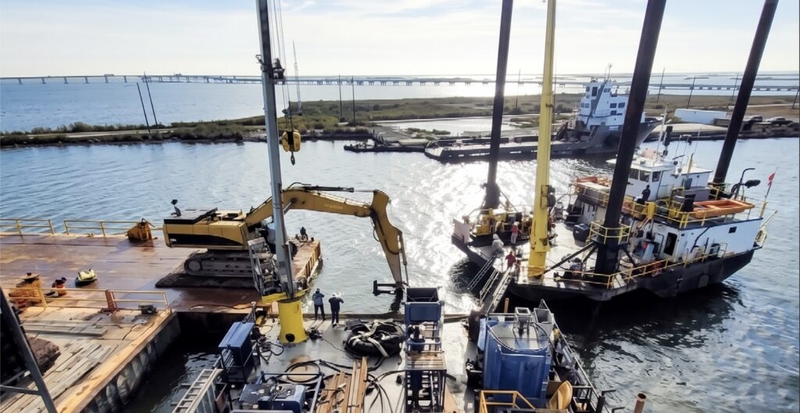
Contractors with the Louisiana Department of Conservation and Energy's Oilfield Site Restoration plug an orphaned well. (Photo by Louisiana Department of Conservation and Energy)
A coalition of environmental groups is asking the governor to address the risks of orphan wells, citing a new report detailing thousands of abandoned drilling sites throughout the state.
The groups sent a letter to the governor Monday asking if he would meet with them to discuss his vision for tackling what they see as a looming threat to the state’s vulnerable coastal areas and the ecosystems they host.
“Louisiana should not have to clean up messes that are connected to some of the world’s richest oil corporations,” Rachel Mathews, a senior attorney at the Center for Biological Diversity, said in a news release detailing the letter sent to the governor.
The letter references a new analysis Mathews authored. Other groups that co-signed the letter to Landry are the Deep South Center for Environmental Justice, For a Better Bayou, Habitat Recovery Project, Healthy Gulf, Louisiana Wildlife Federation, Mossville Environmental Action Network and Vessel Project of Louisiana.
Mathews cites data from the LSU Center for Energy Studies that places the number of orphan wells in Louisiana at more than 6,300, up from 4,900 orphan wells in March 2025. They include at least 724 in state coastal waters that major oil companies once owned, with some having changed hands through acquisitions.
“Orphan wells are those whose current operators are unwilling or unable to plug them — leaving the state responsible for them,” the groups’ letter reads. “Louisiana has never been able to reduce its orphan well population because the number of wells that oil companies abandon to the state is far outpacing the state’s ability to plug them.”
The governor’s office did not respond to requests for comment on the groups’ letter or their request to meet with Landry.
The state government’s approach to oil well abandonment involves a financial commitment exploration firms are required to make before they obtain a state drilling permit. The companies must submit written proof that they have the resources to permanently shut down the well they are drilling, with costs averaging $113,000 per well according to a Louisiana Legislative Auditor calculation. Using that figure, it would cost nearly $712 million to plug all of the state’s current orphan wells.
It’s up to the state Department of Conservation and Energy to tackle orphan wells that the companies abandon. The agency permanently plugs about 125 sites a year, according to LSU data cited in the report. At that pace, it would take more than 50 years to erase the current backlog without any new orphan wells being added.
The state had between $126 million and $250 million in combined state and federal money to put toward orphan well abatement as of July 2025, according to LSU research.
Department of Conservation and Energy officials were not available for comment before the deadline for the report.
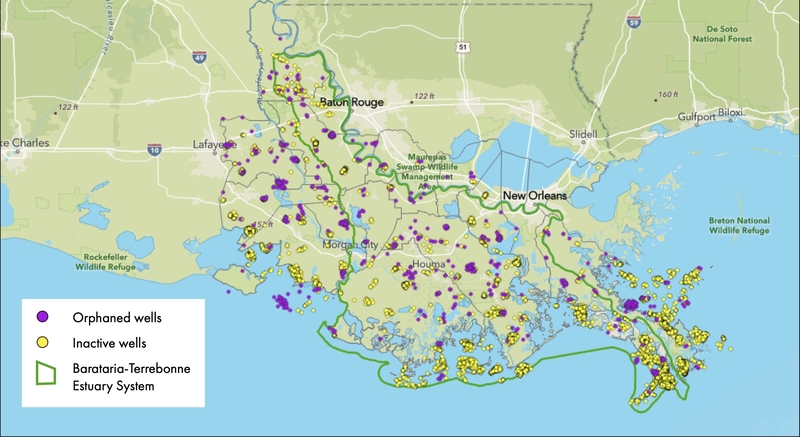
The groups’ letter highlights what they see as an acute orphan well problem in the Barataria-Terrebonne estuary, which lies between the Mississippi and Atchafalaya rivers and touches 16 parishes. The area is home to 509 orphan wells and 3,231 that are inactive, a status that typically means the cost to operate and maintain the well exceeds the value that can be extracted from it.
There are more than 22,000 inactive wells across the state. Oil and gas companies are only required to pay the state a few hundred dollars in annual fees for each one they take offline. The environmental groups say the system fails to encourage the industry to permanently plug their dormant wells, some of which sit inactive for decades with no indication they will be put back in production.
“If Louisiana is ever going to get ahead of this problem, it must focus on getting oil companies to comply with their obligations to plug the wells they’ve profited from before the wells are orphaned,” the letter reads. “This should start with requiring companies to plug their inactive wells.
Recommendations to the governor from the group’s letter include:
- Prioritize getting the industry to plug offshore and coastal wells, which are at high risk of failure, the most costly and complicated to plug, and most likely to impede coastal restoration efforts.
- Develop a plugging plan based on priority oil and gas fields, not just by well.
- Adopt a process for the Department of Conservation and Energy to require former operators to plug wells before they declare a site orphaned.
- Close the loophole in state law that allows operators to pay an inactive well fee instead of plugging their idle wells.
- Stop the transfer of state drilling leases to or from companies with overdue well-plugging obligations.
Baton Rouge, LA