New Mexico students walk out of classes to protest data centers, US Sen. Heinrich’s permitting bill
Oct 27, 2026 | 6:53 pm ET
Description
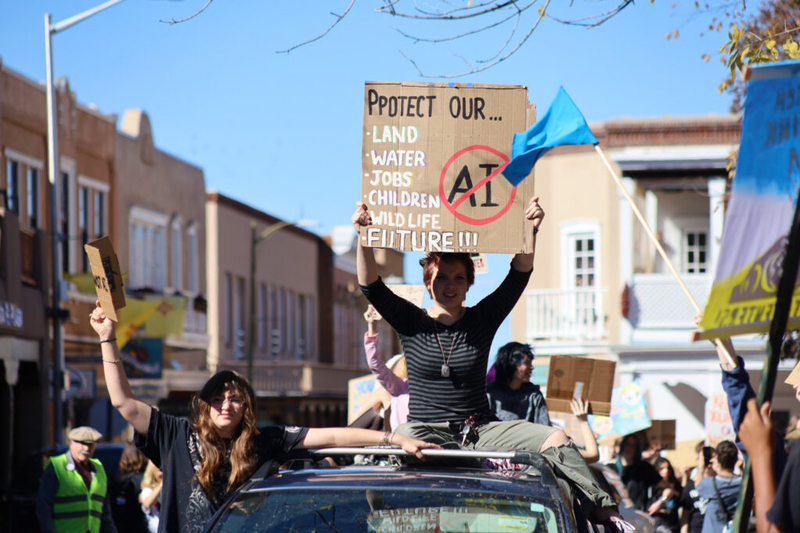
Students from the New Mexico School for the Arts in Santa Fe marched to the Capitol for the "Pull Out the Plug" protest on Oct. 27, 2026. (Photo by Matt Mondschein/Source NM)
Hundreds of students from New Mexico School for the Arts in Santa Fe and the University of New Mexico in Albuquerque — some donning Halloween costumes — walked out of classes Tuesday and joined protests organized against data centers, pipelines and fossil fuel projects.
The protests, organized by Youth United for Climate Crisis Action (YUCCA), followed a Sunday protest on the Las Cruces campus of New Mexico State University and a coordinated campaign to support a data center moratorium during next year’s legislative session.
“We will not get back the last 20 years of climate progress Project Jupiter will undo,” Isabelle Taylor-Ault, a student organizer and junior at NMSA, said to the crowd outside the Roundhouse in Santa Fe. “You, the adults, the ones supposed to be fighting for us, you may get the privilege of dying of old age, but our children will die from climate change.”
A handful of state lawmakers sitting on the interim Water and Natural Resources Committee — which was meeting on the Capitol’s third floor — headed down to watch the protest unfold.
State Rep. Micaela Lara Cadena (D-Mesilla), a vocal critic of Project Jupiter and one of the first state lawmakers to call for a statewide data center moratorium, told Source NM she was thrilled to see teenagers across the state opposing the development.
Last month, Democratic gubernatorial nominee Deb Haaland said if elected on Nov. 3, she plans to enact a statewide data center moratorium as an executive order immediately upon taking office. Lara Cadena acknowledged that the Dec. 7 public hearing on whether to give Project Jupiter’s power source an air quality permit — one of the last hurdles the data center needs to clear to become fully operational — could result in a decision before then, but said she plans to continue using her office to hold the industry to account.
“Those permits haven’t been issued yet,” she said.
Protesters — bearing signs with messages like “El agua es vida,” “This sign was not made by AI” and “Make Orwell fiction again” — stood in a circle around the perimeter of the second-floor rotunda, where they began a “Stop Project Jupiter” chant.
As the chant echoed across the rotunda, they marched upstairs to Gov. Michelle Lujan Grisham’s fourth-floor office. Standing outside Lujan Grisham’s office, they shouted in unison: “MLG, you can’t hide. You support ecocide.”
Office staff told the students Lujan Grisham was out of office, but Kaila Rubbel, a visual arts student at NMSA, waited outside for her turn to write and deliver a letter to the governor. She told Source NM that she wants Lujan Grisham “to take action. I want her to stop this. And I think that not showing up or not doing so shows us who she is.”
Michael Coleman, Lujan Grisham’s communications director, told Source NM in an emailed statement Tuesday that the governor “understands that young New Mexicans are frustrated with the American political system, and she shares their concerns about some of the issues raised during today’s protest.”
Still, the governor urged the protesters to respect public property and not interfere with government employees “simply doing their jobs.”
“The governor received the letters the students left in our office, and she plans to read and consider them,” Coleman said. “She hopes the students work to stay informed and continue to participate in the political process.”
In Albuquerque, protesters directed much of their ire toward U.S. Sen. Martin Heinrich (D-N.M.), who recently unveiled a sweeping, bipartisan permitting reform bill that protesters say reduces tribal input and empowers fossil fuel companies to quickly break ground on more harmful projects.
New Mexico US Sen. Heinrich touts bipartisan permitting reform bill amid environmentalist criticism
More than 100 protesters marched from the UNM bookstore down Central Avenue to Heinrich’s downtown Albuquerque office. In front of a large sign that read “Heinrich is a sellout,” protesters with YUCCA, as well as Indigenous and environmentalist groups, described the bill as a betrayal by a longtime champion for tribal and environmental causes.
Heinrich’s bill, the Bipartisan American Affordability and Jobs Act of 2026, seeks to hasten the federal permitting process for a variety of projects, including data centers, solar arrays, renewable energy transmission lines and more.
The 400-page bill, cosponsored with U.S. Sen. Mike Lee (R-Utah) and two other senators in both parties, has drawn praise from labor unions, as well as both the American Petroleum Institute and the American Clean Power Association. Groups touting bipartisan policy have also lauded it as a step forward on a policy matter that has long frustrated advocates for all types of energy production in the United States.
But critics have said the pros of the bill that Heinrich has touted — namely a prohibition on data centers imposing energy production costs onto ratepayers, and hastening the approvals of renewable energy projects — are far outweighed by the bill’s other provisions. Protesters on Tuesday said the bill erodes hard-fought environmental protections like the National Environmental Policy Act and laws requiring tribal input.
The All Pueblo Council of Governors, which represents 19 New Mexico pueblos, released a resolution on Tuesday that says the bill’s provisions will combine to ultimately “weaken protections for Pueblo sacred places.”
Outside Heinrich’s office, protesters carried signs decrying “data center giveaways” and “fossil fuel sellouts” and chanted “Kill the bill!” in between speeches.
New Mexico State University students and organizers call for statewide ban on data centers
“We need NEPA. We need our Clean Water Act. We need all of these things because they are the bare minimum for what we need to survive on this land,” Ahtza Chavez, executive director of Naeva, an Indigenous voter empowerment organization, told attendees Tuesday. “And this senator has the gall to say that he’s going to rip that out of our hands. I don’t think so.”
Heinrich’s spokesperson Luis Soriano, in a statement to Source NM on Tuesday, said Heinrich’s bill “actually holds data centers accountable for their energy usage while speeding up the approval of clean energy projects that put cheaper and cleaner electricity on the grid.”
As for tribal consultation, Soriano said that Congress needs to pass the bill to ensure that President Donald Trump’s administration is required to heed tribal input instead of ignoring it.
“The legislation also defends against the Trump administration’s efforts to make all Tribal consultation discretionary and eliminate consultation altogether on cultural landscapes. All of this means stronger Tribal consultation protections, lower utility bills, more good-paying jobs, and a path toward unlocking our clean energy future.”
Santa Fe, NM