Can this film change our understanding of the climate and migration crises?
Oct 28, 2026 | 3:00 am ET
Description
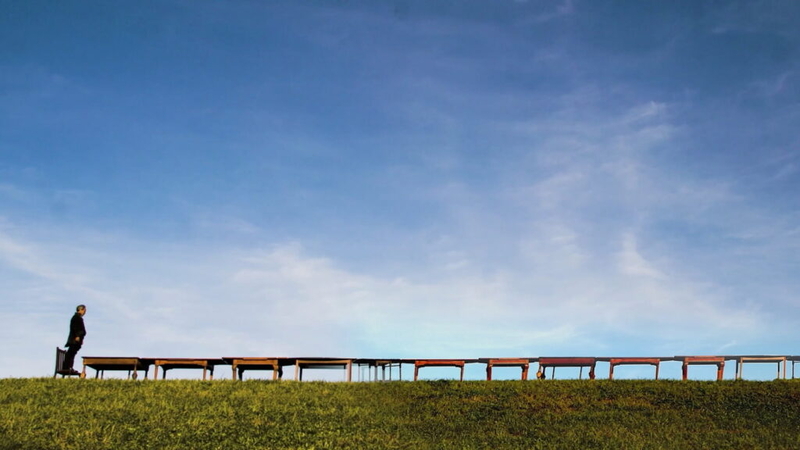
A still from The Welcome Table. (Image courtesy HBO.)
This story was originally published by Capital & Main.
Filmmaker Josh Fox has racked up a lot of miles covering the climate crisis. Sparked by a confounding business offer at his family home nearly two decades ago, his latest project took him around the world to tell stories of people uprooted by extreme weather and natural disasters.
It started in 2008 when a fracking company approached Fox, whose family has long had a home in northeastern Pennsylvania, with a $100,000 offer to lease minerals beneath the property for natural gas development.
Attempting to make sense of the offer, Fox turned to a nearby town already on the frontlines of fracking: Dimock. In that rural Pennsylvanian hamlet, he found families complaining that the natural gas extraction technique had ruined their well water and caused stomach aches and other sicknesses.
That spurred Fox to go deeper and take a road trip, documentary gear in tow, to natural gas-producing areas across the United States where, over and over, he heard testimonials from landowners living near operations of the nascent industry.
He discovered people who would hold a match up to their kitchen faucets — and light their tap water on fire. He strung together such images in the Emmy-winning, Oscar-nominated documentary “Gasland,” a cautionary tale about the risks of the booming industry, which saw the number of fracking wells nationwide multiply 13-fold between 2000 and 2015.
In the years since, the industry has continued to grow, even as climate change-fueled natural disasters have surged in frequency and severity.
In the shadows of “Gasland,” which was pivotal in paving the way for what developed into a potent protest movement against fracking, Fox’s latest film, “The Welcome Table,” shows the result of continued fossil fuel development.
The HBO Original Documentary takes viewers into communities on six continents that Fox visited over a nine-year period. It follows climate migrants who are victims of wildfires — like the 2018 blaze that nearly wiped the town of Paradise, California, off the map — floods and hurricanes, back to the homes from which they fled or to the new ones to which they relocated.
The film visits residents in communities ravaged by drought and mudslides where locals are holding out after fearful neighbors took off. It also features climate migrants who, among the growing number of people seeking refuge in other countries, are hampered or blocked entirely by tightening border policies that don’t take into account the gravity of their hardships.
The film argues that solving the climate crisis and the vast global migration intertwined with it will require collaboration, not division.
Ahead the film’s Oct. 25 national tour kickoff, Fox spoke with Capital & Main about the new film, how it fits into his larger body of work and what it says about the state of the climate crisis.
This interview has been edited for clarity and brevity.
Capital & Main: Some of the first shots in this movie are from the Paradise fire in Northern California in 2018, where you follow a couple who lost their home as they wade through the rubble of their old lives. That was eight years ago. When and how did you know you had a movie on climate migration — a departure from your earlier films on resource extraction?
Josh Fox: So, with “Gasland,” there’s this image of people lighting their water on fire. Ninety-nine percent of people have a kitchen sink. So, when you light the water on fire, they’re like, “Oh f—, that’s just like my kitchen sink.” And people would tell me that they went home to try to light their water on fire, even though they were living nowhere near fracking.
But nobody has [a visceral concept] of their “climate” [the way they have a concept of their tap water]. This is a problem.
“The Welcome Table” is not a climate movie. I think climate change is the background, the backdrop. I felt like what we needed to look at was: How many people are going to lose their homes? How many people are going to be displaced?
I realized that these two issues [climate and immigration] were on such a collision course. And the film focuses on people losing their homes because home is so intrinsic to everyone. Everyone should have a home, or at least has an idea of home, right? Even if they don’t have an idea of “climate.”
“Gasland” was really about one thing — fracking. “The Welcome Table” is about climate change, but also nationalism, border policies and colonialism, and these three things get their own attention in the movie. Was that intentional?
We have made a tragic error about what the cause of climate change was by focusing on parts per million of carbon dioxide in the atmosphere. That’s a symptom. Colonialism is the real cause, and the ideology that goes along with it. What I wanted to show was people’s reaction to loss and crisis. As [a Brazilian community leader named] Gabriel says at the end of the movie, “Home is not a place; home is the people around me.” That’s the only home we have left.
“Gasland,” which came out in 2010, in the early days of natural gas extraction, was a cautionary tale about fracking. “The Welcome Table” is about not listening to that cautionary tale. As our societies have extracted and burned more natural gas, these people who have seen their homes threatened by climate change are living proof of the result.
This is the result of 100 years of influence of the oil industry on our politics. It’s more powerful than anything. Our leaders didn’t want to take it on, and as a result, the world is burning and it’s a disaster. The question is: Can we move on from this extractive ideology, or will it destroy the planet? There are these giant questions that I don’t know the answer to, but it does feel very dire at this moment.
“Gasland” created a lot of buzz, including in and around Dimock, where, 12 years after the film came out, Pennsylvania Gov. Josh Shapiro, then-attorney general, secured a plea deal from a fracking company charged with polluting the area. The deal saw the company agree to pay for a clean water line for residents. Yet, the same day, regulators lifted a vital protection preventing fracking in the town that had been in place for 10 years. Is this the justice you expected for that area, and what does justice for the communities you feature even look like?
It’s a betrayal in every sense. It would be very helpful to redefine rural Pennsylvania as a place that has been colonized by the oil industry, by the powers that be, and whether you have a Democratic label, like Josh Shapiro, or a red one like [former pro-drilling Republican Gov.] Tom Corbett, this is not what we need.
Josh Shapiro, not only is he politically a hypocrite, but he is a better agent for the oil industry than somebody like Tom Corbett. Josh Shapiro is trying to pretend to be the good guy. Pennsylvania has a history of people who are mealy-mouthed corporate centrists who love to pretend that they are on the side of the working class, but they ignore the working class. It’s incredibly condescending and it’s dehumanizing. The first thing you do when you colonize the place is you dehumanize those people.
After “Gasland,” you faced a broad backlash from the natural gas industry, which argued the film contained falsehoods. That effort included a campaign to disqualify your film from Oscar consideration after it was nominated for best documentary. The disinformation ecosystem has changed a lot since then.
What we’re seeing right now in the arena of truth and misinformation is the toxic data that is everywhere, and it’s polluting the landscape of journalism. Misinformation is more prevalent than fact. Propaganda is more prevalent than journalism.
Right now, we need to imagine. We need to indulge that poetic part of us that is much more human and true. When I started “The Welcome Table,” we were in a different era.
The ideas that sort of bind the movie to what I imagine its audience would be are still there. The principles in there are: human rights and love and generosity. It’s better to share than to be greedy, and be accepting of people, rather than bigoted. Those things I would hope we still have a consensus about.
Harrisburg, PA