Greene, Tunney spar on budgets, gun laws and affordability in 35th Senate District candidate forum
Mar 25, 2026 | 9:59 am ET
Description
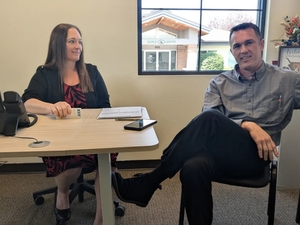
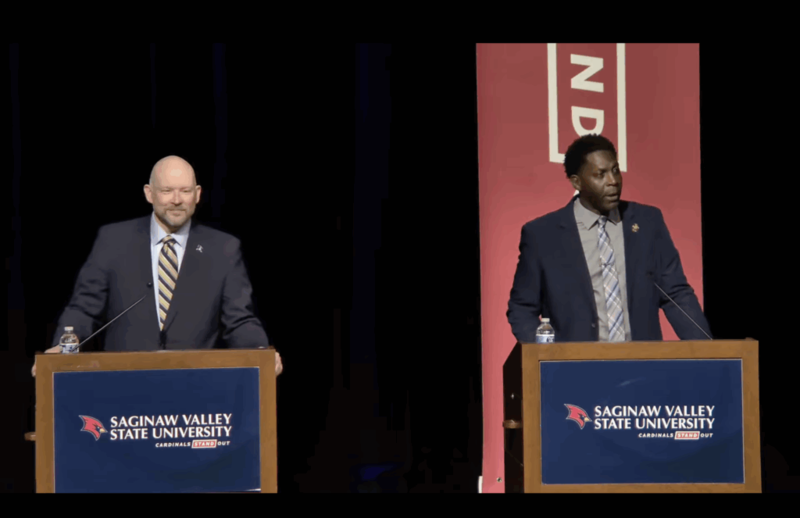
Jason Tunney (left) and Chedrick Greene (right) present opening remarks at a candidate forum at Saginaw Valley State University in their race to represent Michigan's 35th Senate District. March 24, 2026. | Screenshot.
Republican Jason Tunney and Democrat Chedrick Greene took the stage at Saginaw Valley State University on Tuesday night for a candidate forum in their special election race to represent Michigan’s 35th Senate District for the remainder of 2026.
While some of their broader priorities — improving educational outcomes and bringing more jobs to the district — aligned, the two candidates disagreed on how to get those priorities done in Lansing.
On education, Tunney, a lawyer in Saginaw, called funding free breakfast and lunch for all public school students “a waste of taxpayer money” and resources, arguing that some of the communities receiving that money are wealthy enough not to need it.
Greene, a fire captain in Saginaw and a U.S. Marine veteran, refuted that argument swiftly, saying, “None of those school districts are here.”
“We have a district that 60%, makes less than $60,000 gross,” he continued. “So when we talk about providing breakfast and lunch, for a lot of our urban and our rural areas in this district of Saginaw Bay and Midland counties, it is needed.”
Greene’s pitch centered on affordability, emphasizing again the district’s economic demographics.
“As you drove here tonight in Saginaw Valley and you looked at the price of gas, or you drove to the grocery store and looked at the price of food, small businesses can’t thrive if people aren’t visiting those small businesses,” he said, telling the crowd that he would vote in favor of increases to minimum wages. “So if I don’t have disposable income making less than minimum wage, which is currently still too low to survive on, then I’m not going to be able to survive, and those small businesses might not be able to survive.”
Tunney argued that such minimum wage increases would harm small businesses in the district, and throughout the forum, argued for lower regulations on business owners, saying that Michigan is “not business friendly.”
The Fiscal Year 2027 budget was also a central issue in the forum, as whoever wins the election will be a deciding vote in that budget’s passage through the state senate. Currently, Democrats hold a 19-18 majority in the chamber, and if Tunney is elected to the seat, he would put the chamber at a tie. Though Lt. Gov. Garlin Gilchrist can cast a tie-breaking vote, he can only do so if every member is present and there is a 19-19 tie, making this seat crucial for Democrats to maintain their control of the chamber.
“We’ve got to start making some tough decisions in this state,” Tunney said, echoing arguments made by top Republicans in the legislature about unnecessary state-owned buildings and cutting back on government employment. “We’ve got to start thinking about tax cuts in this state. We’ve got to start thinking about budget cuts in this state.”
Tunney also rejected the idea of taking money from the state’s “rainy day fund” to balance the FY 2027 budget, a proposal that Gov. Gretchen Whitmer included in her executive budget recommendation to withdraw $400 million from the fund.
Greene, on the other hand, supported that idea, saying that it is needed to fund key programs and the education budget.
“We are balancing the budget. It’s a balancing act, right? So in order to make sure that we are taking care of our constituents, we would take some of the money from the rainy day fund. How much that is, that remains to be seen,” he said. “But we have to make sure that we have a balanced budget every year, ensuring that we put in place parameters on how we are spending is key.”
Greene also criticized House Republicans for holding up the state budget in late 2025, saying that in the short term that the winner of this election will hold in the Legislature, he would count a successful term as “getting there in time to work on a budget, work on our school budget, and make sure that our things are funded, to continue to work on working family tax credits, to work on a working parent tax credit so those who are working can afford health care.”
In the final questions of the forum, the two candidates also conflicted on red flag gun laws, which allow judges to temporarily remove firearms from the possession of individuals at risk of harming themself or others.
Tunney called Michigan’s Extreme Risk Protection Orders “big government deciding who gets to do what, when and where,” and a constitutional violation. Greene, on the other hand, emphasized that as a Marine veteran, firearm safety — including red flag laws, as well as proper firearm storage — is the best way to prevent suicides and mass casualty events.
Lansing, MI