With Graham Platner exiting the US Senate race, here’s where his money could go
Jul 09, 2026 | 3:32 pm ET
Description
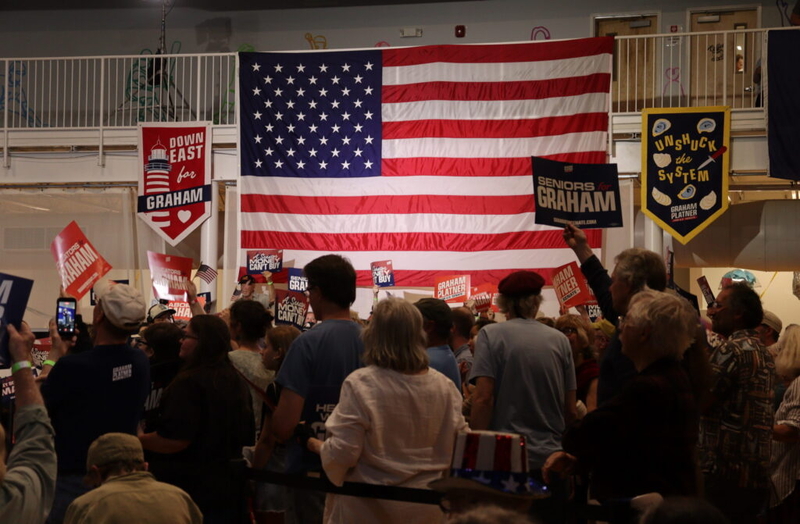
Supporters of Graham Platner rallied in Blue Hill after the polls closed in the Democratic primary for U.S. Senate on June 9, 2026. (Photo by Emma Davis/ Maine Morning Star)
With Graham Platner suspending his campaign for U.S. Senate, the Maine Democratic Party has asked for donations to support the new nominee, who Executive Director Devon Murphy-Anderson said is going to start from “scratch.”
That could be the case. Though it might not be — and a U.S. Supreme Court ruling last week has altered what’s possible.
As of the last filing deadline on May 20, Platner had $2.2 million cash on hand, but it’s unclear how much of that he spent or raised since. That will be known on July 15, when the latest campaign finance filings are due.
Platner, who announced he was exiting the race Wednesday night but has yet to formally withdraw, can use any remaining funds to pay off debts, and may have to pay back some donors who specifically donated to his general election bid since he is no longer running. He could donate funds to charity, or sit on the money for a future run.
Platner can only donate up to $2,000 to another candidate’s committee under federal law. But he could indirectly help whoever the new nominee is by way of Democratic Party groups, whose spending limits the high court recently nixed.
Platner’s campaign did not respond to questions about how it plans to spend any remaining money.
How the SCOTUS decision factors in
Already, federal law allows candidates to transfer unlimited campaign funds to a party committee or organization. On June 30, the U.S. Supreme Court removed limits on how much political parties can spend in coordination with candidates.
That means Platner’s campaign could send remaining funds to a Democratic Party group, which can coordinate directly with candidates and now aren’t capped on how much they can spend.
“It would probably have to be a national one because that’s what the Supreme Court decision dealt with,” said Mark Brewer, chair of the political science department at the University of Maine.
Given how recent of a decision it was, its application in general is untested. What is clear is that Platner’s campaign wouldn’t be able to earmark any funds it gave to a party group specifically for the new nominee.
However, Brewer concluded, “As long as there’s no strings attached, could Platner take that money, donate it to a party group, and then the party group turn around and say we’re going to use this money in a coordinated campaign with whoever the Maine Democratic Senate candidate is? I think so,” Brewer said.
It is unclear if Platner would, given that relationships between his campaign and the state party have soured as they’ve been sparring over the process of selecting his replacement.
Platner could also send money to super PACs, or independent political action committees. Those groups have already been allowed to spend unlimited money to influence elections, but can’t coordinate directly with candidates.
Whoever does replace Platner will be at a clear financial disadvantage against Collins, who already had far more cash on hand — $10 million as of the last deadline — than Platner and the backing of major super PACs.
“It’s hard to see how any of these candidates are going to catch up to Collins in terms of campaign fundraising,” said David Meyers with Open Secrets, a national nonprofit that tracks money in politics.
Financial hurdles, or lack thereof, of candidates switching from other races
That point is further drilled by the fact that candidates for state office can’t under state and federal law transfer any money raised in their previous races into a federal one.
Three of the people who have announced Senate bids after Platner’s withdrawal were candidates in Maine’s June Democratic primary. They include former state Senate President Troy Jackson, former director of the state’s Center for Disease Control and Prevention Nirav Shah, and Maine Secretary of State Shenna Bellows.
Candidates who unsuccessfully ran for Maine’s U.S. House seat in the 2nd Congressional District have no such restrictions.
Those candidates can transfer their campaign funds into a new committee for a U.S. Senate bid, or keep the same committee, Meyers said.
That process is already familiar to Jordan Wood, who initially ran for U.S. Senate before switching to run to the U.S. House. Jordan Wood had $422,975 cash on hand as of the last filing deadline on May 20.
Another former House candidate in the running for the other chamber now, Paige Loud, has $2,805.
Then, there’s former U.S. Senate candidates — both in the latest race and earlier ones. Candidates have to refile as long as there is cash in their account, even if they’ve long suspended their campaigns.
Maine Beer Company founder Dan Kleban, who left the Senate race in October but reentered after Platner’s exit, has only $419 remaining. Gov. Janet Mills, who suspended her campaign in April, has $717,000 left. Mills has not said whether she’d reenter the race.
David Costello, who stayed in the primary but lost to Platner, has reentered the race and has $41,787 left.
Current Secretary of State Shenna Bellows, who unsuccessfully ran for the Democratic gubernatorial nomination this year, had been Maine’s nominee for U.S. Senate in 2014, and lost to Collins. She ended her 2014 bid with $17,969.
Meanwhile, Collins’ unsuccessful Democratic challenger the last time she was up for reelection in 2020, Sara Gideon, still has about $2.4 million. Gideon has not indicated she’d run again.
Augusta, ME