In GOP governor debate, Biggs sets sights on Hobbs while Schweikert tries to slow him down
Jun 18, 2026 | 1:12 am ET
Description
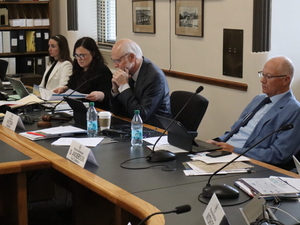
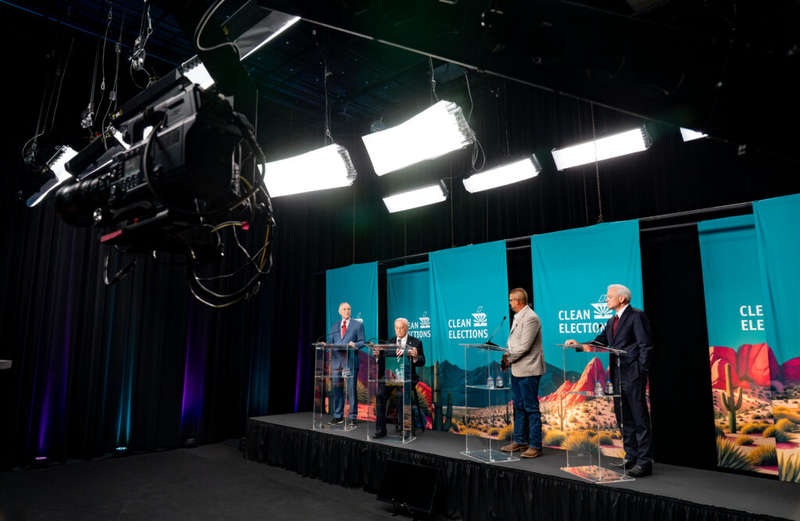
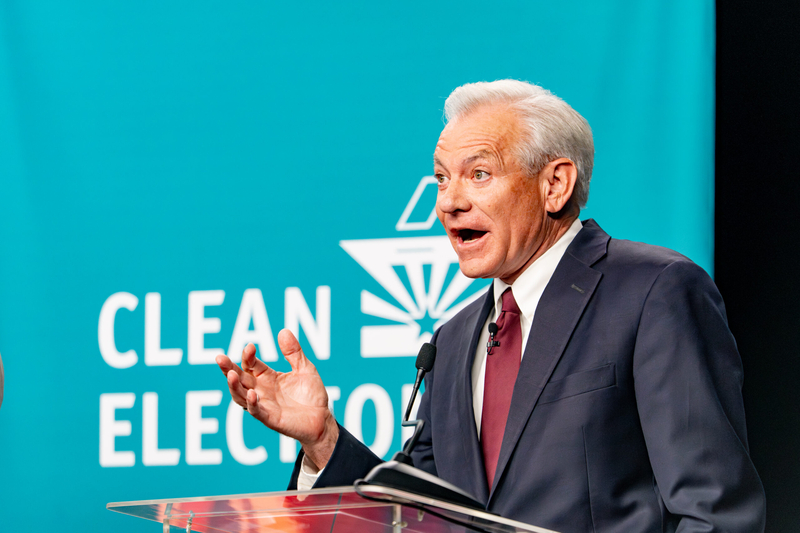
Rep. Andy Biggs (left), Ken Miceli, Scott Neely and Rep. David Schweikert debate in the 2026 AZ Clean Elections governor primary debate at Sneaky Big Studios in Scottsdale on June 17, 2026. (Pool photo by Diannie Chavez/The Arizona Republic)
Republican U.S. Rep. Andy Biggs told Arizonans on Wednesday evening that he’s got the best chance of beating Democratic Gov. Katie Hobbs in November.
Biggs’ chief opponent in the Republican primary for Arizona governor, U.S. Rep. David Schweikert, countered that he is the better, more moderate candidate to appeal to the state’s growing share of independent voters.
Joining the two most prominent candidates for the Citizens Clean Elections debate were builders and businessmen Scott Neely and Ken Miceli.
Biggs, who is the favorite to win the July 21 primary election, made clear that he already has his eyes on the general election, often comparing his own plans and viewpoints to Hobbs’ instead of his GOP opponents.
Schweikert has come under fire from the Maricopa County Republican Party for his ads accusing Biggs of having ties to antisemitism and white nationalism.
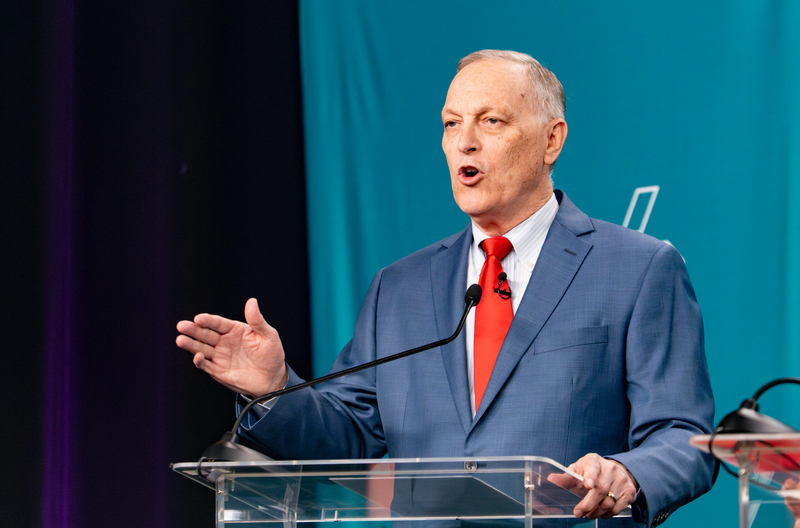
During the debate, Schweikert continued to paint Biggs as too extreme to win in November, saying that he was “wholly owned by Turning Point” USA. Turning Point Action, the political arm of the far-right organization founded by the late Charlie Kirk, is putting its power and money behind Biggs in the primary.
“In every poll that’s been released, I am the most competitive Republican in the entire state with Katie Hobbs,” Biggs said.
Biggs, who is endorsed by President Donald Trump, said he also has a history of reaching across the aisle, citing his work with Democrat-turned-independent Kyrsten Sinema and the late John McCain as examples. Biggs also mentioned his work in 2018 alongside Democratic U.S. Rep. Hakeem Jeffries on an anti-corruption bill, which he used to segue into accusations that Hobbs engaged in a pay-to-play scheme, which Democratic Attorney General Kris Mayes is investigating.
Schweikert argued that he, unlike Biggs, has a history of winning in competitive districts, and said he knows how to market conservatism for voters.
“We have to explain that prosperity is moral,” Schweikert said. “Voting for ‘conservative’ is how we bring prosperity back to Arizona.”
Water
As Arizona battles with the other states that rely on Colorado River water in an incredibly dry year, even amid a 25-year drought, both Schweikert and Biggs agreed that Arizona is not running out of water.
Each argued that the Grand Canyon State instead has a water management and water allocation problem.
Schweikert said the state needs to take an “all in” approach to water management, saying that everything from desalination to fixing leaky pipes would probably be necessary.
Biggs said that he agreed with Hobbs’ three-year moratorium on new tax breaks for the data centers needed to run artificial intelligence, but he thanked the Republican-led Arizona Legislature for the legislation.
Hobbs signed the moratorium into state law via the annual budget that she negotiated with legislative leaders, but the moratorium was included at the insistence of Hobbs and legislative Democrats.
Biggs said that, if he’s elected, taxpayers will not pay for infrastructure for data centers, and he will force data centers to produce their own energy.
Affordability
Both congressmen said that aggressively recruiting businesses to the state would help solve increased prices paired with stagnant wages.
Biggs said a major part of his recruitment strategy would be elimination of the state’s income tax, something he would pay for by cutting out waste and fraud in the state’s Medicaid program. Arizona, he said, is losing business to places like Texas and Florida, which don’t have state income tax.
Schweikert said that he would put some of Arizona’s state trust land on the market to help with the housing crisis that has helped drive a higher cost of living.
Healthcare
Schweikert and Biggs both said they would deal with the increasing costs of healthcare by encouraging Arizonans to make healthy choices.
Too much of the spending for the Arizona Health Care Cost Containment System, the state’s version of Medicaid, is used to treat obesity-related illnesses, Schweikert said.
“Should we give someone an EBT card to buy onion rings?” Schweikert asked. “Why can’t we help you on the nutrition side, through gamification, actually participate in a healthier lifestyle.”
He said his plan, which would also cut down on waste, would save the state between $400 million and $500 million per year.
Biggs said he had a similar plan, with a focus on Health Savings Accounts that Arizonans could use to save money to pay for medical expenses.
“And you’re going to provide incentives for better diets, making sure that you can get some exercise, so you don’t get sick,” he said.
Education
Schweikert and Biggs both expressed firm support for the state’s universal K-12 school voucher program.
They both repeated the false statement that the Empowerment Scholarship Account Program saves money compared to public schooling.
“We should be expanding it fully,” Biggs said of the ESA program. Exactly what he meant was unclear, however: Republicans expanded the voucher program to be available to every K-12 student in 2022.
Elections
If Biggs were governor, he said he would have signed a piece of legislation proposed last year that would have made Arizona’s elections more like Florida’s. The proposal was designed to speed up the reporting of election results, but critics said it would make voting more difficult for some people, especially those in rural areas.
Schweikert said that Republicans need to come to terms with the fact that Arizonans love voting by mail, which some in the legislature have attempted to ban, but that updated identification verification and maintenance of voter rolls was necessary.
Phoenix, AZ