As education freedom account program grows, Republicans consider tighter oversight
Jun 22, 2026 | 5:00 am ET

Description
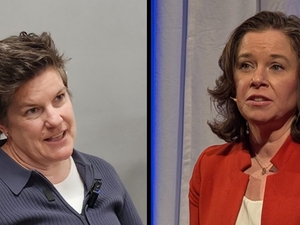
Sen. Timothy Lang (left), shown here during a Joint Legislative Committee on Administrative Rules meeting in August, has raised concerns about education freedom accounts oversight. At right is Rep. Erica Layon, a Derry Republican. (Photo by Claire Sullivan/New Hampshire Bulletin)
Five years into the state’s education freedom account program, Republican lawmakers are expressing some interest in increasing oversight and clarity over how it operates.
In an April letter to the State Board of Education, a bipartisan group of lawmakers called for the board to write more specific descriptions of which programs may receive EFA funding — and which may not.
The Legislative Budget Assistant, a nonpartisan office, is wrapping up a yearlong audit of the EFA program ordered by lawmakers in 2025. In May, Democrats and Republicans directed that office to expand that audit to review data on EFA students’ New Hampshire residency and educational attainment.
And last week, the Republican chairman of the House Education Funding Committee, Rick Ladd, said he wants to explore tightening the verification process for EFA students receiving additional special education funding. Ladd said legislation may be necessary.
While the interest exists, concrete changes to EFA oversight are unlikely to happen soon. The state board, whose members are appointed by the Governor and Executive Council, rejected lawmakers’ request to clarify the rules this month on technical grounds, arguing the request was too vague and did not adhere to proper submission protocols. And any legislative changes to the oversight program would likely not materialize until the 2027 legislative session at the earliest.
Still, the proposals represent flickers of bipartisanship around a program that has been divisive for years.
Created in 2021, the education freedom account program allows a family to access the per-pupil state education adequacy funding that might have gone to the family’s local public school and spend it on private education or homeschooling expenses such as tuition, programs, and books.
Republicans have hailed the EFAs as a needed mechanism to give students and families a choice in their education if their local public school is not working for them. The program distributed about $4,911 per student in the 2025-26 school year, according to the Department of Education.
Democrats have consistently objected to the program, arguing the funds should be used to increase state aid to public schools, and noting that the majority of EFA recipients never attended public schools before joining the program. In the 2025-26 school year, just 343 of the 10,510 students in the program attended a public school the year before, though other EFA students may have transferred in prior years.
But as the EFA program continues to expand, and Democrats press to regain control of one or both chambers of the State House in November, the expansion of oversight is a rare common ground that could offer a roadmap for future compromise.
“So this is a request for the Department of Education to make better rules on these two specific subjects?” remarked Rep. Carol McGuire, an Epsom Republican, speaking at a meeting of the Administrative Rules committee. “That sounds like a reasonable request.”
Local pushback
The latest impetus for oversight came from outside the State House. In March, New Hampton voters delivered an unlikely rebuke of the state’s education freedom account program — and a call for restraint.
The Republican town, which voted for Donald Trump for president and Kelly Ayotte for governor in 2024, passed a warrant article at its 2026 town meeting requesting lawmakers to limit the program to families “with demonstrated financial need.” They also asked for “fiscal and educational performance reports” for the program. The resolution pointed to a 2025 law to remove income limits for the program while imposing a 10,000-student cap, which took effect this past school year.
“This question is raised because state legislators recently removed all income limits from the Education Freedom Account Program (vouchers), expanding it beyond its original purpose,” the resolution read. “These changes added tens of millions of dollars in costs, while the program provides limited public information on how funds are spent or whether educational standards are being met.”
The municipal resolution is one of about two dozen criticizing EFAs that have passed at town meetings in the past two years, part of a campaign started a year ago by Democrats.
But this resolution fell on influential ears. Sen. Tim Lang, a Sanbornton Republican representing New Hampton and a longtime supporter of EFAs, took the residents’ requests for clarity seriously. He met with Department of Education Commissioner Caitlin Davis after receiving the resolution and brought up the oversight concerns.
“Many of us got these letters that our towns voted in their warrant articles about state funding,” Lang said. “Some of them had to do with EFAs and some of them didn’t.”
The education freedom account program, like other state programs, is governed by two authorities: state statutes passed by lawmakers and signed by the governor, and administrative rules. For EFAs, those rules must be proposed by the Department of Education and approved by the State Board of Education.
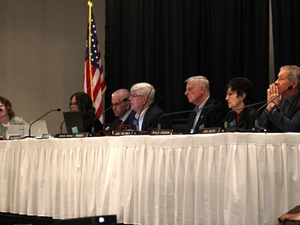
And in April, Lang wrote a letter to the state board on behalf of the Joint Legislative Committee on Administrative Rules — the committee that provides non-binding recommendations on state regulations — calling for a formal process to add two rules. One rule would clarify what is a valid use of an EFA. The other would require twice-annual audits of EFA recipients to ensure they are not using public school services.
Introducing the rules, Lang said they were meant “to address two identified gaps in the EFA program.”
It was the kind of request that might have been made by a Democrat and been voted down. But the letter received unanimous committee approval.
Growing participation — and expenses
The latest calls for oversight come as the EFA program has expanded. In the 2024-25 school year, families using the program spent about $20.2 million on educational expenses and submitted more than 65,000 transactions to do it.
Those numbers are likely to double when the 2025-26 school year is fully accounted for. The 2025 bill to remove income limits increased the number of participants from 5,765 enrollees in the 2024-25 school year to 10,510 students in the latest year. Next school year, the official cap on EFA students will expand to 12,500, though because of the availability of exceptions to the cap for certain students, the total enrollment could be higher.
Under the program’s rules, families do not have direct access to the near-$5,000 in average annual per student grant funds. The money is instead held by the Children’s Scholarship Fund in designated per-family accounts. Families must use a digital portal to submit expense and reimbursement requests, which are approved and carried out by the organization.
When it comes to how the money is spent, the law creating the program provides flexibility. The EFA law outlines 14 categories of qualifying expenses, from tuition to textbooks to uniforms. But it also allows “any other educational expense approved by the scholarship organization,” which runs the program. As the rules are currently written, the Children’s Scholarship Fund makes the ultimate decision over whether an expense will qualify, and must maintain its own application process to vet education providers interested in receiving funds.
As for which vendors are allowed to accept EFA funds, the rules also provide latitude. According to the rules, the Children’s Scholarship Fund must determine whether the program serves one of the state’s “core knowledge domains,” identified in statute as “science, mathematics, language, government, history, health, reading, writing, spelling, the history of the constitutions of New Hampshire and the United States, and an exposure to and appreciation of art and music.”
Once the organization approves a vendor, the law and administrative rules do not allow the state to override or veto that approval. A vendor that is rejected may appeal its rejection, but the appeal is decided by an advisory commission whose members are chosen by the Children’s Scholarship Fund.
The result: The 65,523 approved EFA transactions in the 2024-25 school year take a wide variety of forms, from tuition to Christian private schools to visits to the New England Aquarium to ski rentals in Campton to Amazon purchases. In January, the Children’s Scholarship Fund released details of how much each vendor received in an annual report, though not what each purchase was for.
In the past, Democrats have argued that if the EFA program is to continue, decisions over qualifying vendors and expenses should be made by the state Department of Education, not the Children’s Scholarship Fund. But the proposed bipartisan rules from lawmakers in April do not aim to remove the Children’s Scholarship Fund’s decision-making authority. Instead, they would provide more parameters.
“Specifically, the committee would like the Board to … amend the rules to provide clearer and more specific definitions of what constitutes a permissible educational expense, and an eligible education provider, with the goal of ensuring EFA funds are used only for appropriate educational purposes,” reads the letter.
The second proposed rule would tighten oversight of EFA recipients. It asks the state board to “amend the rules to require the Department of Education to conduct a bi-annual audit of the EFA program to reconcile EFA participants and public school enrollment records for the purpose of ensuring accounts are not funded for students ineligible for the program because they are continuously enrolled in another public education pathway.”
That proposed rule comes after lawmakers passed a bill, House Bill 1817, that would grant EFA recipients access to public school curricular courses and cocurricular programs — as long as they did not receive more than 50% of instruction from public schools. Ayotte signed that bill Friday.
Opening up the rules
Despite Lang’s letter, the State Board of Education voted June 11 to reject the request for a rules change. Board Chairman Drew Cline said Lang and the administrative rules committee had not followed a proper procedure.
A petition to open up the rules process must “state the nature of each proposed rule and the reasons for the proposed rule, and include the text of what they proposed,” Cline said. He argued Lang’s letter had not sufficiently done that.
“I think we ought to just send this back to them and say, ‘Can you give us a little more clarity here on what you want?’” Cline said.
But Department of Education Commissioner Caitlin Davis suggested that even if this particular request doesn’t move forward, the department may soon be revisiting the EFA rules, which have stayed static since the program began in 2021.
Davis noted that the Legislative Budget Assistant’s audit of the state-run portions of the EFA program — which she said might be released in the fall — is anticipated to include 44 findings. Once those findings are released, Davis said the department will likely need to revise the EFA rules, if only to update the regulations to reflect the changes lawmakers have made to the program since 2021.
“We are anticipating that some of those findings are going to be largely about clarifying different aspects of the rules,” Davis said. “… So we anticipate meeting in probably the next year, opening up those rules and reviewing them to ensure that they align with the current statute.
Doing that would delay any substantial changes to the EFA rules by at least a year. But after five years of political acrimony, even that timeline represents a change.
“We are absolutely open to opening it up,” Cline said.
Concord, NH