GOP-backed ‘preborn child’ legislation could imperil future abortion access
Mar 13, 2026 | 7:17 pm ET
Description
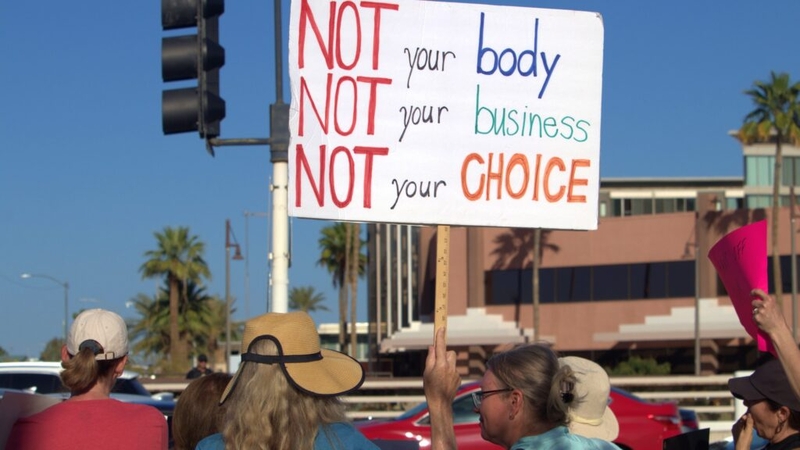
A protestor holds a sign at an April 14, 2024, protest in favor of reproductive rights and abortion access in Scottsdale. Photo by Gloria Rebecca Gomez | Arizona Mirror
Over a year ago, Arizona voters told Republican lawmakers to stay out a woman’s decision to terminate a pregnancy. That hasn’t stopped them from pushing laws that include phrases like “unborn” or “preborn child,” and reproductive rights experts say that’s an intentional strategy to chip away at abortion access.
Israel Cook, the state legislative counsel for the Center for Reproductive Rights, denounced the continued efforts from Republican legislators in Arizona to attack abortion care as out of touch with what voters want.
“Arizonans overwhelmingly voted to protect the right to abortion access and we’re continuing to see state politicians push new bills to restrict that right,” she said.
In 2024, 61% of voters agreed to enshrine abortion as a fundamental right in the Arizona Constitution. Proposition 139 explicitly prohibits lawmakers from passing or enforcing laws that infringe on a woman’s ability to obtain an abortion unless the laws are narrowly tailored and intended to preserve her health. The ballot measure won a majority of votes in every legislative district. But despite that voter mandate from their own constituents, Republican lawmakers have proposed multiple bills this session that critics warn could lead to an outright ban of the procedure in the future.
Fetal personhood is a theory long espoused by abortion foes that aims to endow fetuses with legal protections. Laws that ostensibly punish criminal actions or purport to inform women seeking an abortion about their options elevate the rights of fetuses when they use language like “unborn” or “preborn.” Such phrases are intended to expand the legal understanding of who deserves certain rights. Over time and with repeated use in state laws, the language works to advance the idea that fetuses are owed legal protections and could be used in court to justify the restriction of abortion care.
“This ‘unborn child’ language and fetal personhood language continue to build up this record to attack bodily autonomy,” Cook warned.
Arizona Republicans tried to explicitly enshrine fetal personhood into state law in 2021, passing legislation that bestowed “an unborn child at every stage of development, all rights, privileges and immunities available to other persons.” A federal judge ultimately froze the law, ruling that it conflicts with the state’s existing personhood definition, but it remains on the books. The use of “unborn child” in Arizona law is a less blatant, but still definite way of giving fetal personhood a legal foothold in the state. The phrase is written into more than 100 statutes and is defined in Arizona law as the “offspring of human beings from conception until birth.”
Among the laws that mention “unborn child” are several that pertain to homicide, one of the most common ways to codify fetal personhood that reproductive rights advocates warn could quickly turn into criminalizing women or doctors for abortion care. This year, a GOP bill threatens to do just that by punishing the killing of an “unborn child” with the death penalty or life imprisonment. Other proposals add to the fetal personhood allusions in state law by allowing child support payments for “pre-born” children and requiring abortion clinics to tell patients that the fetal remains of “unborn children” can be transferred to a funeral home.
Republicans have framed their use of fetal personhood dogwhistles as an effort to acknowledge the innate humanity of fetuses. During a March 11 meeting of the Senate Regulatory Affairs and Government Efficiency Committee, Sen. Frank Carroll vocally opposed petitions from Democrats to change “unborn children” to “fetal remains” in the proposal that gives women the option to transfer remains to a funeral home after an abortion.
“I will not accept politicizing the meaning of words by degenerating a human being to something less than that,” the Sun City West Republican said. “If there’s an attempt to amend it that way I will fight it every inch of the way.”
Athena Salman, the head of the Arizona chapter of Reproductive Freedom For All, said that doubling down on the use of the inflammatory phrase proves that Republicans are advocating for a broader goal. The bill was unanimously opposed by Democrats on the panel, who said they would support it if the phrase was switched out. Without bipartisan backing and amid accusations of enshrining fetal personhood, the proposal is headed straight for Gov. Katie Hobbs’ veto stamp. The Democrat ran on a campaign to protect abortion access and has repeatedly rejected legislation that would threaten the procedure.
“By refusing to compromise on this language, Republican legislators have made it clear that they will push their extreme agendas at the expense of families,” Salman said.
And while the state’s abortion rights amendment currently guarantees access to abortion care, Salman warned that voters shouldn’t be swayed into complacency. No legal protection is wholly infallible, she said, as was shown when the nearly 50-year-old constitutional right to abortion in Roe v. Wade was struck down in 2022.
“Any new ban or restriction on reproductive health care is a threat even if you have a constitutional right,” Salman said. “We had secured this constitutional right and anti-abortion extremists just kept on passing law after law after law to see what would stick.”
After the U.S. Supreme Court overturned the nearly 50-year-old constitutional protection in Roe v. Wade, states where Republican lawmakers had previously created anti-abortion frameworks and passed trigger laws promptly restricted or banned the procedure. Arizona itself was plunged into uncertainty, grappling with a 15-week gestational prohibition and a complete ban from 1864. Salman noted that the fetal personhood movement is looking for a similar opening now that several states have enshrined their own constitutional protections and said the best way to fend off future attacks on abortion access is for Arizonans to show up at the ballot box.
While every anti-abortion bill proposed this year is doomed by Hobbs’ veto pen, Republicans remain undeterred by public opposition and the Democrat’s defensive shield isn’t guaranteed. She faces re-election in the fall. If the GOP claws back the state leadership positions it lost in 2022, amid fears of a near-total abortion ban, reproductive rights advocates worry hard-won progress will be much more successfully undermined. Salman, whose group has endorsed Hobbs and is advocating for flipping the state legislature to Democratic control, called on voters to mobilize.
“Voters really need to see and witness how their elected officials coming from all these districts that Prop 139 won are refusing to listen,” she said. “(They’re) instead wasting taxpayer funds — not making life in Arizona more affordable — but trying to overturn and diminish the fundamental right to abortion.”
Phoenix, AZ