With giant IUD outside Capitol, Arizona Democrats call on GOP to protect contraception access
Jun 11, 2026 | 6:58 pm ET
Description
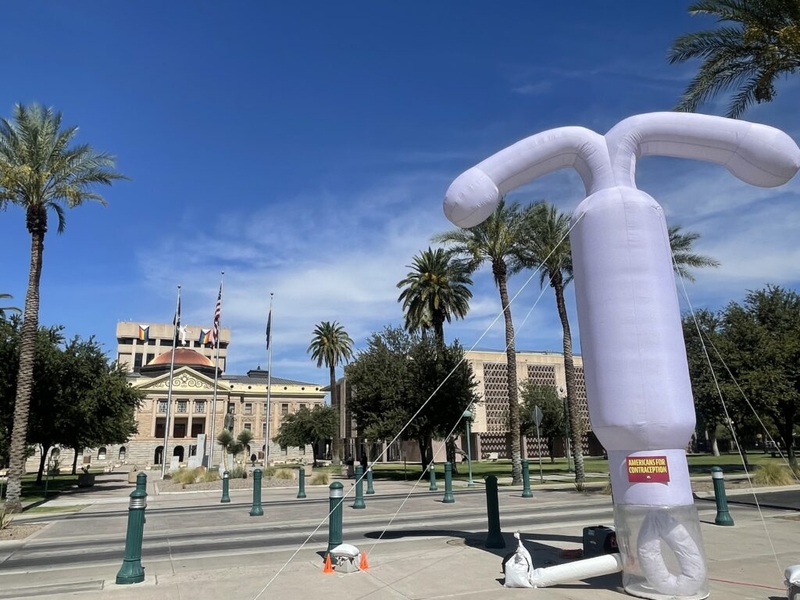
Americans for Contraception, a nonpartisan organization that advocates for the passage of legislation across the country enshrining access to contraception as a fundamental right, set up a massive inflatable IUD at Wesley Bolin Memorial Plaza across the street from the Arizona Capitol on June 11, 2026. (Photo by Gloria Rebecca Gomez/Arizona Mirror)
Standing in front of a 20-foot tall, inflatable IUD across the street from the state Capitol, Democratic lawmakers lambasted Republicans for blocking efforts to ensure Arizonans have a right to contraception.
In 2023, on the one-year anniversary of the U.S. Supreme Court eliminating the constitutional right to abortion — a decision that prompted Justice Thomas Clarence, in his concurring opinion, to write that a reconsideration of the constitutional right to contraception should be next — Gov. Katie Hobbs and Democrats in Arizona unveiled an intent to pass statewide protections for contraception ahead of any federal challenges that might arise in response to Clarence’s proposal.
The bills that would have done just that, both of which were entitled ‘The Right to Contraception Act’, were never put up for debate in the Republican-controlled legislature. And when Democrats tried to force floor votes on the bills, they were quickly shut down.
That pattern has been repeated for the last three years. The most recent attempt to fasttrack the ignored legislation was in March, as part of the Arizona chapter of Reproductive Freedom for All’s fifth annual “Reproductive Freedom Day” at the legislature. That same day, Republicans held a news conference intended to overshadow the event during which they vowed to continue working to undermine the state’s abortion rights amendment.
On Thursday, Americans for Contraception, a nonpartisan organization that advocates for the passage of legislation across the country enshrining access to contraception as a fundamental right, set up a massive inflatable IUD at Wesley Bolin Memorial Plaza to commemorate the 61st anniversary of Griswold v. Connecticut, the landmark Supreme Court decision that made contraceptives a constitutional right at the federal level in 1965.
Sen. Priya Sundareshan, a Tucson Democrat who heads the party’s members in the upper chamber, warned that, while the federal protection remains in place, it shouldn’t be taken for granted because the right-wing supermajority on the Supreme Court has shown an eagerness to overturn precedent.
“We know that those threats are real, and something as basic as the right to contraception should not be in question,” she said. “That’s why we have put forward bills at the state legislature every single year in order to cement that right here in state law.”
The Arizona proposal would guarantee the ability of Arizonans to obtain any form of birth control, including the pill, IUDs and emergency contraception like plan B, and it would protect the right of healthcare providers to prescribe them or inform their patients about them.
Sundareshan lamented that Democratic efforts to advance the legislation have been repeatedly foiled by Republicans, a move that she criticized as out of step with what Arizonans actually want.
“We’ve seen no action at the state legislature to show that Republicans are hearing the will of the voters in wanting to protect the right to contraception,” she said.
A 2024 poll found that 91% of Americans believe birth control should be legal, including a majority of Republicans. And about 81% of people across the political spectrum at the time supported the idea of Congress codifying the right to obtain contraception, including plan B, which has been targeted by some anti-abortion activists and politicians.
Kelley Dupps, the director of public affairs for Planned Parenthood Arizona, the state’s largest abortion provider which also offers a range of reproductive health care and family planning services at its clinics, emphasized that the majority of voters support the legalization of contraception.
“It’s really a bipartisan issue,” he said. “So, the question really isn’t, ‘Where do voters stand on this? Where are Arizonans?’ It’s about why are Republican politicians standing in the way of access to basic healthcare rights?”
Similar to the push to protect access in the Grand Canyon State, recent efforts to make contraception a right at the federal level through the legislative process have so far proven unsuccessful.
But that hasn’t deterred Democrats in Congress, either. U.S Rep. Lizzie Fletcher, a Democrat from Houston, filed a discharge petition earlier this week that could force a vote on the Right to Contraception Act, which she sponsored but has not been given a hearing. The petition needs to win support from 218 members to override any opposition from Speaker Mike Johnson and be considered by the full chamber.
On Thursday, Sundareshan called on Arizona’s congressional delegation to help Fletcher make that possible.
“I especially challenge our representatives, Congressman (David) Schweikert, Congressman (Andy) Biggs, Congressman (Juan) Ciscomani…to sign onto that petition,” she said, referring to three of the state’s GOP members of its congressional delegation. “Let’s protect this right that the vast majority of Arizonans demand.”
In 2022, a Right to Contraception Act failed to move forward in Congress, with both Biggs and Schweikert voting against it. And all three congressmen have previously supported legislation that could bestow personhood to fetuses at every stage of development, which critics say could result in outlawing some types of birth control, like plan B.
Democrats also urged voters to keep Gov. Katie Hobbs in office in November, noting that her Republican opponents — Biggs and Schweikert are squaring off in the July primary election — have shown little inclination to preserve access to contraception in their time in Congress. Rep. Stephanie Stahl Hamilton, D-Tucson, said that the best way for voters to guarantee that Arizonans can keep using the birth control of their choice is at the ballot box.
“We must hold elected officials accountable when they fail to protect fundamental freedoms and continue working to ensure contraception remains affordable, accessible and protected under Arizona law,” she said.

Phoenix, AZ