Black astronauts tout space exploration at CBCF legislative conference
Sep 18, 2026 | 8:38 pm ET
Description
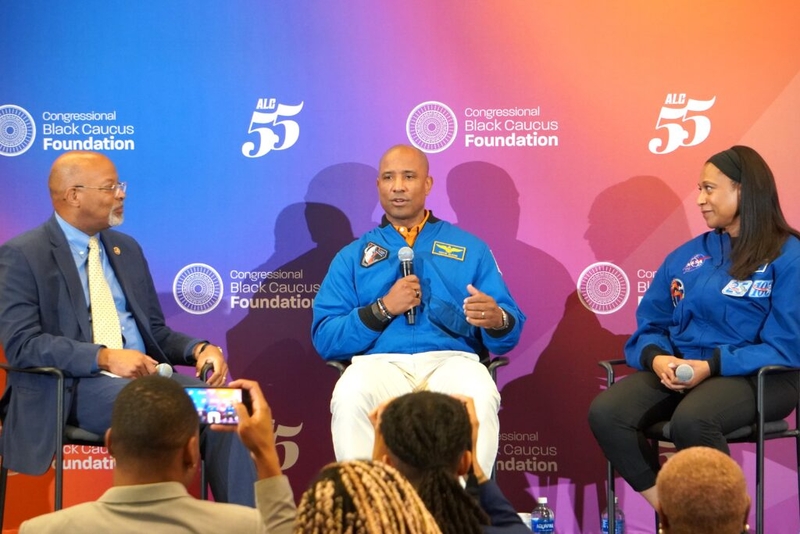
NASA astronaut emeritus Victor Glover, center, speaks Friday at the Congressional Black Caucus Foundation’s legislative conference in Washington, with retired NASA astronaut Jeanette Epps and Rep. Glenn Ivey (D-4th). (Photo by William J. Ford/Maryland Matters)
There have been fewer than 20 Black astronauts in NASA history, but two of them were on a Washington stage Friday for a discussion as part of the Congressional Black Caucus Foundation’s annual legislative conference.
Jeanette Epps and Victor Glover were on hand for “Ad Astra: African Americans in Space Exploration,” hosted by Rep. Glenn Ivey (D-4th), honorary co-chair of the 55th annual conference this year. Ivey, whose district includes the Goddard Space Flight Center, said the panel was to not only tout space exploration, but to encourage younger Blacks to enter what Ivey called a multitrillion-dollar industry “that’s just going to keep growing.”
Glover, a pilot with the rank of captain in the Navy, completed a 10-day mission in April on the Artemis II that traveled around the moon, taking humans farther from Earth than they had ever traveled. That led Ivey to point at Glover and quote the opening lines from the original “Star Trek” TV show, “To boldly go where no one has gone before.’ He really did.”
Glover, who spent a total of 178 days in space in his career, said one of his inspirations to become a pilot was when he attended college and saw a Black man in a Navy uniform.
“Thinking about my future, I wound up having a mentor come to campus … and he was in his Navy uniform,” Glover said. “And from a young man who did not believe he had any place in the federal government, but especially in the military, that changed that myth instantly by seeing this Black man in that Navy uniform, and I would join the Navy a couple of years later.”
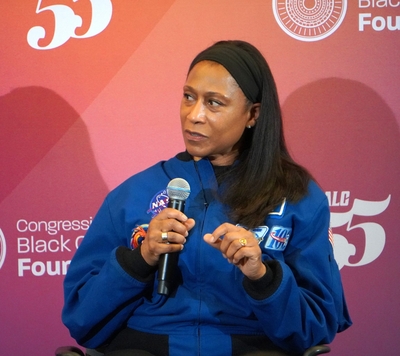
Epps spent 235 days in space as a mission specialist on the International Space Station. What was supposed to be a six-month mission ended up being almost eight months in space, when delays in launching a return vehicle extended her crew’s stay. She became the Black astronaut with the most time recorded in space.
“I had a wonderful eight months in space. It was glorious,” she said Friday. “I saw a solar eclipse in space, which is amazing because all you see is a shadow of Earth. I saw hurricanes, some of the most beautiful auroras you can think of. Nothing would take away my joy.”
Dozens showed up for the hourlong panel discussion, after which both Glover and Epps were asked how they maintained their mental health being in space for several months.
Glover said NASA provided resources such as strength and conditioning professionals, and even a nutritionist. For behavioral and mental health support, Glover said NASA had “operational psychologists.”
But he said mental preparation must be part of your lifestyle before a trip to outer space begins.
“If you don’t have healthy habits on the ground before you go on mission, it is not going to get better in space,” said Glover, who now works at California Polytechnical State University.
Epps, who resides in Prince George’s County, said she would communicate with her family on “WhatsApp” and turn her iPad toward the window so they could see space.
“I wanted to make sure everybody I knew got a chance to see what I was looking at every day,” she said. “I called my family every day, every night before I went to bed.”
Before the panel discussion began, both said in a brief interview that talking with younger people about space exploration begins at an early age. They also acknowledged NASA hosts programs for the public, including one coming up in November called “MAX POWER.”
“We’re going to talk about rockets. We’re going to talk about airplanes and the technology behind them,” Glover said. “What the [NASA] administration is doing now is quite impressive. Could we do more? Of course, but I don’t think people realize all of the things that we’re doing now, and this administrator’s vision is the right direction.”

Annapolis, MD