Georgia cuts payments by 30% for foster children’s autism therapy
Oct 05, 2026 | 4:00 am ET

Description
Ava Bullard, who is the namesake of a 2015 Georgia law, was diagnosed with severe autism as a toddler. Bullard graduated in December from the University of Georgia with a major in biology and now has a job in the medical field. Photo courtesy of Ava Bullard
Krystina McQueen’s severely autistic foster son – who is prone to biting and hitting — has made big strides in his few weeks in specialized behavior therapy. He’s in it at the crucial time to learn basic skills, as he’s about to turn 3.
But last week the Hall County foster mom got a call from the therapy provider. The business said it may not be able to afford treating him, after Georgia Medicaid abruptly slashed the reimbursement rate by 30% in their policies for foster kids.
Her provider has already stopped accepting new patients at that rate, she was told. Other providers are doing the same, or have even dropped existing patients.
Georgia’s Department of Community Health administers the state’s Medicaid health insurance programs, and it has put rate decisions for foster children in the hands of the insurance company Amerigroup, an insurer in the Elevance family along with Anthem Blue Cross Blue Shield of Georgia. Georgia outsources its Medicaid insurance work to three insurance companies and has decided for the population of foster children it covers that the contractor will be Amerigroup.
The notice from Amerigroup to clinics said the rate cut is “intended to better align reimbursement across autism services.”
In an email from Amerigroup to the state obtained by the Georgia Recorder, Amerigroup said it would raise rates instead for the work that clinicians do training parents on the therapy strategies, calling the new rate structure “a more targeted and clinically defensible approach.” Therapy advocates say that training parents and caregivers in the strategies to deal with the child is important but that parents can’t take the place of the trained clinicians.
A spokeswoman for Amerigroup said that medically necessary services are still being covered, and that patients should keep up with appointments and follow the treatment.
The state, in a statement from spokeswoman Lauren Williams, said that “in those instances where an in-network provider is not available, Amerigroup is required to secure services with an out-of-network provider” for each individual patient case. Whether patients know to ask for that is an open question; McQueen said she’s not heard anything from Amerigroup.
Clinics that provide the therapy that McQueen’s foster son was getting, called applied behavior analysis therapy, say that a letter arrived out of the blue in August announcing that the 30% payment cut for the therapy would start Sept. 1.
Dr. Michelle Zeanah, who runs a different clinic across the state in southeast Georgia, had the same reaction as McQueen’s therapy providers to the size of the rate cut. She wasn’t sure it would really happen so quickly, until last week when her office started getting back the benefit statements for September therapy appointments. The payments were slashed by 30%.
“I can’t do that,” Zeanah said. “From a business perspective, we’ll be too far in the red. I can’t do that. And it breaks my heart.”
She said there’s already a serious shortage of providers in rural areas, and she’s the only option for many in her area.
Georgia state Rep. Lee Hawkins, a Gainesville Republican, chairs the House committee on health. He’s been hearing about the issue from both Amerigroup representatives and those who run the clinics. The industry representatives have told him that among those they’ve surveyed, 75% of clinics that provide the therapy report that within three months they will have to reduce or stop serving the state’s foster children at that rate. More than 90% said they would reduce or stop taking new patients, he says.

That means not only treating fewer patients, but laying employees off. The clinics are not facing the same dilemma for the patients whom Anthem insures under its more commercial plans like Blue Cross. At a recent conference in Atlanta, the president of Anthem Blue Cross and Blue Shield of Georgia, Amanda Free, said she only oversees commercial plans and couldn’t comment on the therapy cuts. A reporter asked her to comment after a panel in which she advocated for spending on regular care up front lest problems become emergencies.
Therapy advocates argue that in the long term it’s economically more sensible to invest in therapy up front, and hope the patient needs less assistance later in life.
“What’s going to happen to all our children in foster care?” said Zeanah in an interview shortly after she received the rate notice. “I mean they all have Amerigroup. Foster kids have so little control over their lives already. It seems like a corporation is putting profits above everything else.”
The actions by Amerigroup follow other attempts to scale back spending on the specialized therapy by the other two insurance companies that serve Georgia Medicaid patients. Only Amerigroup serves foster children.
‘It’s devastating’
Applied Behavior Analysis therapy is meant to teach skill sets to those who don’t learn in a traditional way, and autistic children represent a big portion of ABA patients. Advocates say the therapy can unlock critical life skills and vibrant futures for some severely autistic children, though they concede it doesn’t work for every child with autism.
It has only recently become widely accepted, with permanent billing codes issued by the American Medical Association in 2019. But the research showing that it works well for some children is strong, said Dr. Nathan Call, clinical director for the Marcus Autism Center in Atlanta. And in the absence of other remedies, people are now flocking to it.
“A lot of families are told that they should seek out ABA at the moment their child gets a diagnosis,” Call said. “Whether that’s the right thing for their kid or not.”
Adjacent to that are concerns about fraud and waste raised nationally. Does every child who gets the therapy need it? Is every patient actually getting the real therapy, or is someone pretending that babysitting is therapy?
The U.S. Centers for Medicare and Medicaid Services this summer released a report showing that between 2021 and 2025, ABA spending in the government program increased 421%, far more than increases in the number of children receiving services after an autism diagnosis. It released a toolkit for states to use in overseeing proper funding and structure of the service, saying that the “rapid program growth requires stronger oversight to ensure children receive services based on medical need rather than financial incentives.”

“Families deserve confidence that ABA services are clinically appropriate, personalized, and delivered by qualified providers,” added the centers’ administrator, Dr. Mehmet Oz.
Anna Bullard, an activist for the therapy, acknowledges legitimate concerns with fraud and overbilling in some quarters.
“Every one of those (Georgia insurance contractors) is trying to mitigate the significant rise in autism costs for therapy by cutting rates,” Bullard said. “Again, my argument to them is, but we’re still not dealing with the issue of ensuring that kids get access to quality care where they need it.”
Done right, it’s expensive and technical. The key to the therapy is in painstaking one-on-one analysis of a particular child’s disabilities, and then finding out what that individual child may react to as a reward.
If a child’s physician determines that they are a candidate for the therapy and an analyst agrees, then a trained technician or therapist is assigned to the child and puts the analyst’s plan into action. They break down the basic path of learning into miniscule parts, and sometimes spend enormous energy teaching the child just one step and rewarding them for it. For example, just the act of walking into the bathroom.
Step by step, over time, the child is rewarded in the way that matters to them when they perform the step. As success in one step becomes more natural, the reward for it fades. The goal is to connect the complete chain of steps. For example, when they recognize they have to go, then get up and go to the bathroom and urinate there instead of staying put in a diaper. The therapy can take several hours-long or daylong shifts each week.
Some critics have lamented that the therapy focuses on making neurodivergent children act normal, instead of making the world accept neurodivergence as a kind of normal in itself. The critics, such as Harvard Assistant Professor of Health Policy and Management Ari Ne’eman, also cite the therapy’s history of using not just rewards but punishment too, potentially damaging the child’s mental health. Call and others acknowledge that but say punishment is no longer accepted as a best practice.

Ava Bullard, Anna Bullard’s daughter, has sparse memories of receiving the therapy but is grateful for it.
“I was completely nonverbal,” says Ava Bullard, now 22 and diagnosed with severe autism as a toddler. “They thought I was deaf at first.”
Her parents say they were told she would probably never speak and would never be in a general education classroom with her peers.
She has vague memories of wanting to be able to communicate something but not being able to. She wasn’t motivated to learn to eat, but her parents would wait for her to watch her beloved movie, “One Hundred and One Dalmatians,” at which point her mouth would drop open and they could feed her.
Ava grew up in southeast Georgia. She now lives on her own in Florida and works as a surgical neurophysiologist, monitoring spinal cords during spine surgeries. She still processes things differently as an autistic person, she says, but she’s grateful for the difference.
When a reporter told Call her story, Call said he couldn’t comment on Ava specifically. However, he said, such a level of progress with ABA isn’t seen in every case but is “absolutely possible.”
Ava’s mother did the research to find applied behavior analysis therapy for her daughter when it wasn’t common, and paid for it personally. From about 2007 to 2009, the therapy workers came from South Carolina to her house in the Vidalia area, a luxury others could not afford but the family’s only choice. Anna and Ava got the Georgia Legislature to pass “Ava’s Law” in 2015, mandating that state-run health insurance cover the therapy for autism. That’s been followed by a more recent push to equalize rates for in-clinic and at-home therapy.
Anna Bullard said she is afraid the rate decrease makes the legal protections meaningless.
“For me it’s devastating,” said Anna Bullard. “Because we have fought so hard to ensure there is equal access. No matter where you live, how much money you make, if you’re Black, if you’re white, if you’re in foster care – it doesn’t matter. We fought so hard, and we’re – it’s like falling off the cliff backwards.”
What the state can do, and can’t
Foster children are just one group that’s affected. All three of the insurance companies that Georgia chose to administer its Medicaid programs have shaken up their applied behavior analysis therapy policies within the last year.
Hawkins, the state lawmaker, says the concern seems to be that the newfound popularity of the therapy is bringing in a lot more patients for the pricey therapy and potentially making the Medicaid contracts a money loser for the companies. Foster kids can’t drop Amerigroup, but many other Medicaid patients can choose between the three: Amerigroup, CareSource and Peach State. In some cases, changes have been proposed but scaled back. Amerigroup acted quickly though, and the cuts are in effect.
A key policy official at Georgia Medicaid, Stuart Portman, told the Georgia Recorder there was little they could do until they see what damage is done.
“Our ability to review things is much more on the back end,” he said. “However, we are engaging as early on as we can to make sure that the care to the beneficiaries is being provided.”
Mental health advocate Roland Behm argues that the state actually has the ability and the obligation under a federal law to review the potential impacts to network adequacy before approving the rate change. He says the state doesn’t assert it.
“You don’t implement a rate cut and then see what happens,” Behm said. “Because how do you make up for that failure? So if you have a person that was entitled to care but couldn’t get access to the care, and that person deteriorated because of the inability to access the care, how do you make that up?”
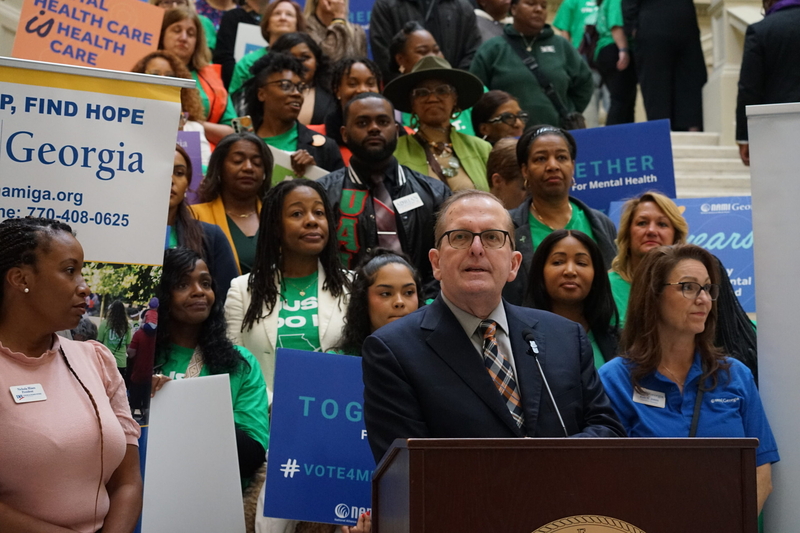
Practitioners and families are concerned about a potential lifelong cost to the children if they miss out on certain types of therapy in the crucial window.
Call, at the Marcus Autism Center, notes that ABA therapy is most effective when delivered young.
“So there is evidence in the literature that the earlier interventions are delivered, the better the outcome,” he said. “Meaning delays can have a negative impact on outcomes.”
Katie White is a guardian ad litem for the state, appointed by courts to watch over the interests of children in court cases, who has multiple high-needs children of her own. She has been raising her 14-year-old adopted son since she became his foster mom at 7 months old. She said he’s got so many issues as a medically fragile child that she only just learned he was autistic when he was 12. Waitlists are already always long for ABA therapy slots, but his wait time was especially long because of his age. She searched for a year for a healthcare provider who would give her son Applied Behavior Analysis therapy despite his starting out at an older than typical age.
But in mid-September, they called her.
“He lost his services after only being in it about six weeks,” she said.
White said she intends to try to keep doing the home exercises she learned so far since she’s already seen so much progress. Then again, she’s got the luxury of being able to stay home and juggle his 26 caregivers, she said. Your average foster parent or the parent whose kids are on Medicaid because of income might not. And she’s been offered no alternatives from Amerigroup since she got dropped, she says. “They have yet to respond to my provider’s certified notice declining the new rate.”
As an attorney who represents kids in the juvenile justice system, White thinks of those foster kids who need to keep their Medicaid as they’re reunited with their parents. Those social skills are important for keeping the family together, she said, and a high percentage of them have autism.
“Depending on where they fall on that spectrum, they need those services desperately,” she said. “And you know, I’m just not sure what it’s going to look like if we don’t have providers.”

Atlanta, GA