General Assembly takes one giant leap for home foot care patients in Rhode Island
Apr 09, 2026 | 4:43 pm ET
Description
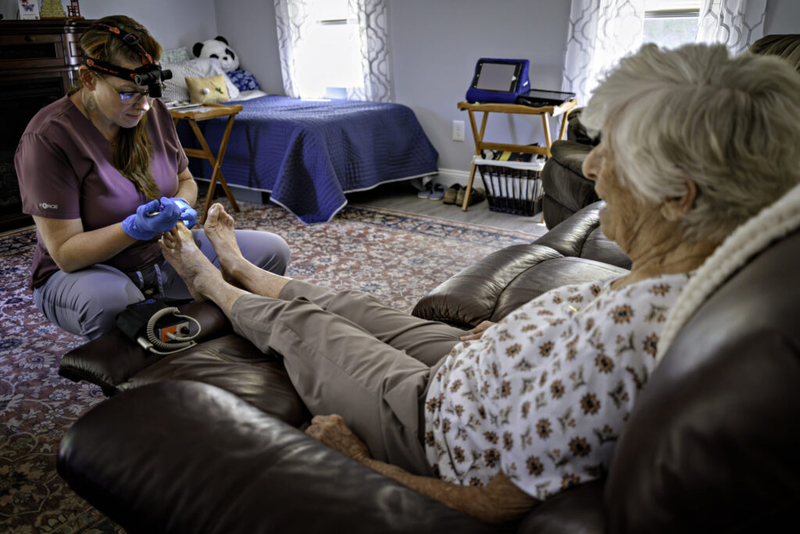
The Rhode Island Department of Health ordered Tiverton home care nurse Tina McDonald, shown last year providing foot care to a patient in Seekonk, Mass., to stop treating Rhode Island patients in January 2024 because of a gap in state regulations for nurses. (Photo by Michael Salerno/Rhode Island Current)
A statutory oversight that kept homebound and vulnerable Rhode Islanders from receiving critical foot care will soon be corrected with legislation passed by the Rhode Island General Assembly this week.
The companion bills by Rep. Jennifer Boylan, a Barrington Democrat, and Sen. Lori Urso, a Pawtucket Democrat, granting certified nurses the authority to perform foot care at home, sailed through both chambers with unanimous support on Thursday, and Tuesday, respectively.
State nursing laws don’t address foot care, and a separate section on podiatry says only licensed podiatrists can treat feet. But for years, the gray area went unaddressed, with a handful of nurses providing home foot care across the Ocean State.
Until January 2024, when the state health department shut down Tiverton nurse Tina McDonald’s 12-year home foot care practice, citing the state laws on podiatry.
Homebound R.I. seniors can’t get basic foot care they desperately need. Blame state law.
McDonald was able to rebuild her business across the state line in Massachusetts, which like every other state except Rhode Island allows nurses to trim toenails, shave calluses and provide lifesaving foot care for patients with underlying blood and vascular conditions like diabetes and arthritis.
Her Rhode Island patient roster, including a 350-person waiting list, was not so lucky, with caregivers searching in vain for an alternative to help their aging family members live in comfort, dignity and health at home. Most podiatrists don’t offer home visits.
Heartwrenching testimony from families and medical caregivers dominated legislative hearings, bringing attention to what many lawmakers acknowledged was a problem they previously knew little about, including Boylan.
“I had no idea,” Boylan said in an interview Thursday. “The unmet need is huge.”
The second-term lawmaker first introduced legislation in 2025. Despite strong support from community members, nurses and senior services groups, and unanimous passage in the House, the measure got stuck in the Senate, which ran out of time to vote before the session ended.
Boylan, who said she has since become known among her colleagues as “Jen with the toenail bill,” was determined not to let the proposal get lost in the shuffle again this year. She introduced legislation on Jan. 9 — three days into the start of the session — and lined up Urso to sponsor a Senate companion.
Again, dozens of letters poured in to urge lawmakers to take action. Preliminary hearings were held in the House and Senate committees on health and human services on Feb. 10 and Feb. 27, respectively.
“It seems like a small problem, but it is not,” Charles McMellon, an 86-year-old Block Island resident and Type 2 diabetic, wrote in a Feb. 8 email to lawmakers. McMellon, a widower who lives alone, explained that he can no longer reach his toenails to clip them himself.
“If I cannot have my feet inspected on a regular basis, I risk neuropathy and possible surgery and amputation,” McMellon wrote. “If I cannot have my toenails clipped properly, I develop in-grown toe nails which are very debilitating and require surgery.”
Anne Hagan, a retired home hospice nurse, recounted patients who suffered “preventable harm,” including a homebound veteran who ended up in the emergency room after taking a pocket knife on his toenails.
McDonald stressed the value of her services in providing dignity and social contact to homebound patients.
“In the rushed world of our health care system, with telehealth visits on the rise since Covid, thorough assessments are challenging,” McDonald wrote in a Feb. 10 letter to lawmakers. “I often discover issues outside the realm of routine foot care, requiring referrals, which are made before I leave the patient’s home, involving the patient and/or family members to determine a clear plan for follow-up appropriately.”
Even podiatrists, who opposed the legislation last year due to health and safety concerns with home medical care, have warmed to the idea, with revisions made to address their concerns.
The modified legislation includes specific training and certification requirements for foot care nurses, and authorizes the state health department to determine license and renewal fees.
“There’s more agreement than there is disagreement on this issue,” Jesse Martin, a lobbyist for the Rhode Island Podiatric Medical Association, said during the Feb. 10 hearing.
Each chamber must sign the other’s bill as customary procedure before sending it to Gov. Dan McKee’s desk for signature. Boylan was eager to complete the ceremonial final stages and report back to the homebound veteran and his wife who first brought the issue to her attention.
“I know she is watching this very closely,” she said Thursday of her constituent.

Providence, RI