Former Arkansas state senator pardoned by Trump discusses prison reform, pardons
Jul 23, 2026 | 6:46 pm ET
Description
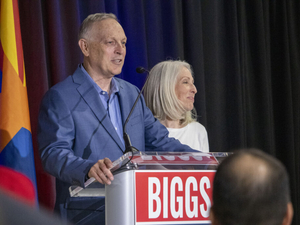
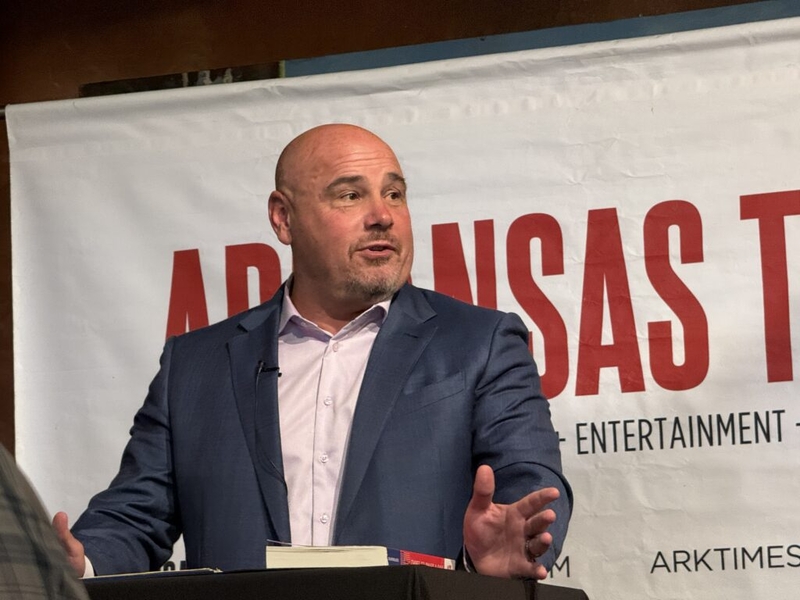
Former Arkansas Sen. Jeremy Hutchinson speaks about the need for criminal justice and prison reform at an Arkansas Times luncheon on July 23, 2026. (Photo by Ainsley Platt/Arkansas Advocate)
Jeremy Hutchinson, a former Republican state legislator convicted in a sprawling corruption probe and pardoned by President Donald Trump, said Thursday he plans to advocate for establishing a compassionate release program in Arkansas during next year’s legislative session.
Hutchinson, a state senator and the son of former U.S. Sen. Tim Hutchinson, was indicted in federal courts in Missouri and Arkansas in 2018 on federal bribery and tax charges.
The charges stemmed from bribes he took from an orthodontist, and from a corruption scandal that ensnared several other legislators as well as lobbyists, and executives from a Missouri-based healthcare nonprofit. He resigned his Senate seat the same day he was charged.
Hutchinson, whose uncle is former Gov. Asa Hutchinson, pleaded guilty in 2019 and was sentenced to a total of eight years across both cases in 2023. He spent just over two years in prison before Trump pardoned him last year.
Former Arkansas legislator Jeremy Hutchinson sentenced to almost 4 years in federal prison
“They have a form of (compassionate release) in the federal system, and the federal system is the most abusive system in the country, worse than any state,” Hutchinson said. “So the fact that the feds have some measure of it should mean it’s not crazy.”
The idea, Jeremy Hutchinson said, would be to give Arkansas prison officials the authority to allow elderly incarcerated people to serve their sentence on home confinement if they aren’t a threat, without going to the parole board or a court.
Hutchinson told attendees of a luncheon hosted by the Arkansas Times that his time in prison left him with the desire to advocate for reform. He said he met some of the “finest people” during his time in prison, including one man sentenced to 30 years for selling marijuana in the 1990s. The man struggled to write because he only finished third grade.
“That’s not justice,” Hutchinson said. “We, as a society, let that third grader fall through the cracks, didn’t step in, intervene, take actions necessary to make sure he succeeds in life. And then, as an adult, we sentence him to 30 years for selling what now is legal almost everywhere in the country.
Hutchinson said the federal criminal justice system sets people up to fail, with an innumerable number of potential criminal charges. He said each of those possible criminal violations can be interpreted differently by each prosecutor. Federal prosecutors have a high degree of discretion in what charges, if any, are filed in a criminal case.
Many of the men he served time with had no idea what they had done was a crime, he said.
Hutchinson compared the system to how Caligula, a Roman emperor known for his cruelty, “used to write new edicts in very small font, put it on parchment and hang them 30 feet high on top of pillars” so subjects wouldn’t realize they had violated the law before executing them.
“What Caligula did by intent, I’m afraid our American system has done by negligence,” Hutchinson said.
Arkansas has some of the highest recidivism rates, crime rates and incarceration rates in the country. Hutchinson said preventing people from ending up in prison would help reduce all three.
Hutchinson spoke on the fairness of the presidential pardon, too. Hutchinson, whose uncle ran unsuccessfully against Trump for the Republican presidential nomination in 2024, said he did not have special access to Trump.
“I’ll say this: we didn’t hire anybody,” Hutchinson said. “My uncle was out there criticizing Trump every time somebody put a camera in his face. My dad didn’t hire anybody, didn’t contribute to Trump’s anything.”
Pardons, Hutchinson said, were meant to “heal the nation,” even as he said there have been issues with the pardon “forever.” He pointed to historical examples of controversial pardons such as ones Abraham Lincoln issued to Confederate soldiers as examples of that philosophy.
“Gerald Ford used the pardon to bring healing to the country, and he pardoned Richard Nixon and got defeated for it,” Hutchinson said. Unpopular at the time, but I think history said it was probably the right thing to do.”
He had similar views of the preemptive pardons former President Joe Biden issued at the end of his term for several administration officials.
“I think that was an appropriate use of the pardon,” Hutchinson said. “ I know a lot of my party criticized him for it. I think that was healing the nation.” He also agreed with Biden’s decision to pardon his son, Hunter, because he would be “a pretty bad father” if he hadn’t.
The same logic about healing the country and moving on applied to Trump’s pardons for those charged in connection with the January 6 riot at the U.S. Capitol — though he said there were “some who probably don’t deserve the pardon.”

Little Rock